EchoChat: The Real-Time Chat App Where the Database Comes First
A Flask and React messaging stack that authenticates sockets, tracks presence across sessions, and persists every message before it ever hits the room.
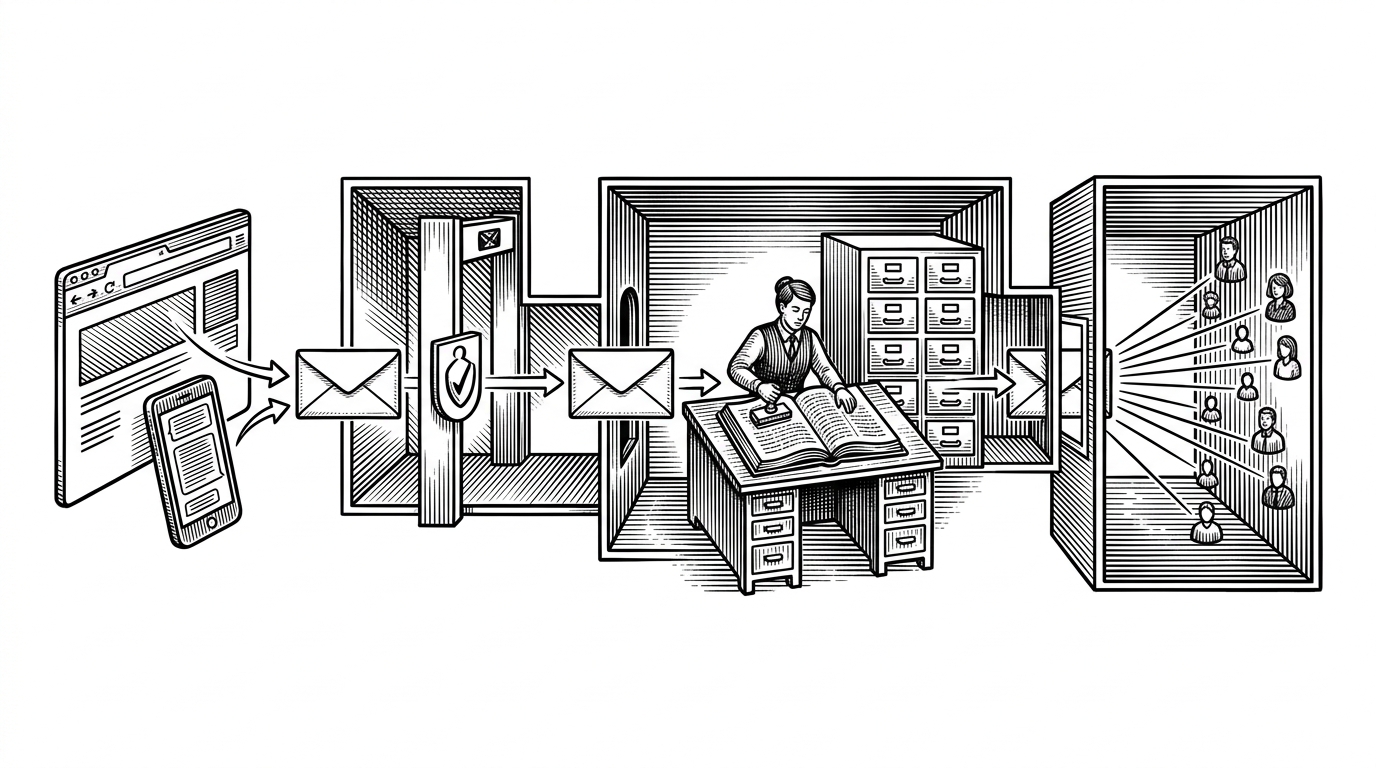
- EchoChat treats real-time messaging as a backend trust problem, not a front-end animation problem.
- Its socket handshake, database commit, and room broadcast form a strict order that keeps the UI honest.
- Presence is modeled as a set of live sessions, which fits real multi-tab and multi-device behavior better than a single online flag.
- The schema looks like a foundation for durable chat features, not just a demo for sending text.
Most chat tutorials race to the part where a bubble appears on screen. EchoChat starts earlier. It asks a harder question: what has to be true before a message is allowed to exist at all?
That is why this repo stands out. It does not treat real-time delivery as a UI trick layered on top of the database. It treats the database, socket auth, and presence model as the real product.
The Message Path, End to End
The backend flow is disciplined. A client connects, supplies a JWT in the Socket.IO auth payload, joins the right room, and only then can send a message event. On the server, the message is written through SQLAlchemy first. Only after the commit succeeds does the app broadcast to chat_{conv_id}.
That ordering matters because it removes a lie from the interface. A chat bubble should not appear as truth if the server never committed it. EchoChat makes persistence the source of record, then lets the socket layer distribute that record.
Socket Auth Is the Real Security Boundary
The visible chat screen is not where trust begins. The socket handshake is. EchoChat uses the connection boundary, not the message boundary, to decide who gets a live channel.
That choice is better than the common shortcut of passing tokens around in query strings. In EchoChat, the token is checked during connection setup, and unauthenticated sockets can be rejected before they ever join a room. That is the right place to fail.
The result is subtle but important. The app is not just protecting API endpoints. It is protecting the real-time session itself, which is where chat apps often get sloppy.
Presence That Understands Reality

This is the detail that makes the repo feel mature. EchoChat does not pretend online status is a boolean. It tracks multiple socket IDs per user, which is the right model for tabs, reconnects, and multiple devices.
| Dimension | Typical chat demo | EchoChat | Why it matters |
|---|---|---|---|
| Socket auth | Token in a query string or skipped entirely | JWT checked during the Socket.IO handshake | Unauthorized sockets can be blocked before they join live traffic |
| Message persistence | Broadcast first, save later, or save only in memory | Commit to SQLAlchemy before broadcast | The database stays the source of truth |
| Presence tracking | One boolean per user | A set of socket IDs per user | Multi-tab and multi-device sessions stop breaking the model |
| Conversation uniqueness | Duplicate threads are easy to create | One-to-one conversations are checked for uniqueness | The app avoids parallel threads for the same pair of people |
| Read receipts | Usually omitted | Supported as a dedicated table | The schema is ready for status-aware chat |
| Schema extensibility | Text messages only | Replies, attachments, and encrypted content flags | The model already points toward richer messaging |
The Data Model Is More Ambitious Than the UI
The schema tells you what the project thinks it might become. EchoChat is not built around a single messages table and a hopeful frontend. It has Conversation, ChatMember, Message, and ReadReceipt models that already imply multi-user rooms, participant membership, and message state.
That design leaves room for replies, attachments, and encrypted content without forcing a rewrite. The reply_to relationship gives messages structure. The attachment_url field makes non-text payloads possible. The content_encrypted flag suggests the author is thinking beyond plain delivery.
This is the difference between a demo and a foundation. A demo proves a screen can change. A foundation proves the data model can grow.
Why This Feels Different From Typical Chat Tutorials
| Pattern | Tutorial shortcut | EchoChat’s choice | Result |
|---|---|---|---|
| Auth boundary | Check credentials only on REST routes | Validate the socket itself | Live connections are controlled, not assumed |
| Delivery order | Emit first, clean up later | Persist first, broadcast second | The UI cannot outrun the database |
| Presence | One user equals one connection | One user can own many socket IDs | The model matches real usage |
| Conversation shape | Only simple public rooms | One-to-one and group chat support | The app can represent real messaging topologies |
| State durability | In-memory state only | Relational models for messages and receipts | The backend survives beyond one session |
EchoChat still reads like a compact project, and that is part of the point. It does not chase feature sprawl. It picks the hard architectural problems first and handles them with enough care that the rest of the system can grow later.
That is why it feels more serious than many chat apps with larger surface area. The repo is small, but the design instincts are not.
What EchoChat Suggests About the Builder
The strongest signal here is not aesthetic polish. It is systems thinking. Someone built this with an eye toward session integrity, durable storage, and future features like receipts and encrypted content.
That makes EchoChat feel portfolio-worthy in the best sense. It shows a builder who understands that chat is not just a frontend problem. It is an ordering problem, a trust problem, and a data modeling problem.