decentralized-staking: The contract that settles itself
In sodofi/decentralized-staking, the important move is not staking. It is letting a deadline and a public `execute()` call decide whether pooled ETH gets forwarded or refunded.
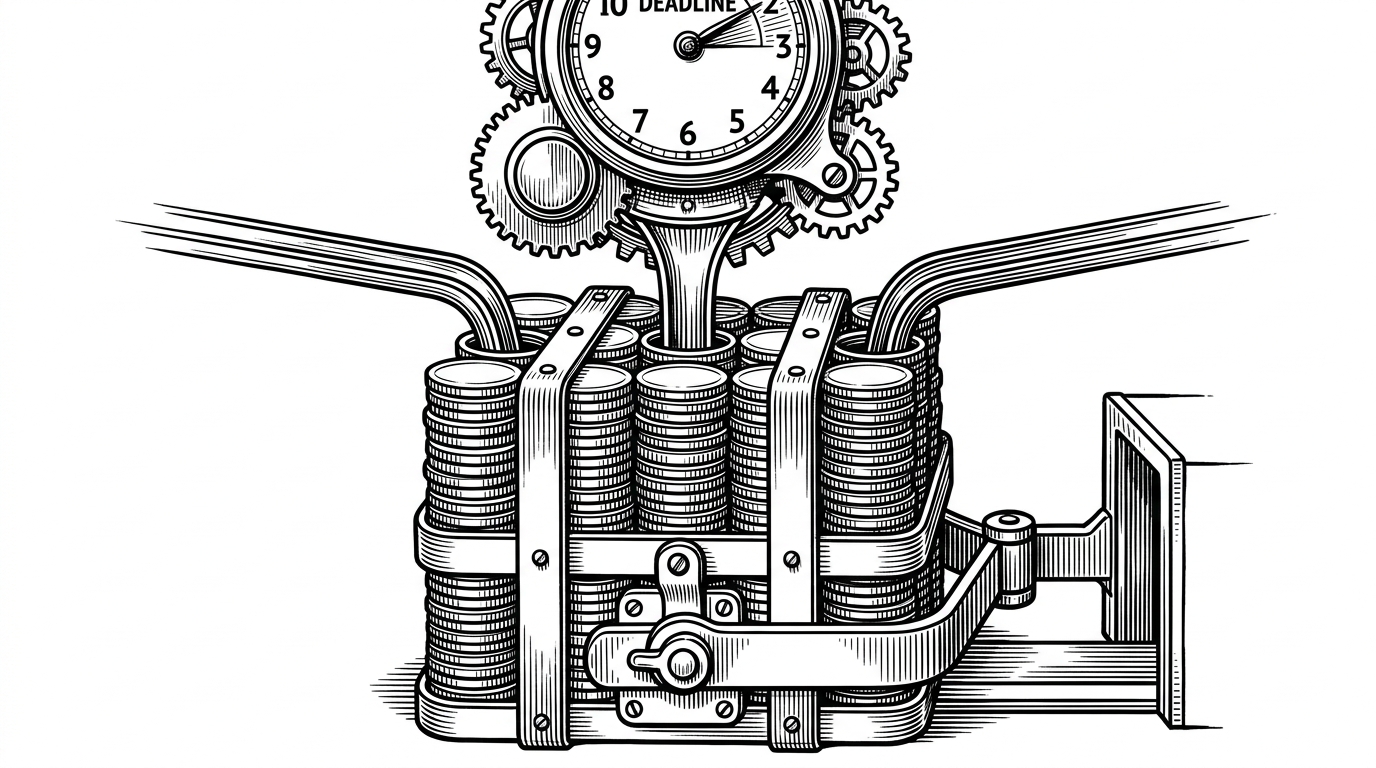
- sodofi/decentralized-staking is best understood as a self-settling threshold contract, not as a full staking protocol.
- The decisive moment is permissionless `execute()`, which lets the chain, not the operator, close the round.
- The Scaffold-ETH 2 stack keeps the frontend tightly coupled to contract state without manual ABI plumbing.
- The repo is valuable because it strips non-custodial settlement down to the smallest possible mechanism.
Most staking writeups start with rewards. This repo is better understood as a settlement machine. In sodofi/decentralized-staking, users pool ETH until a deadline, then a permissionless call decides whether the contract forwards everything to an external target or flips into refunds.
A deadline, not a manager
That is the threshold assurance pattern in its leanest form. The logic lives in Staker.sol, and it makes a simple promise: after the deadline, anyone can settle the round, but no one can change the outcome except the chain state itself.
How the contract settles itself
The state machine is tiny. `stake()` records balances, `receive()` routes plain ETH transfers into that path, and `execute()` checks only two things at the end of the round: time and total balance. If the threshold is met, the contract calls an external completion contract. If not, it opens withdrawals.
function execute() external {
    require(block.timestamp >= deadline, "too early");

    if (address(this).balance >= threshold) {
        exampleExternalContract.complete{value: address(this).balance}();
        status = Status.Executed;
    } else {
        openForWithdraw = true;
    }
}

function withdraw() external {
    require(openForWithdraw, "withdrawals closed");
    uint256 amount = balances[msg.sender];
    balances[msg.sender] = 0;
    payable(msg.sender).transfer(amount);
}
The small safety move is easy to miss: refunds zero the sender's balance before any ETH leaves the contract. That is the checks-effects-interactions pattern, and it is the difference between a clean refund flow and a reentrancy bug waiting to happen.
The interface mirrors the machine
The Next.js app is not a separate product layer. Scaffold-ETH 2 generates typed ABIs and network addresses into the frontend, so hooks like `useScaffoldReadContract` and `useScaffoldWriteContract` can read chain state without glue code. The result is a UI that stays in lockstep with the contract's visible phases: staking, executed, and open for withdraw. The Hardhat config also points at Celo by default, which fits the low-fee, consumer-adjacent feel of the project.
What it is, and what it is not
This is not ether.fi, and it is not Geode. Those systems solve production staking at protocol scale. This repo is smaller on purpose, which is why it is useful: it shows the mechanism before the machinery. If you want to explain non-custodial settlement in one sitting, this is a clean example.
| Model | Who finalizes | What the deadline does | Trust assumption |
|---|---|---|---|
| Custodial escrow | A person or platform | They decide whether money moves or refunds | Trust the middleman |
| Typical staking pool | Protocol operators and validator stack | Rewards and state changes are mediated by infrastructure | Trust the stack |
| sodofi/decentralized-staking | Anyone can call execute() | The contract checks time and balance, then settles itself | Trust the code and chain state |
The comparison is the point. Ordinary staking assumes operators and validator infrastructure. Custodial escrow assumes a trusted manager. This repo removes both assumptions and replaces them with a deadline, a balance check, and a public `execute()` call.
The real pedagogical move is the codebase shape. A monorepo with Hardhat on one side and Next.js on the other makes the contract, the UI, and the generated bindings feel like one artifact. That is useful if you want to teach the mechanics without burying them under protocol complexity.