edge-cityverse: A blank repo with a city-sized thesis
edge-cityverse is only a README, but the name points to something bigger: an edge-native layer for city-scale coordination, where local nodes keep the working state and shared rules hold the network together.
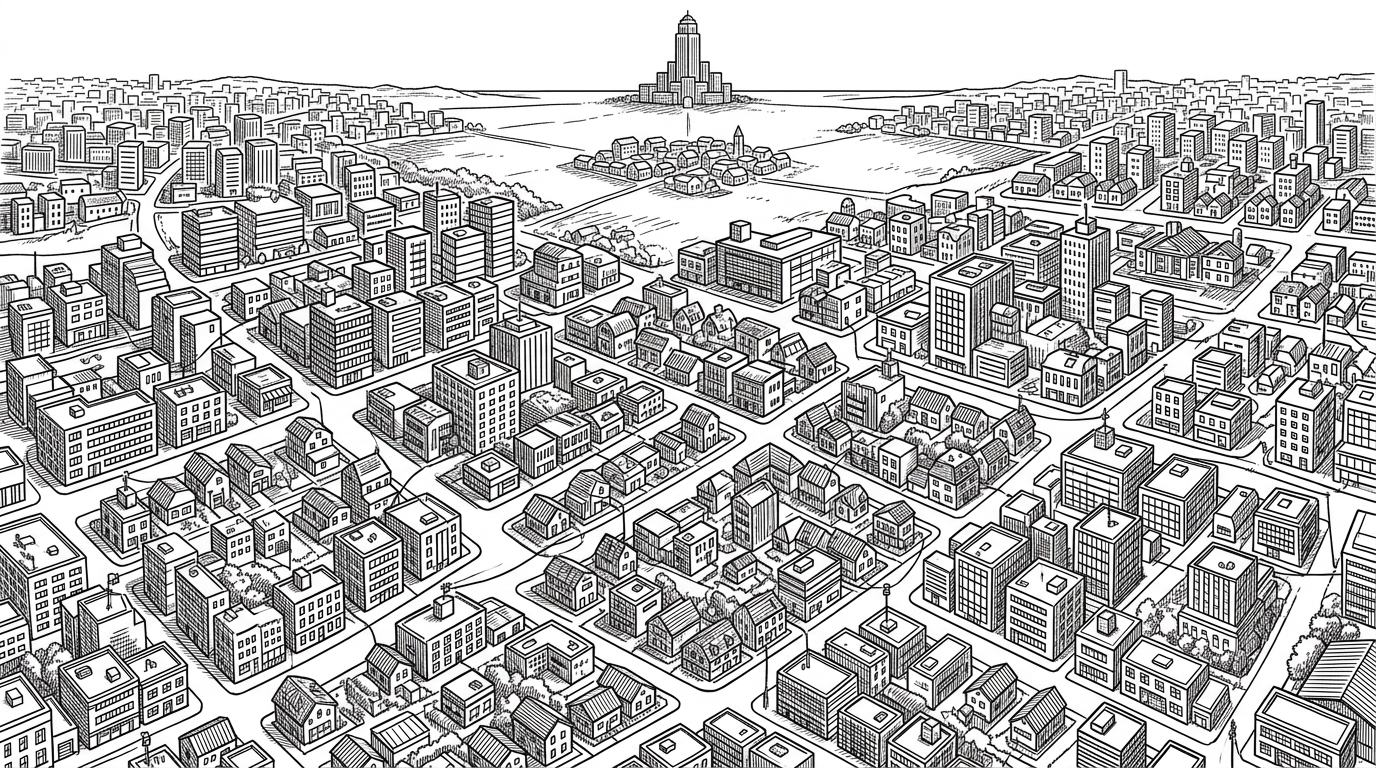
- edge-cityverse reads less like software than a thesis that civic systems should compute locally and reconcile globally.
- The repository's emptiness is meaningful because the article is about architectural intent before implementation.
- Citybound is the closest comparison, but edge-cityverse would only be distinct if it adds network coordination to moddable simulation.
- The hardest problem is keeping local autonomy and shared state in balance without collapsing into a central cloud.
The most interesting thing about edge-cityverse is that there is almost nothing in it. A single README, no source tree, no build system, no framework choice. That emptiness is not a flaw in the story. It is the story, because the name already frames the problem: how to make a city-sized system run close to the edge instead of hiding behind a remote core.
The emptiness is the signal
That makes the repo feel less like a project snapshot and more like a design thesis. The maintainer's public profile points toward Ethereum and onchain agents, which nudges the reading further: this is not just about maps or dashboards, it is about coordinated actors, local context, and rules that have to survive outside one central server.
The early days of Edge were about proving we could create something new: month-long popup villages where scientists, technologists, artists, and builders live and work side by side. Environments designed for health and serendipity, where new ideas for society can take root.
Edge City's physical villages already test the social side of that idea. If those villages are the place where people gather, edge-cityverse sounds like the layer that would preserve state, route signals, and keep a distributed civic memory from dissolving when the village ends.
What would have to exist
The architecture implied by the name is simple to describe and hard to build. Each neighborhood needs local ownership of data, a fast path for nearby decisions, and a narrow synchronization layer for the shared rules that cannot fragment.
| Project | Where state lives | Strength | Limit |
|---|---|---|---|
| Central cloud digital twin | One backend | Simple to operate | High latency and weak locality |
| Citybound | One transparent simulation engine | Deep moddability and educational clarity | Not built for edge-native coordination |
| edge-cityverse | Neighborhood nodes plus shared rules | Local autonomy with city-level coherence | Hard synchronization problem |
The closest open-source comparator is Citybound. Citybound's strength is that it makes a city legible and moddable. edge-cityverse would have to keep that transparency, then add network behavior, because the point is not just to simulate a city. It is to let a city think across many machines without losing local autonomy.
Our roadmap to build a global ‘network city’: a collection of temporary and permanent ‘villages’ designed as laboratories for social, economic, and technological innovation.
That is why the roadmap language matters. A "global network city" is not a fancy frontend. It is a coordination problem with a civic face, and the hard part is deciding which state stays local and which state becomes shared law.