`sodofi/tokenization`: The NFT repo that makes minting feel like normal web dev
A Scaffold-ETH 2 challenge template that hides the hard parts, then reveals the architecture behind them: IPFS metadata, generated ABIs, reusable hooks, and a surprisingly clean ownership loop.
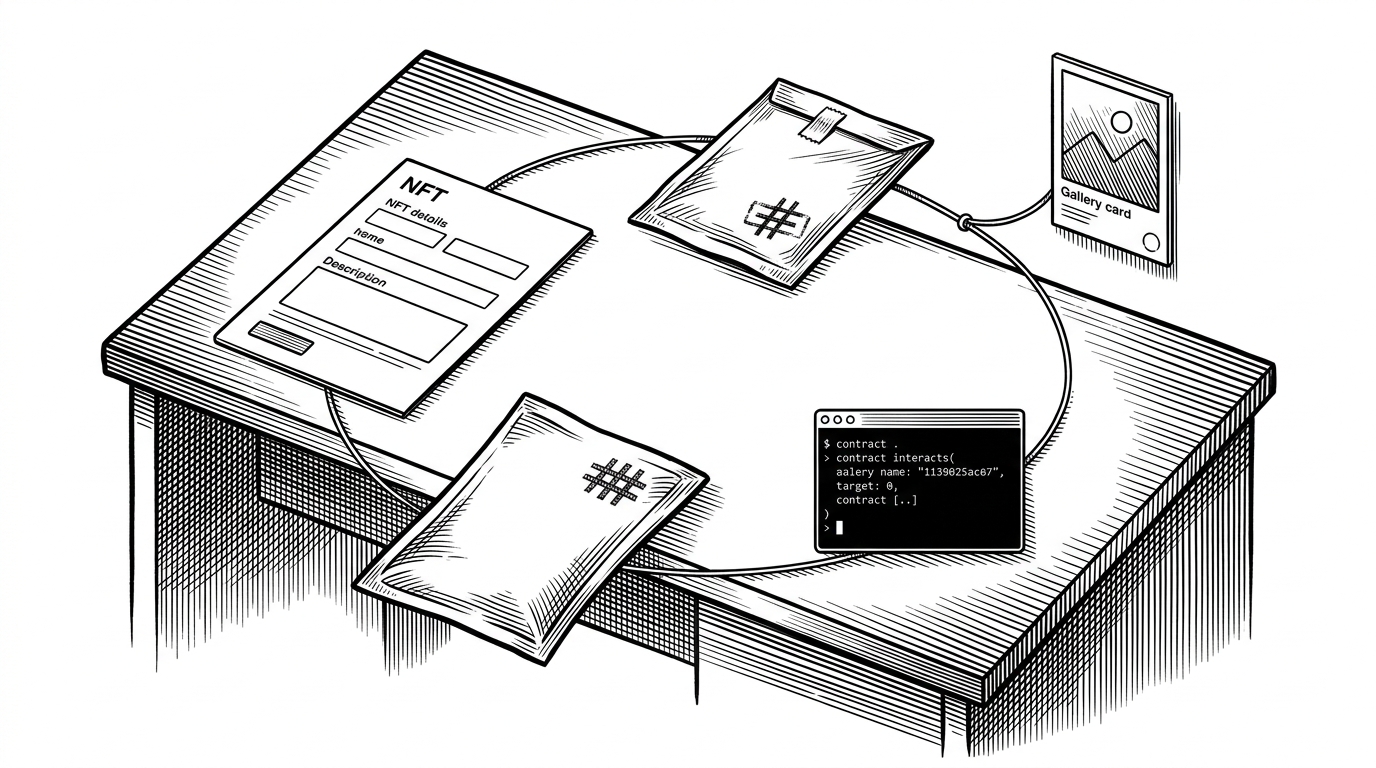
- This repo turns NFT minting into a closed feedback loop where metadata creation, IPFS pinning, on-chain ownership, and gallery rendering all reinforce each other.
- It favors developer clarity over gas minimalism by choosing contract patterns that make the frontend and holdings view much easier to build.
- The IPFS upload route keeps storage credentials and upload plumbing off the browser, which makes the client simpler and the security posture cleaner.
- Scaffold-ETH 2 removes the boring wiring work, so the whole stack feels closer to ordinary product development than to Web3 archaeology.
Most NFT repos try to impress you with contract tricks. This one is more interesting because it removes friction instead. You type metadata once, the app pins it, mints it, and then shows the result back in the gallery without making you care about indexers, wallet plumbing, or bespoke ABI glue.
That is the Scaffold-ETH 2 instinct. The repo is a challenge template, so its job is not to win gas golf. Its job is to make the architecture legible while still feeling like a real product pipeline.
How one NFT becomes a live gallery tile
The cleanest way to understand the repo is to follow one object through the system. On the write path, a form becomes metadata, metadata becomes a CID, and the CID becomes the token URI for minting. On the read path, the wallet balance becomes token IDs, token IDs become token URIs, and the URIs become gallery cards.
async function handleMintItem(form: NFTForm) {
  const cid = await uploadMetadataToIpfs(form)
  await writeContractAsync({
    functionName: "mintItem",
    args: [cid],
  })
}

async function loadHoldings(address: string) {
  const balance = await readContract({ functionName: "balanceOf", args: [address] })

  for (let i = 0; i < Number(balance); i++) {
    const tokenId = await readContract({ functionName: "tokenOfOwnerByIndex", args: [address, i] })
    const uri = await readContract({ functionName: "tokenURI", args: [tokenId] })
    const meta = await fetch(uri).then(r => r.json())
    setItems(prev => [...prev, meta])
  }
}
That loop is the real product. Once the CID lands in the contract, the UI can recover the asset from ownership alone. There is no separate admin dashboard, no hand-built indexer, and no mystery state hiding in the frontend.
Why this repo chooses convenience over minimalism
The contract makes an explicit trade-off. `ERC721Enumerable` and `ERC721URIStorage` are not the cheapest choices, but they buy a much cleaner gallery experience and much less frontend bookkeeping. For a learning template, that is the right side of the trade.
If you were building a marketplace at scale, you would revisit those choices. If you are trying to make a newcomer understand the full loop fast, the extra readability matters more than shaving a few conceptual steps off the contract.
The hidden product is the scaffold
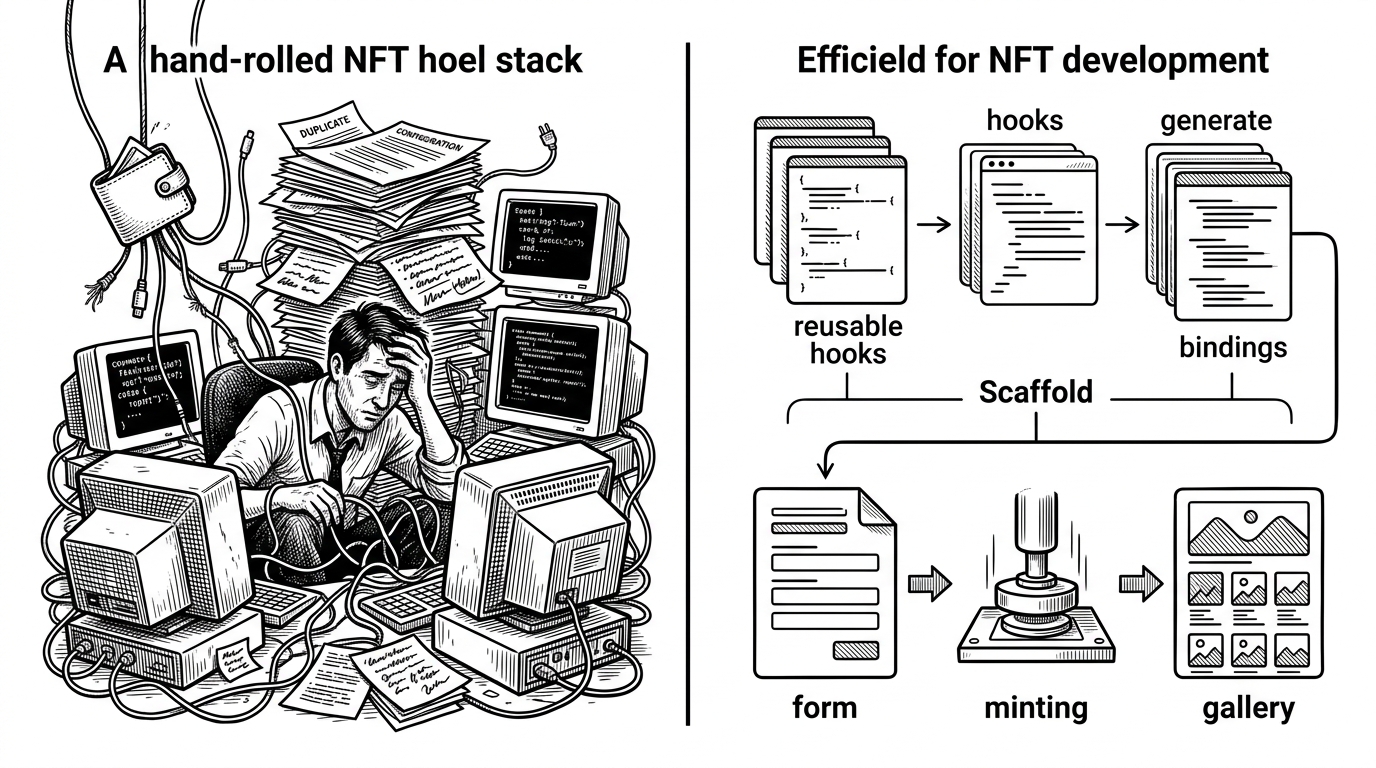
The strongest developer-experience trick here is not hidden in Solidity. It is in the scaffold: generated ABIs, deployment-aware hooks, and the `useScaffoldWriteContract` wrapper that turns a lot of glue code into one obvious action. The result feels less like dApp archaeology and more like normal application development.
// Simplified pattern, not exact source
const { writeContractAsync } = useScaffoldWriteContract("YourCollectible")

await writeContractAsync({
  functionName: "mintItem",
  args: [cid],
})

// The hook resolves the deployment details, so the page code stays small.
That compression matters because it keeps the contract and the UI in sync while you are still iterating. When the deployment changes, the frontend does not need a round of manual wiring just to keep up.
Why the IPFS bridge matters
The IPFS route handler is a small detail with outsized value. By moving upload logic to the server side, the repo keeps credentials out of the browser and hands the frontend a simple CID instead of a bunch of storage-specific ceremony. The client gets thinner, the trust boundary gets clearer, and the code is easier to reason about.
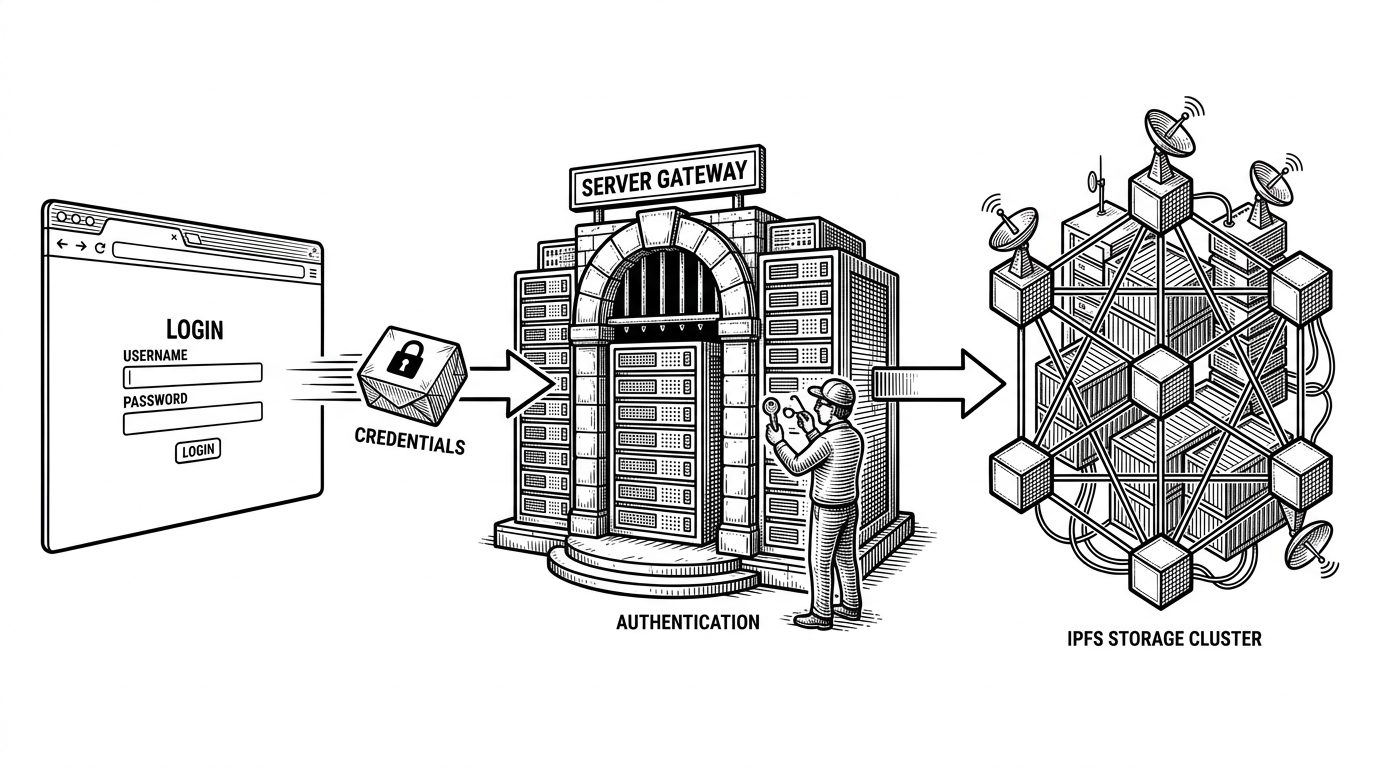
You still end up with the same public artifact on chain. The difference is that the path to get there is disciplined, which is exactly what a good scaffold should give you.
Where this sits in the tokenization landscape
Compared with a hand-rolled NFT app, `sodofi/tokenization` removes a lot of boilerplate and makes the feedback loop visible. Compared with a production marketplace stack, it leaves out search, moderation, analytics, and the operational baggage that comes with scale. Compared with no-code mint tools, it gives developers actual control over the contract, the data path, and the UI.
| Dimension | Hand-rolled NFT dApp | sodofi/tokenization | Production marketplace stack |
|---|---|---|---|
| Mint flow complexity | Manual wallet, ABI, and upload wiring | One coherent write path from form to CID to mint | Heavy orchestration with more service boundaries |
| Metadata handling | Often client-side and ad hoc | Server-side IPFS route with a clean CID response | Dedicated ingest and moderation pipeline |
| Indexing requirements | Usually needs The Graph or custom indexing | Enumerable ownership makes the holdings view straightforward | Full search and analytics stack |
| Frontend boilerplate | A lot of contract and notification glue | Generated bindings and scaffold hooks | Large app shell with auth, cache, and monitoring |
| Developer feedback loop | Deploy, wire, test, repeat | Feels close to hot reload for Web3 | Slower, staged, and more operationally gated |
| Best use case | Bespoke experiments and one-off builds | Learning, prototyping, and teaching the full loop | Large-scale distribution and commerce |
That is the right frame for reading it. The repository is not trying to be the final word on NFT infrastructure. It is trying to make the important parts obvious, and that is a much rarer skill than it looks.
What sodofi/tokenization teaches
The deeper lesson is that tokenization is becoming a UX problem disguised as a smart contract problem. The interesting design work lives in the loop between metadata, ownership, and rendering. Once that loop is short and legible, the rest of the stack stops feeling magical and starts feeling usable.
That is why this repo is worth studying. It compresses the messy parts without flattening the architecture, and it shows how far a modern dApp can get when the scaffold does the unglamorous work well.