Mirage: The Filesystem That Teaches AI Agents How to Work
A unified virtual filesystem that turns cloud services, databases, and local files into one Unix-like workspace, with command overrides that make raw data readable to an LLM.
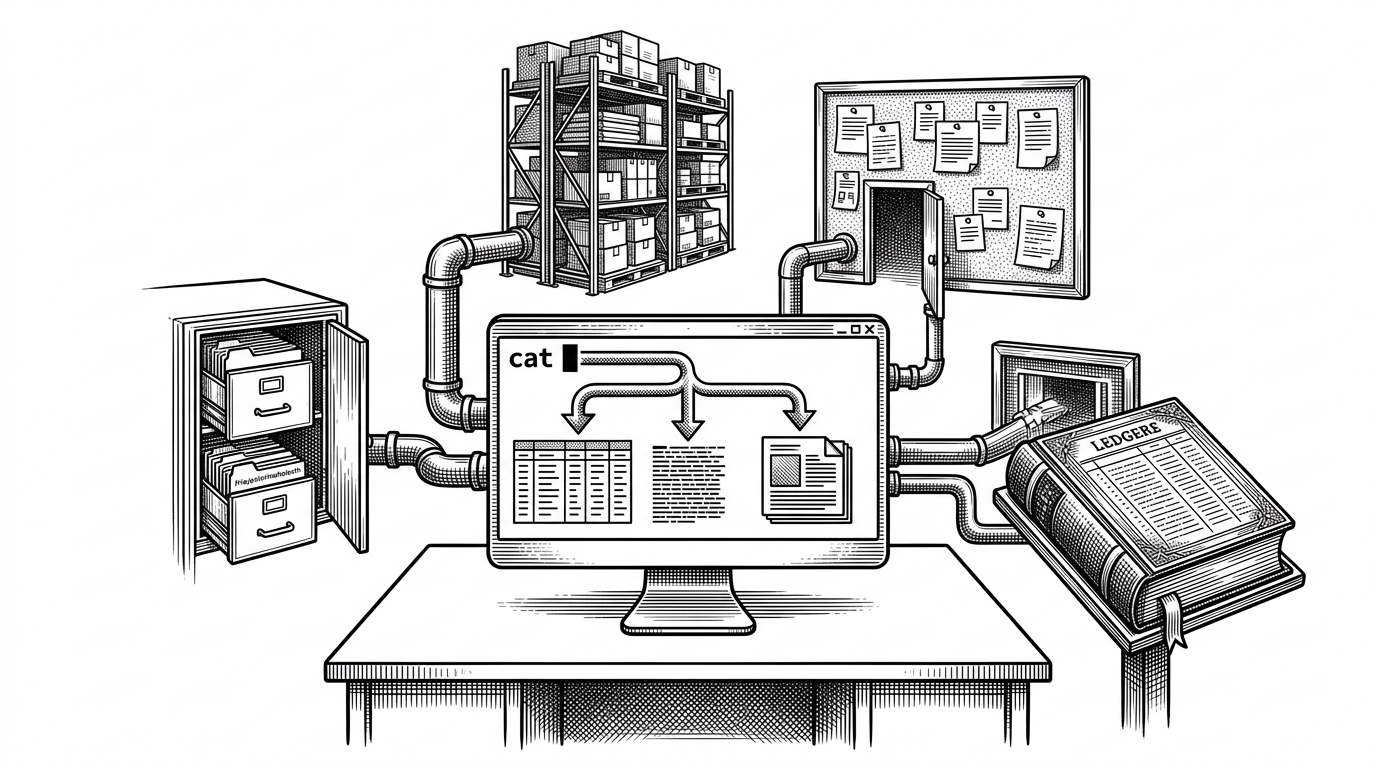
- Mirage’s real bet is not broader storage access, but a new interface contract that lets agents use filesystem verbs as context-aware operations.
- The Workspace abstraction keeps many backends under one flat tree, so the agent sees one workspace while the drivers handle the API details.
- Resource-aware overrides turn commands like cat into LLM-friendly views, which reduces token waste and brittle glue code.
- Mirage sits closer to infrastructure than a loader library, because it tries to unify access and adapt the interface at the same time.
Why `cat` Is the Most Interesting Part
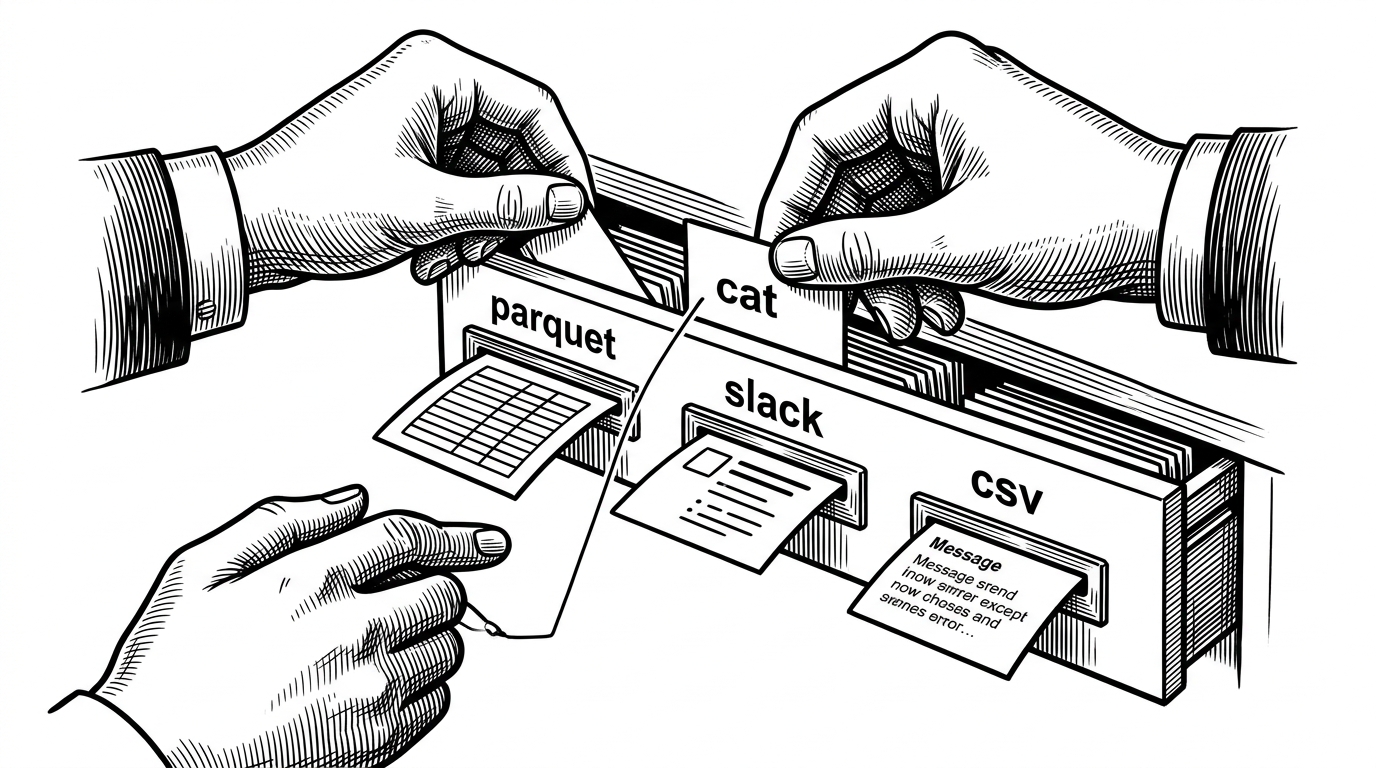
Most filesystem tools mount things. Mirage also reinterprets the verbs. On the right backend and file type, `cat` stops meaning “dump bytes” and starts meaning “give me the useful shape of this resource.”
That matters because agents do not fail only on access. They fail on representation. A Parquet file, a Slack thread, and a database table are all “files” in the broad Unix sense, but only one of them should be read as raw text. Mirage’s trick is to make the output legible to an LLM without forcing every agent to learn special-case loaders.
AI agents are incredibly powerful, but they are often bottlenecked by the complexity of accessing data. Mirage aims to solve this by providing a unified, abstract filesystem interface.
Mirage’s Core Bet: One Workspace, Many Backends
The central abstraction is the Workspace. It maps resources onto paths, then routes commands to the right driver behind the scenes. To the agent, it looks like one flat tree. Under the hood, it is a dispatcher, cache, and policy layer glued to a set of backend-specific translators.
That design keeps the agent’s mental model small. The path names still matter, but they do not force the agent to know each service’s API quirks. `ls` can become a list call, `cp` can become a transfer, and `cat` can become a preview, summary, or schema-aware render depending on what sits behind the mount point.
| Layer | What it hides | Who it serves | Agent aware? | Command rewriting? | Portable workspace? |
|---|---|---|---|---|---|
| Workspace | Backend details, routing, cache | Agent builders | Yes | Yes | Yes |
| FUSE mount | OS-level storage plumbing | System users | No | Usually no | Partial |
| SDK loader | API differences inside one library | Framework users | No | No | No |
| Generic filesystem API | File operations across backends | Application developers | No | No | Limited |
How the Resource Drivers Translate Unix into APIs
Each driver is the translation layer for one resource class. A Slack driver does not pretend to be S3. A Parquet-aware reader does not pretend a columnar file is plain text. The driver inspects the resource, applies an override policy, and returns the most useful representation for the command that was issued.
That is why Mirage feels different from a mount helper. It is not only exposing storage. It is making the output shape part of the backend contract. For an agent, that means fewer dead ends, fewer custom parsers, and fewer moments where a tool returns data that is technically correct but practically useless.
// Conceptual flow, simplified
const ws = new Workspace();

ws.mount("/s3", new S3Resource({ bucket: "reports" }));
ws.mount("/slack", new SlackResource({ workspace: "team" }));

// Same shell verb, different backend behavior
await ws.execute('cat /s3/q1/report.parquet');
await ws.execute('ls /slack/general');
await ws.execute('cp /s3/output.csv /local/tmp/output.csv');
We chose Rust for Mirage because its performance and safety guarantees are essential for building infrastructure that AI agents can rely on. Rust’s type system allows us to define clear interfaces for backends while ensuring that implementations are correct and robust.
Why Mirage Feels Different from rclone, fsspec, or LangChain Loaders
The comparison is useful because Mirage sits between categories. Tools like rclone or s3fs are excellent at mounting storage. fsspec is excellent at abstracting file I/O in Python. LangChain loaders are excellent at getting data into a framework. Mirage is aiming at a different layer: the agent’s working surface.
| Project | Primary layer | Best for | Backend scope | Agent context | Command reinterpretation |
|---|---|---|---|---|---|
| rclone / s3fs | Storage mount | Local access to remote files | Narrow to medium | No | No |
| fsspec | Library API | Python data workflows | Wide | No | No |
| LangChain loaders | Framework component | RAG ingestion | Framework-bound | Partial | No |
| Mirage | Workspace infrastructure | Agentic work across services | Wide | Yes | Yes |
That does not make the others obsolete. It means they solve adjacent problems from lower or narrower layers. Mirage’s claim is more ambitious: if the agent lives in the terminal, then the filesystem is the most universal interface it can get.
The Portability Story: A Workspace You Can Move
The most underrated part of the project is not just access. It is state. If the workspace can be snapshotted, versioned, and restored, then an agent’s working world becomes debuggable. You can inspect what it saw, replay what it touched, and move that context across machines or runs.
That changes the tool from a connector into a reproducibility layer. A messy agent session stops being a pile of ad hoc API calls and becomes something closer to a portable working directory, which is exactly the kind of thing engineers can reason about when a workflow breaks.
Why the Language Split Matters
The repository spans Python and TypeScript, and that is not a cosmetic choice. It is a distribution strategy. Python reaches AI engineers who live in framework code. TypeScript reaches product teams shipping agent experiences in the browser, on servers, and in CLI tools.
That split also suggests Mirage is trying to be conceptual infrastructure rather than a single-language convenience wrapper. The same workspace model can sit underneath different runtimes, which is how a tool starts to feel like a platform instead of a package.
Just added IPFS support to Mirage! Now your AI agents can read and write to the distributed web as if it were a local folder. Check out the example in the repo.
The Real Audience: Agent Builders Who Are Drowning in Glue Code
Mirage is not for every filesystem task. It is for agents that move data, inspect data, and reshape data across systems. If your workflow spans cloud buckets, SaaS threads, local files, and databases, the pain is usually not the model. It is the integration surface.
That is why Mirage is interesting. It treats the filesystem as the universal control plane, then makes the verbs smarter so agents can consume the result. The result is not just fewer SDKs. It is a tighter contract between intention and output.