Syncthing: The File Sync Project That Treats the Cloud Like an Optional Extra
A deep dive into the P2P architecture, cryptographic identity, and failure-tolerant machinery that let your devices sync directly, safely, and without a central account.
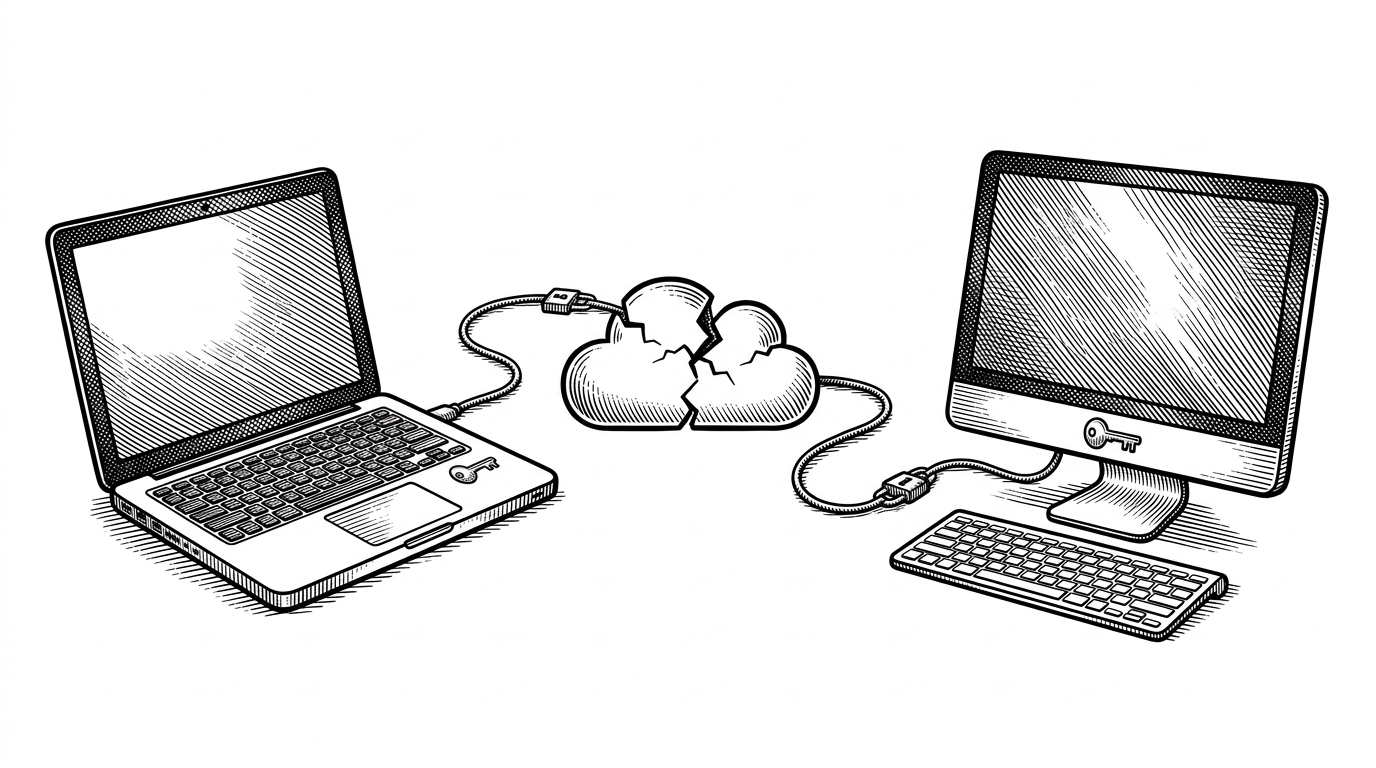

The goal is to provide a decentralized, secure, and private alternative to proprietary sync and cloud storage services.
- Syncthing turns a device’s public key into its identity, which fuses authentication and encryption into one trust model.
- Its architecture prefers direct peer-to-peer transport, but discovery and relays exist as support rails, not as the center of the system.
- When files diverge, Syncthing protects data by preserving both versions instead of guessing a merge.
- The project’s real product is not sync convenience alone, but a distributed privacy stance that makes the cloud optional.
Syncthing’s most interesting trick is not sync. It is trust. The project turns each device into its own identity, so the network never has to become a trusted middleman. That one decision changes everything downstream: setup, transport, failure handling, and even how conflicts are resolved.
The Device Is the Identity
In Syncthing, you do not log into an account and hand data to a server that promises to keep it safe. You exchange device IDs, and those IDs are derived from public keys. That means the same cryptographic machinery that proves who a device is also secures the channel it uses to talk.
That is why Syncthing feels less like Dropbox with better privacy settings and more like a design argument. The identity layer is not separate from transport security. It is the same idea, expressed at two layers of the stack.
How Sync Works Without a Cloud
The mechanics are more ordinary than the philosophy, which is part of the appeal. Devices announce themselves to discovery infrastructure when needed, learn each other’s locations, attempt a direct encrypted connection, and only then fall back to a relay if the path is blocked. Once connected, they exchange file blocks over the Block Exchange Protocol and update local metadata as they go.
The important part is not that discovery and relays exist. It is that they are support services, not the source of truth. The network can help peers meet, but it never becomes the place where identity or file ownership lives.
// cmd/syncthing/monitor.go, simplified
func monitorMain() error {
    stopSign := make(chan os.Signal, 1)
    signal.Notify(stopSign, os.Interrupt, sigTerm)

    stdoutLastLines := newLastLines(50)
    cmd := startWorker(stdoutLastLines)

    err := cmd.Wait()
    if err != nil {
        writePanicLog(stdoutLastLines)
    }
    return err
}
The Part That Saves Your Data When Everything Goes Wrong
Syncthing’s resilience story starts outside the sync engine. The monitor process watches the worker process, captures useful crash context, and restarts the application when appropriate. Inside the app, supervisor-style management with suture keeps smaller services alive independently instead of letting one failure take down the whole machine.
That matters because real sync systems live in ugly conditions. Wi-Fi drops, USB drives disappear, laptops sleep, and routers rewrite the rules. Syncthing is built to keep going anyway.
| Failure mode | Typical centralized app | Syncthing |
|---|---|---|
| Sync service crashes | One process failure can take the whole client down | Monitor restarts the worker and preserves crash context |
| One subsystem fails | The app may become unavailable until the service returns | Supervisor trees isolate the failure and restart the child |
| Peer unreachable | Server remains the source of truth | Peers reconnect later or use relay paths |
Why Syncthing Refuses to Merge Smarter
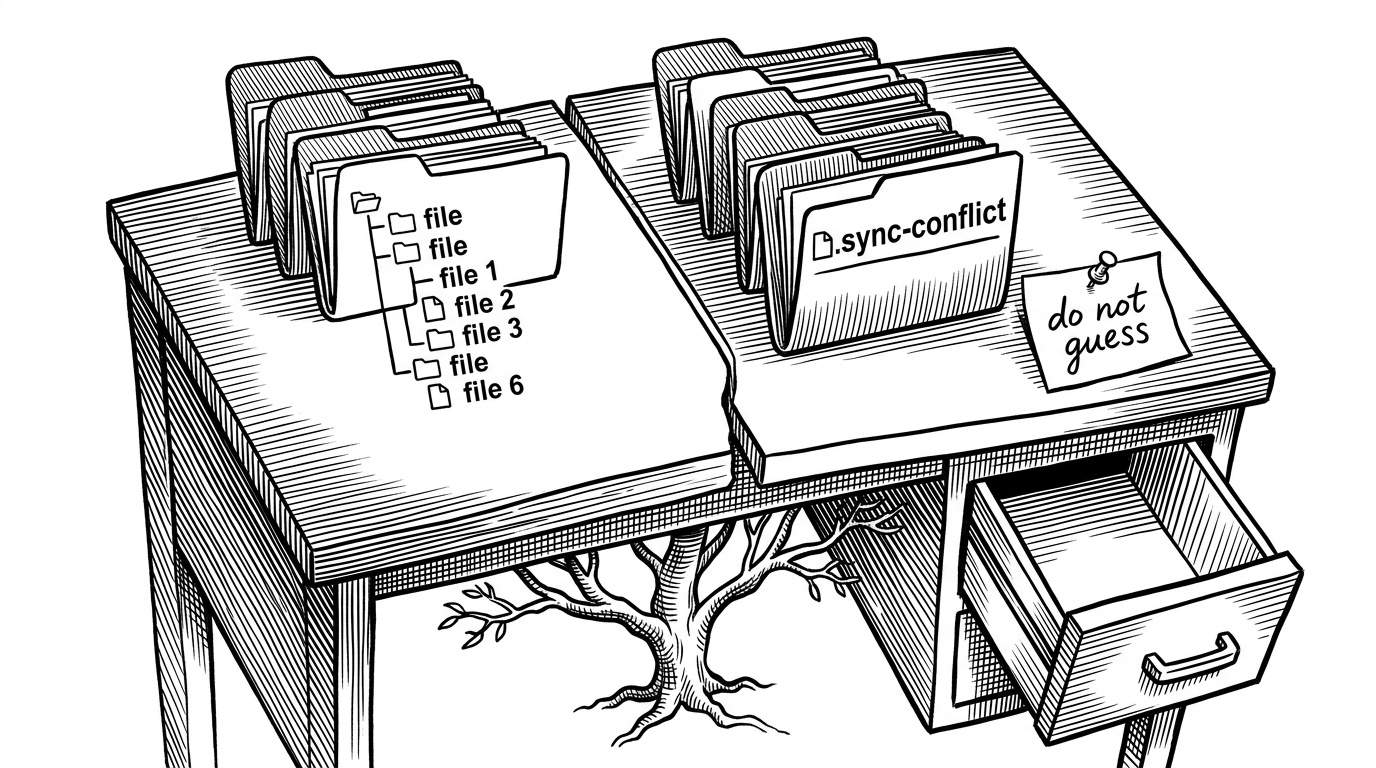
This is one of the project’s sharpest product choices. When versions diverge, Syncthing does not try to invent the right answer. It uses version vectors to detect conflict, then preserves both versions by creating a conflict file rather than silently merging data that may not belong together.
That sounds conservative because it is. It is also the safest possible choice for a system that runs without a central authority. If the software cannot know which copy is correct, it should stop pretending that it can.
| Question | Smart merge | Syncthing’s approach |
|---|---|---|
| Can the app infer intent? | Sometimes, but often incorrectly | No, not when divergence is ambiguous |
| Risk profile | Convenience first, with possible data loss | Safety first, with visible conflicts |
| User outcome | One combined file, maybe wrong | Two versions, both preserved |
The Network Around the Network
Syncthing is peer to peer, but not anti-infrastructure. The repository is intentionally modular: the core sync engine lives in lib/, while separate binaries in cmd/ handle discovery, relaying, crash reporting, and usage reporting. That split makes the project easier to reason about and easier to operate at different scales.
In other words, the architecture is decentralized where trust matters and pragmatic where convenience matters. That is the real pattern. Not purity for its own sake, but a careful boundary between the data plane and the support plane.
What Syncthing Is Better Than, and What It Is Not
| Tool | Trust model | Central server required? | Privacy posture | Setup complexity | Best fit |
|---|---|---|---|---|---|
| Syncthing | Peer-to-peer, device identity via keys | No | Strong end-to-end privacy | Moderate | Private sync between your own devices |
| Dropbox or Google Drive | Centralized account and server | Yes | Convenient but service-held data | Low | Simple mainstream cloud sync |
| Nextcloud | Self-hosted client-server | Yes, self-hosted | Good if you operate the server | High | Broader collaboration stack |
| Resilio Sync | Peer-to-peer proprietary | No | Private, but closed source | Moderate | P2P sync with a polished commercial path |
Syncthing is not trying to replace every cloud product. It is trying to make one narrow promise exceptionally well: your files can move directly between your devices without turning a third party into a trust center. That is a smaller product surface and a stronger thesis.
Why It Has Lasted
Longevity matters in infrastructure projects because the hard part is not the launch. It is staying coherent long enough for the edge cases to accumulate. Syncthing has done that through a stable maintainer core, a real contributor base, and a design that has not drifted far from its original promise.
The result is a rare kind of open-source maturity. The project is opinionated enough to be recognizable, practical enough to be used daily, and principled enough to remain legible after years of growth.