OpenScience: The Open-Source AI Workbench Turning Research Into a Local Loop
A model-agnostic scientific IDE that reads papers, loads domain skills, runs experiments, and writes the report without handing your data to a vendor.
Generating illustration...
- OpenScience’s core idea is that scientific AI should behave like a research loop, not a chat window.
- Its differentiator is the skill system, which turns domain knowledge into reusable procedures instead of loose prompts.
- The local-first, model-agnostic setup makes data sovereignty part of the product, not a deployment afterthought.
- Bun-based single-binary shipping makes the workstation feel much closer to a desktop tool than a fragile agent stack.
OpenScience is trying to do something more specific than build another agent. It turns scientific work into a local, model-agnostic research loop: read the papers, choose the right domain skill, run code on real data, and write the report. That makes the product feel less like a chatbot and more like a scientific workstation.
OpenScience is an open-source AI workbench for scientific research. You give it a goal, and it works through the research loop the way a capable collaborator would. It reads the papers that matter, forms a hypothesis, writes and runs code, runs experiments on real compute, queries the major scientific databases, and writes up the result.
Research Is a Loop, Not a Chat
That quote is the whole thesis. OpenScience is not trying to help you talk about science. It is trying to help you do science, end to end. Literature review, hypothesis generation, execution, analysis, and write-up are all part of the same path.
The important shift is from conversation to orchestration. Once you treat a research task as a workflow, you can attach tools to each stage: paper search, scientific databases, local scripts, code execution, and report generation. OpenScience is built around that idea.
Why OpenScience Feels Like a Scientific IDE
The UI matters here. OpenScience gives you a workspace, not just a prompt box. The repo’s browser-based interface pulls together a file tree, terminal, scientific visualizers, and streamed agent output, so the user stays inside a real working environment.
That architecture explains why the product feels different from a general agent framework. A general framework gives you components. OpenScience gives you a workspace where the scientific workflow is already opinionated and visible.
The Skill System Is the Real Product
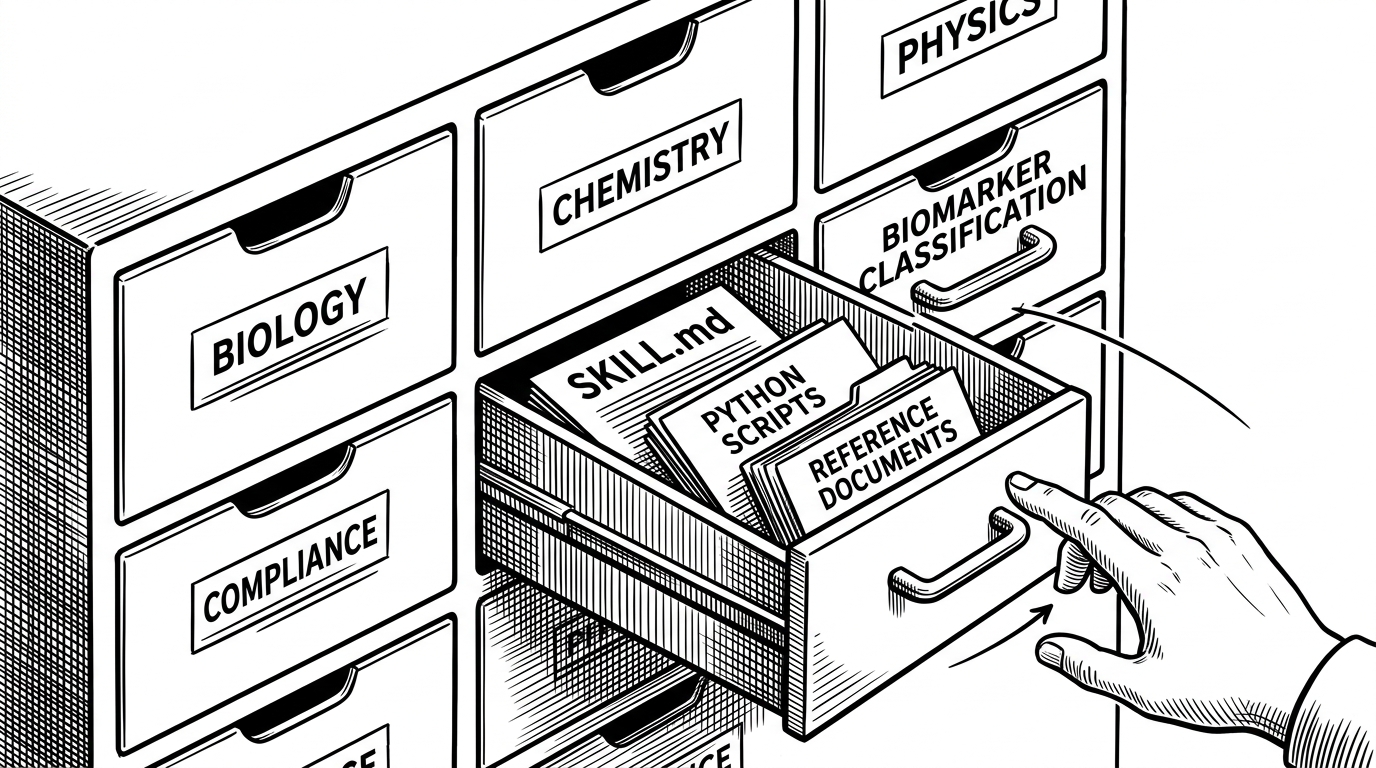
Skills are not just folders of code. They are structured knowledge bundles with metadata, usage guidance, scripts, and templates. In practice, that means the agent is not improvising every time it sees a new task. It can load a domain-specific procedure.
That is a big deal in science, where the difference between “looks right” and “reproducible” is everything. A biology skill can point the agent toward the right parser, the right analysis script, and the right reporting template. The model is still doing reasoning, but the workflow is constrained by domain practice.
| Dimension | Generic agent framework | OpenScience skill system |
|---|---|---|
| Knowledge packaging | Loose prompts and tool calls | Metadata, scripts, and templates bundled together |
| Task selection | User stitches the flow together | Agent can route into the right domain skill |
| Reproducibility | Depends on each builder | Procedures are embedded in the skill |
| Scientific fit | General-purpose | Built around research tasks and databases |
How the Agent Chooses, Loads, and Runs Work
Under the hood, the runtime uses layered prompting and tool dispatch. The agent runtime parses the request, picks a domain, selects skills, and then routes work into tools and local compute. That is the core loop: interpret, load, execute, evidence, report.
The repo’s research-specific plumbing matters too. It is wired for scientific databases, not just generic web search. That reduces the gap between an answer and an actual analysis, because the system can ground itself in structured sources instead of free-form text alone.
User request
  -> agent runtime parses intent
  -> skill matcher selects domain skill
  -> tool layer calls databases or scripts
  -> compute step runs local code
  -> evidence layer collects outputs
  -> write-up layer produces report artifact
The design also keeps the model layer flexible. OpenScience supports a BYOK flow and can route through managed Atlas when needed, but the open-source core does not force one vendor or one model. That is the point.
Why Bun Matters More Than It Sounds
The distribution story is one of the most underrated parts of the repo. OpenScience leans on Bun and native compilation to turn a fairly heavy TypeScript-plus-Python stack into something that behaves like a single product you can install and run. That is unusual for scientific software, where setup friction often kills adoption.
The repo also embeds the frontend into the compiled binary and ships cross-platform wrappers. In plain English: the team is treating installability as a first-class engineering problem. For a research workstation, that is not an implementation detail. It is the product.
| Shipping problem | Typical agent stack | OpenScience approach |
|---|---|---|
| Install friction | Many services and dependencies | Single-binary distribution path |
| Frontend delivery | Separate app build | Embedded in the compiled package |
| Cross-platform behavior | Varies by environment | Explicit wrapper and host detection |
| Operational feel | Like a project | Like a desktop tool |
OpenScience Versus Claude Science
This is not a product comparison about features alone. It is a comparison about control. Claude Science is proprietary and tied to one vendor’s model stack. OpenScience is open, model-agnostic, and local-first. That changes who owns the workflow.
For a lab, that difference is practical. Sensitive data can stay local. Model choice stays flexible. The user is not trapped inside one company’s idea of how scientific AI should work.
| Axis | OpenScience | Claude Science | General frameworks |
|---|---|---|---|
| Model support | Model-agnostic | Vendor-tied | Depends on builder |
| Data locality | Local-first | Vendor-managed | Depends on deployment |
| Scientific skills | Domain-specific and editable | Curated but closed | Must be assembled |
| UI completeness | Full workbench | Full workbench | Usually missing |
| Install complexity | Single-binary path | Subscription product | High |
| Vendor lock-in | Low | High | Low to medium |
| Best fit | Labs and researchers who want control | Users who want a polished proprietary experience | Teams building their own stack |
What the Repo Tells You About the Team
The codebase reads like a focused startup repo, not a loose community garden. A small number of contributors carry most of the work, the style is opinionated, and the security and type-checking workflows suggest a team that cares about shipping something robust.
That matters because OpenScience is not just a demo of scientific agents. It is a product bet. The repository suggests a team optimizing for coherence, speed, and ownership of the full user experience.