9arm-skills: The Repo That Turns Claude Code Into a Disciplined Agent
A skill store, a refusal engine, and a set of workflows that teach an LLM how to debug, review, and report with more rigor than a normal chat prompt ever could.
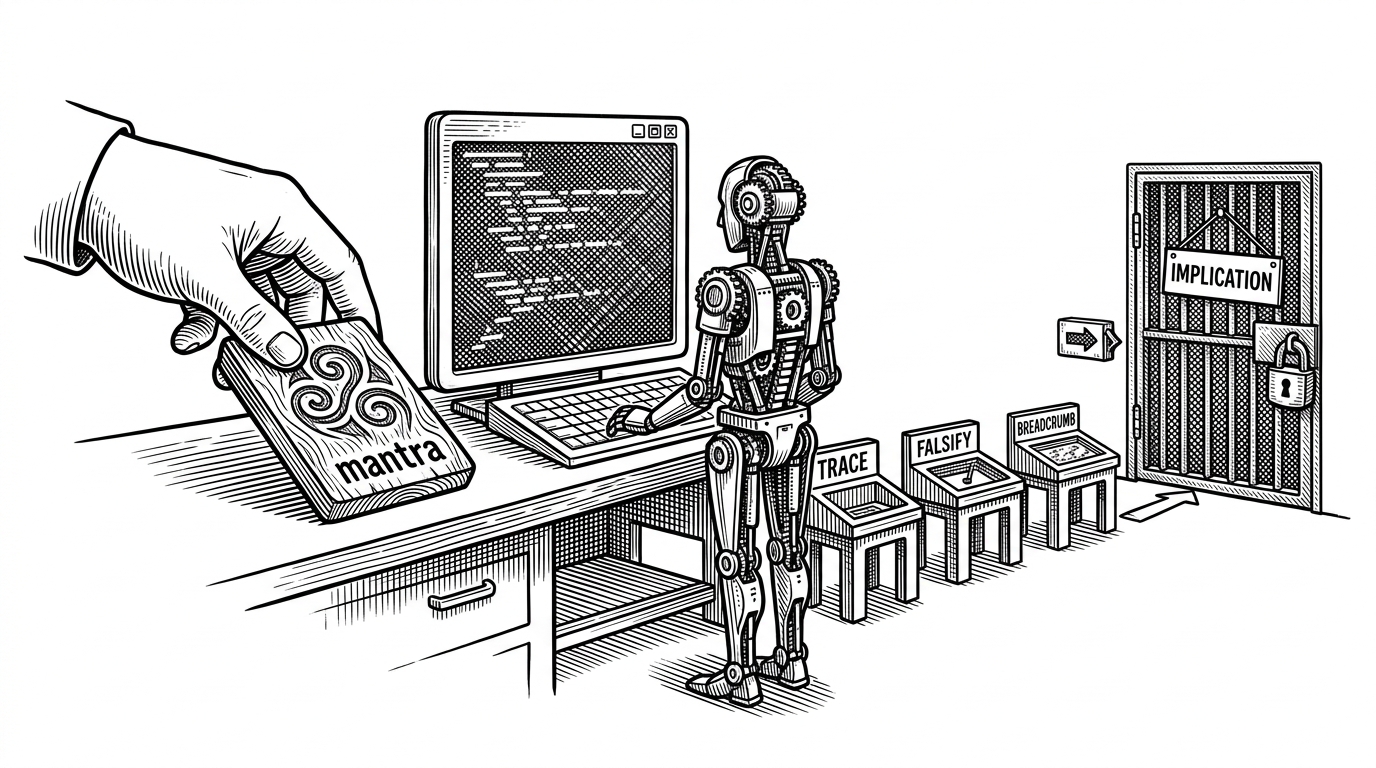
- `9arm-skills` treats Claude Code less like a chat window and more like a runtime that can be governed by installed behavior.
- The `debug-mantra` skill is the repo’s clearest trick: it forces a verbatim recital before any reasoning, which functions like a cognitive lock-in.
- Refusal is not a bug here. It is the quality-control mechanism that keeps the agent from skipping reproduction, root cause, or evidence.
- The repository matters beyond debugging because it also translates engineering facts into management language without sanding off the truth.
The Mantra Is the Point
The most revealing file in `thananon/9arm-skills` is not a feature list. It is `debug-mantra`, a skill that makes Claude Code recite rules verbatim before it is allowed to proceed. That sounds ceremonial because it is ceremonial. The ceremony is the mechanism.
This is the repo’s core move: not “ask better questions,” but “install a state change.” The mantra forces the model to re-anchor on the workflow, then walk through reproduction, tracing, falsification, and breadcrumbing in order. The point is not flavor. The point is to make skipping steps harder.
รวม Skills ต่างๆ ที่ผม (9ARM) สอนหรือแชร์ไว้ เพื่อให้ง่ายต่อการค้นหาและนำไปใช้งานต่อได้ครับ
From Chat to Installed Behavior
The project’s deeper thesis is that Claude Code should be treated like an agent runtime. Skills are not just prompts stored in folders. They are installed modules with triggers, operating rules, and lifecycle scripts.
| Ordinary prompting | `9arm-skills` |
|---|---|
| One-off text in a chat window | A directory-backed skill system loaded into Claude Code |
| Depends on the user remembering the ritual | The ritual is encoded as a workflow |
| Helpful by default | Selective, sometimes refusing until evidence exists |
| Easy to drift off spec | Guardrails are repeated, scripted, and linked from disk |
| Lives in the moment | Persists as a maintained skill store |
How the Skill Store Is Organized
The repository is structured like a small platform. `skills/` holds the actual behaviors, `.claude-plugin/` defines what Claude loads, `scripts/` maintains the plumbing, and `CLAUDE.md` acts like a meta-skill for the repository itself.
skills/
  engineering/
    debug-mantra/
      SKILL.md
    scrutinize/
      SKILL.md
    post-mortem/
      SKILL.md
  productivity/
  personal/

.claude-plugin/
  plugin.json

scripts/
  link-skills.sh
  list-skills.sh

CLAUDE.md
That shape matters. A loose collection of Markdown notes would be easy to browse and easy to ignore. A governed skill store creates expectations about naming, placement, activation, and reuse. In other words, it behaves like software, not content.

Why Refusal Is a Feature
The most mature skills in the repo do not optimize for cheerfulness. They optimize for correctness under uncertainty. `scrutinize` wants an outsider read. `post-mortem` refuses to draft until the evidence is there. That is a deliberate anti-hallucination stance.
| Helpful-at-all-costs | Evidence-first skills |
|---|---|
| Moves quickly to an answer | Stops for reproduction, root cause, or proof |
| Treats hesitation as failure | Treats hesitation as discipline |
| Can produce polished nonsense | Can refuse to overclaim |
| Useful for ideation | Useful for post-incident rigor |
| Optimizes for momentum | Optimizes for trust |
The Shell That Keeps the System Honest
The enforcement layer lives in shell. `scripts/link-skills.sh` discovers `SKILL.md` files with `find`, excludes buckets the repo does not want linked yet, and creates symlinks into the Claude skills directory. It also guards against recursive linking, which is the kind of boring safeguard that usually separates a clever repo from a reliable one.
#!/usr/bin/env bash
set -euo pipefail

repo_root="$(cd "$(dirname "${BASH_SOURCE[0]}")/.." && pwd)"
dest_dir="${HOME}/.claude/skills"

find "$repo_root/skills" \
  -path '*/deprecated/*' -prune -o \
  -path '*/in-progress/*' -prune -o \
  -path '*/personal/*' -prune -o \
  -name 'SKILL.md' -print0 | while IFS= read -r -d '' skill; do
    # link skill into Claude's runtime directory
    :
done
The important part is not the syntax. It is the posture. This repo assumes skills should be discoverable, linkable, and safe to refresh. That makes it feel closer to infrastructure than to documentation.
`management-talk` and the Translation Layer
`management-talk` broadens the project’s value. It takes the same engineering evidence a developer trusts, then renders it in the language of status, risk, and priority without erasing the underlying facts. That is a rare kind of AI use case: not generation, but translation.
| Engineering view | Management view |
|---|---|
| Repro steps, traces, commits, SHAs | Impact, risk, status, next steps |
| Diagnostic density | Decision-ready summary |
| Evidence is preserved | Audience changes |
| Explains what broke | Explains what matters now |
| Technical truth first | Organizational clarity first |
Where This Fits in the AI Tooling Landscape
Compared with prompt snippets, courses, or GitHub “awesome” lists, `9arm-skills` is operational. It is meant to be loaded, triggered, and reused inside an actual agent workflow. That shifts it from learning material into behavioral middleware.
| Category | What it offers | What `9arm-skills` adds |
|---|---|---|
| Prompt library | Reusable text | Persistent activation and refusal logic |
| Course content | Instructional depth | Direct execution inside Claude Code |
| Awesome list | Curated links | Runnable skills and loading scripts |
| Generic assistant chat | Flexible conversation | A disciplined workflow with gates and order |
Why It Matters
The interesting part of `9arm-skills` is not that it helps Claude Code answer questions. It is that it shows how to encode engineering standards into the agent itself. If you care about debugging discipline, review quality, or translating technical reality across teams, that is a meaningful step.
The bigger lesson is simple. As agents get more capable, the value shifts from asking for better outputs to defining better conduct. This repo is an early, opinionated answer to that problem.