Turing Machines as Python Dicts: Inside the tmsim Engine
How a lightweight simulator replaces rigid academic DSLs with the elegance of functional head movement and "Dictionary-as-Code" architecture.


Turing Machine Simulator written in Python
- The engine uses Python lambdas to define head movement, allowing the machine to simulate diverse computational geometries beyond standard left-right movement.
- A "Dictionary-as-Code" architecture replaces rigid academic DSLs with native Python data structures that automatically infer states and symbols.
- The simulator leverages Python's defaultdict to create a memory-efficient and conceptually infinite tape without complex pointer math.
- Built-in testing utilities allow developers to verify theoretical algorithms against ground-truth Python functions.
The Turing Machine is usually a dry, academic abstraction relegated to whiteboards and textbooks. It’s a foundational concept in computer science, but rarely something developers interact with functionally. tmsim flips this paradigm. It treats the Turing Machine not as a dusty theoretical construct, but as a programmable hardware platform using Python as its "assembly" language.
The story of tmsim isn't just about simulation; it’s about the "Programmable Tape." By using Python lambdas to define how the "head" moves, tmsim allows the geometry of computation itself to be rewritten. It transforms a 1936 theoretical construct into a modern, testable, and highly "Pythonic" developer tool.
The Geometry of the Tape
Most Turing Machine simulators hardcode the movement of the read/write head to simple left or right operations (L and R). tmsim takes a radically different approach: functional movement.
It uses a dictionary of lambdas (arrows) to define head movement. For example, moving left might be defined as '<-': lambda x: x-1. This abstraction is deeply powerful. It allows the machine to simulate not just standard infinite-tape Turing Machines, but left-bounded machines, or even finite-state machines, simply by changing the movement logic provided to the engine.
Dictionary-as-Code
Many academic simulators require cumbersome custom Domain Specific Languages (DSLs) or verbose XML files to define state transitions. tmsim abandons this in favor of a "Dictionary-as-Code" approach.
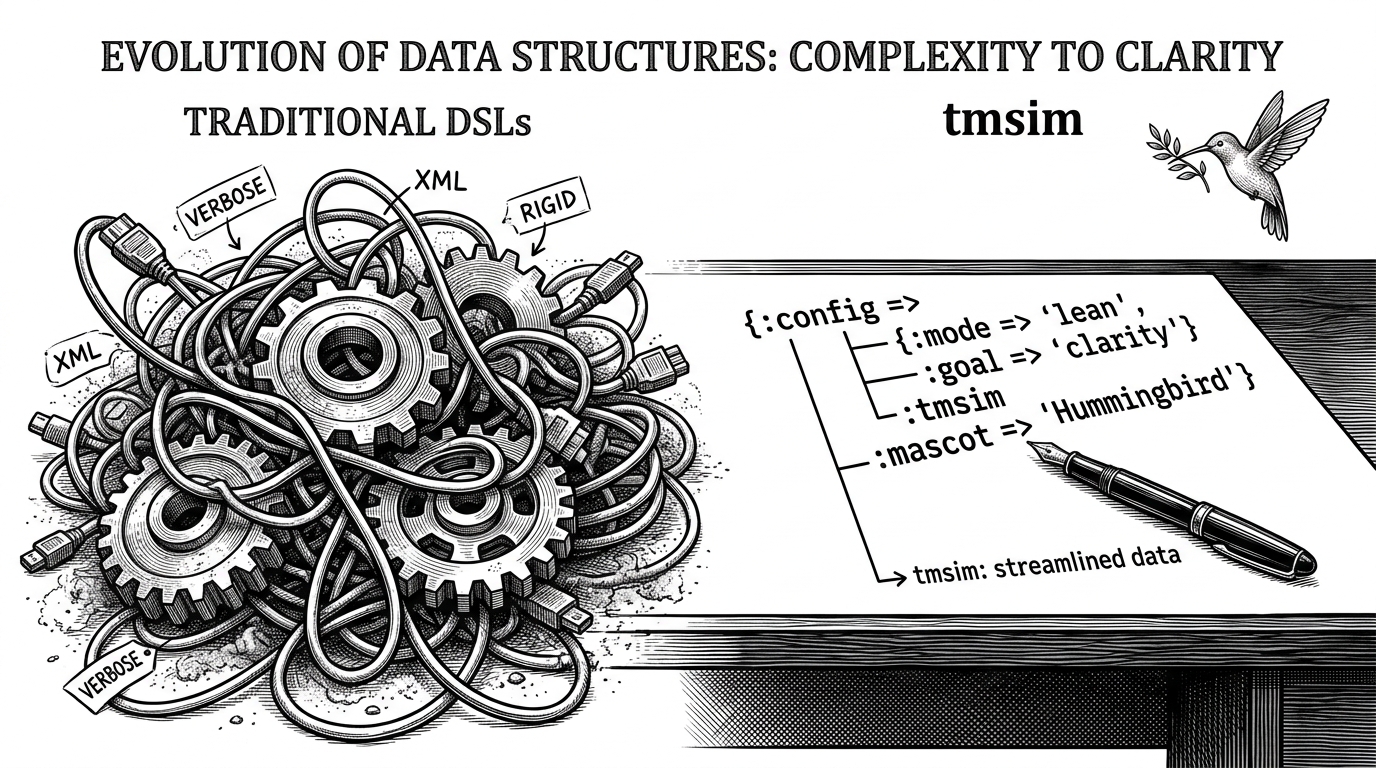
The Algorithm.parse_value logic is where the magic happens. The simulator infers states and symbols directly from a nested Python dictionary. It supports "shorthand" transitions that feel like a high-level language. If a transition only needs to move the head, you can provide '->' instead of a full (current_state, current_symbol, '->') triple.
# A snippet illustrating the shorthand parsing logic (conceptual)
for v in value:
    if v in arrows: new_arrow = v
    elif v in states: new_state = v
    elif v in symbols: new_symbol = v
This flexibility makes the code look more like a formal mathematical specification and less like a low-level implementation. The user doesn't need to explicitly list all states or the alphabet; the Algorithm class infers them by crawling the transition dictionary.
The Infinite defaultdict
A Turing Machine conceptually requires an infinite tape. Implementing this in software usually involves complex pointer math or dynamic array resizing. tmsim solves this elegantly using Python's collections.defaultdict.

By initializing the tape as defaultdict(lambda: self.blank_symbol), the tape is conceptually infinite in both directions. When the head moves to a previously unvisited index, the dictionary automatically creates a new entry with the blank symbol. This provides a memory-efficient solution without the need for complex boundary management.
Unit Testing the Theoretical
Perhaps the most practical aspect of tmsim is its focus on verification. It bridges the gap between theoretical computer science and modern CI/CD practices.
The repository includes an extensive suite of examples that serve as functional tests. Using a .test() method and a generate_words utility, users can verify their Turing Machine logic against "ground truth" Python functions. You aren't just watching a machine run; you are proving that a specific algorithm correctly identifies complex languages like balanced parentheses or modular arithmetic.
| Feature | tmsim | Traditional Academic Simulators |
|---|---|---|
| Input Format | Native Python Dictionaries | Custom XML or proprietary DSLs |
| Head Movement | Programmable via Lambdas | Fixed (Left/Right only) |
| Verification | Automated `.test()` suite | Manual observation |
| Dependencies | Zero (Standard Library only) | Often requires Java or heavy GUI frameworks |
In a landscape often dominated by heavy, GUI-driven academic tools, tmsim stands out as a developer-first approach. It proves that with the right abstractions, even the oldest theoretical models can be elegantly expressed in modern code.