`auth.md`: The Markdown File That Teaches Agents How to Authenticate
A deep dive into WorkOS’s agent registration protocol, where discovery, step-up verification, and human claim ceremonies collapse into one file-shaped entry point.
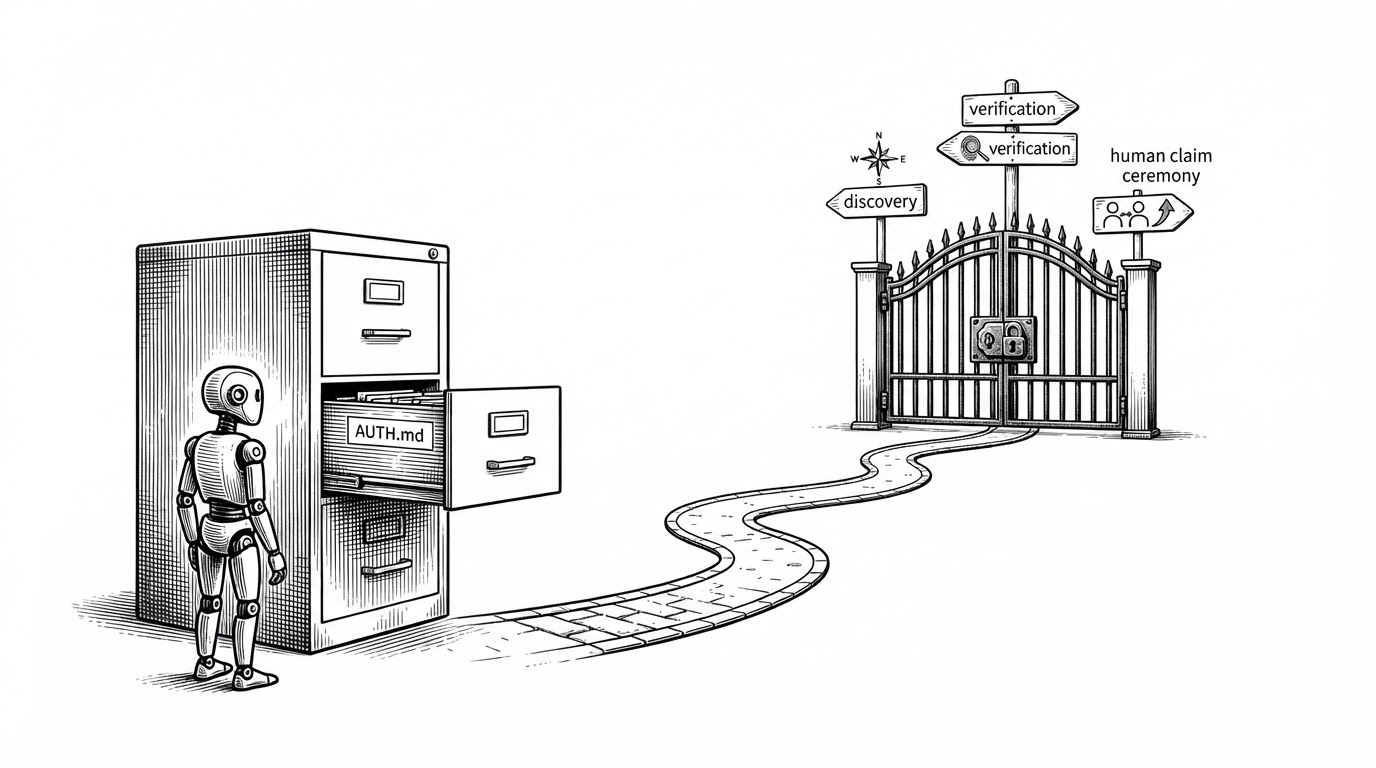
- `auth.md` treats agent onboarding as a discovery problem, not a browser problem.
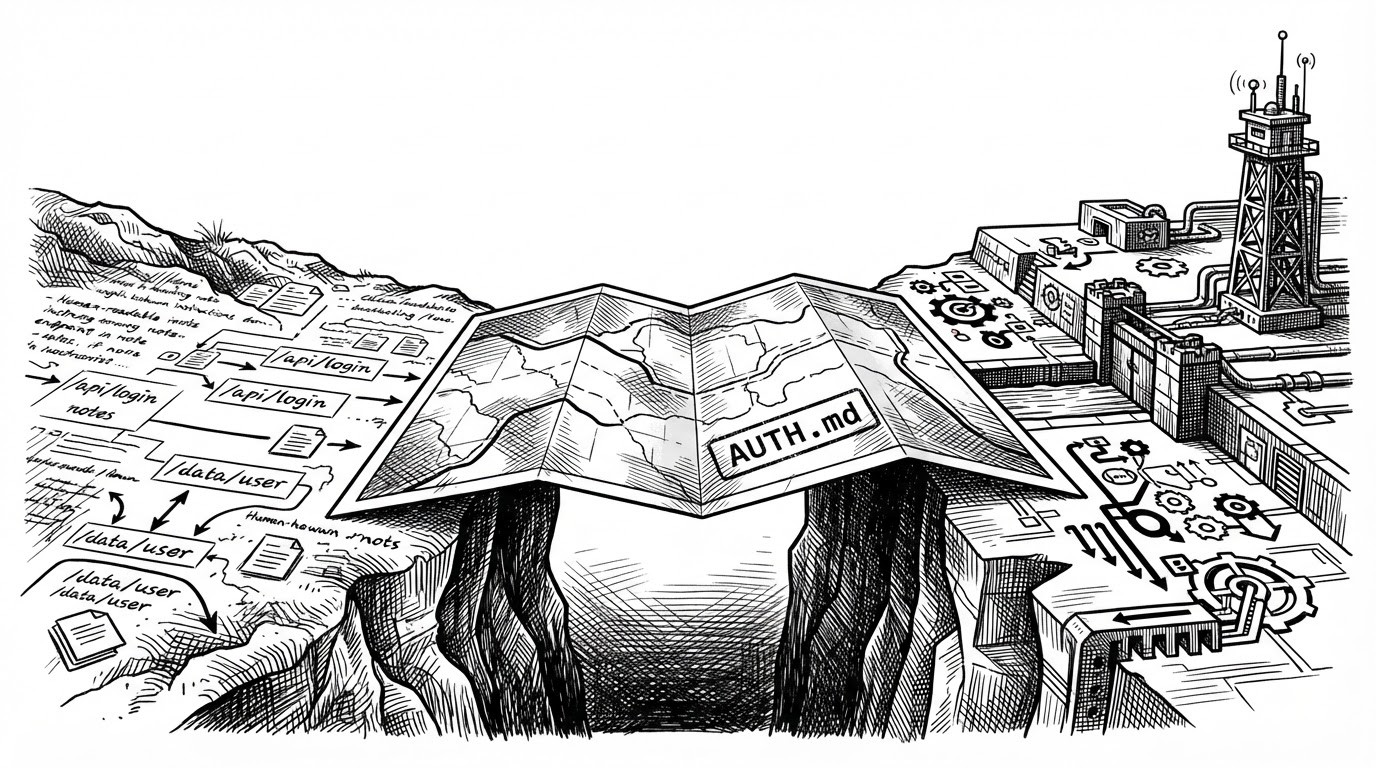
- The protocol uses a Markdown file to bridge human instructions and machine-readable registration flow.
- Its most important design choice is the step-up path, which hands control back to a human when trust is incomplete.
- The repo composes existing standards instead of replacing them, which makes the proposal feel practical rather than speculative.
The strangest thing about `auth.md` is also the most useful. It takes a familiar documentation file and turns it into the place an agent starts when it wants to identify itself, register, and ask for access. That makes the repo feel less like a new auth system and more like a new front door for software that acts on behalf of people.
auth.md is an open protocol, authored by WorkOS, that enables AI agents to register for web services on behalf of users. It consists of a Markdown file published at a domain's root and a set of HTTP endpoints that agents use to discover, register, and authenticate — without requiring a browser, sign-up form, or OAuth consent screen.
Why a Markdown File Became the Front Door
Browser-first auth assumes a person is clicking through a product UI. Agents do not want a maze of redirects and forms. They want a way to discover the right endpoints, understand the rules, and move forward with as little ambiguity as possible. `AUTH.md` is the repo’s answer: a file-shaped manifest that gives the agent a map before it ever touches the service.
The Protocol in One Sentence
In plain English, the system has three parties: an agent, an agent provider, and a service. The agent discovers `AUTH.md`, reads the metadata, then picks a registration path. If trust is already established, the provider can mint an assertion. If not, the service can pause the flow and ask a human to step in. The interesting part is not the endpoint list. It is the way the protocol makes uncertainty explicit instead of pretending it does not exist.
How `AUTH.md` Turns Documentation into a Machine Interface
The repo’s novelty lives in the handoff between the file and the API surface. In `agent-services/src/routes/well-known.ts`, the service exposes well-known metadata, including an `agent_auth` block that points to the `skill` file. That turns a normal docs artifact into the thing an agent is expected to read first. It is a small move with a big consequence: the protocol gives machines a place to start that still makes sense to humans.
We're calling it Auth.md. Auth.md is a spec, not an IETF-ratified standard — please don't bring the pitchforks. It's a set of ideas that lets you expose your application to agents so they can register, sign up, and start using it. Not as spam. Not as a fake human. As an agent acting as a first-class user.
The Three Registration Paths
`agent-auth.ts` handles three routes into identity. One uses an ID-JAG assertion from a trusted provider. One starts from service-auth, which can verify the user through the service itself. One allows anonymous registration, then waits for claim later. That mix matters because it lets the system accommodate both confident identity and first contact that is too thin to trust yet.
| Path | What it assumes | What happens next |
|---|---|---|
| ID-JAG assertion | A trusted provider can vouch for the agent | The service can register or link the identity immediately |
| Service auth | The service can verify the user directly | The flow continues through a verified service-side path |
| Anonymous registration | Nothing is proven up front | The service creates a pending identity that must be claimed later |
The design is careful about what it does not assume. It does not require every agent to arrive with a known identity. It does not force every service to trust the same provider. Instead, it gives the system enough branching logic to accept known agents quickly and unknown ones safely.
Why the Claim Ceremony Matters
This is the repo’s most important product move. When the service cannot prove the link immediately, it returns `interaction_required` and sends the user into a claim ceremony. That is not a failure state. It is a deliberate pause. The protocol acknowledges that trust sometimes needs a human witness before the machine should continue.
Generating illustration...
| Conventional auth | `auth.md` claim flow |
|---|---|
| Optimized for a human signing in | Optimized for an agent that may need a human checkpoint |
| Usually hides ambiguity behind redirects | Makes uncertainty explicit with `interaction_required` |
| Tends to treat the browser as the default interface | Treats a file and a step-up ceremony as the default interface |
That is why the claim flow feels so strong. It does not try to eliminate ambiguity. It turns ambiguity into a controlled transition. The user sees advisories, the agent waits, and the service keeps the state machine honest instead of guessing.
What the Token Endpoint Is Really Doing
The token endpoint composes familiar standards instead of inventing a new universe. In the repository, `grant_type` dispatches between a standard JWT bearer exchange and a custom claim grant. While the claim is pending, the service can reuse `authorization_pending` semantics, which makes the waiting state legible to tooling that already understands OAuth-style polling.
switch (grant_type) {
  case 'jwt-bearer':
    return handleJwtBearerExchange(req, res);

  case 'urn:workos:agent-auth:grant-type:claim':
    if (!claimIsComplete) {
      return res.status(400).json({
        error: 'authorization_pending'
      });
    }
    return issueTokensForClaimedAgent(req, res);

  default:
    return res.status(400).json({ error: 'unsupported_grant_type' });
}
That choice matters because it keeps the protocol grounded. WorkOS is not discarding OAuth conventions. It is extending them just enough to cover agent registration and human-mediated claim without breaking the mental model already used by the ecosystem.
What Makes This Different from OAuth, MCP, and Traditional Auth
| System | What it solves | Primary user | Where `auth.md` differs |
|---|---|---|---|
| OAuth / OIDC | Browser-based login and delegated access | Humans | `auth.md` starts before login, at discovery and registration for agents |
| MCP | Tool connectivity between models and tools | Agents | `auth.md` covers identity and onboarding, not tool transport |
| Auth0, Clerk, Keycloak | Identity management and login UX | Humans and product teams | `auth.md` offers an agent-native entry point instead of a human-first sign-in flow |
The table makes the boundary clear. `auth.md` is not trying to replace OAuth, MCP, or identity vendors. It is carving out the missing layer between discovery and registration, where an agent needs to know how to introduce itself before any login box makes sense.
The Bigger Bet
If this works, agent onboarding stops being a bespoke integration problem. A service can publish a file, expose a small set of metadata, and let an agent figure out the rest. That is a meaningful shift: identity for non-human actors becomes a discoverable surface, not a private implementation detail buried inside product UI.
The bet is bigger than one protocol. It is an argument that the agentic web will need a standard way to say, “Here is how I recognize you.” `auth.md` answers with a file, a few endpoints, and a human fallback when the trust boundary is still fuzzy. That is a surprisingly practical place to start.