DevSocial: A MERN App That Treats a Developer as Structured Data
A close look at the schema, auth flow, and routing choices behind a niche social platform that reads like a developer identity engine, plus the security mistake that tells you exactly what kind of repo this is.

- DevSocial’s real thesis is that a developer can be modeled as structured identity data, not just as an account with a feed.
- The clean split between `User` and `Profile` makes the backend feel intentional, because auth and professional history are handled by different objects.
- JWT keeps the app stateless and API-friendly, which fits the project’s resource-first routing style.
- The hardcoded database credential exposes the repo’s learning-project roots more clearly than any README line could.
DevSocial is easy to misread as a niche social app. The more interesting read is that it behaves like an identity schema for developers, where the backend decides what counts as a meaningful professional profile and what should stay out of the auth record.
A Multi-Page Full-Stack Social Media App for Developer Portfolios Developers can put their portfolio online with projects, contact, education, work experience and other information.
That README line is blunt, but the code goes further. The profile model does not just store a bio. It turns a developer into a structured object with status, skills, experience, education, GitHub, and social links, which makes the project feel closer to a data model than a glossy product shell.
What DevSocial Thinks a Developer Is
The center of gravity is `models/Profile.js`. A user becomes a collection of fields the app can query and render, with `experience` and `education` stored as arrays and `social` tucked into a nested object. That is a strong product choice, because it lets the app treat career history as first-class data instead of freeform text.
The important design move is separation. `User` carries the auth burden. `Profile` carries the career burden. That split keeps the account model lean and gives the app a clean place to grow without turning login credentials into a junk drawer.
Why the User Model Stays Lean
This is classic MERN architecture done well. Authentication data stays close to the account record, while the richer developer biography lives in its own collection and links back through an ObjectId reference. The result is simple to reason about, and easy for the frontend to consume.
// models/Profile.js
user: { type: Schema.Types.ObjectId, ref: 'users' }

// The user record stays lean.
// The profile record holds the professional history.
That pattern matters because it keeps the application from collapsing under its own schema. If DevSocial had stuffed everything into one document, every login, bio edit, and social link would be fighting for the same object boundary.
JWT Turns the App Into a Stateless Service
The auth flow is straightforward: register, hash the password, sign a token, and send that token back in the `Authorization` header. Passport JWT then verifies the bearer token and loads the user by ID, which makes the backend stateless instead of session-bound.
Comment an issue and start discussion Back End: Mongo DB Express Passport JS JWT Auth.
That choice fits the app. A profile service benefits from predictable API calls more than server memory of who clicked what five minutes ago. Stateless auth also makes horizontal scaling much less awkward if the app ever leaves demo territory.
The API Is Organized Like a Small Product Team
`server.js` acts like a traffic controller, not a monolith. The routes are split by resource, so users, profiles, and posts each get a clear boundary. That is not flashy, but it is exactly what makes the codebase readable for a frontend consumer or a future maintainer.
| Area | DevSocial | A more modern setup |
|---|---|---|
| Identity model | Profile-first, schema-driven developer record | Often thinner identity layer, sometimes externalized |
| Auth approach | JWT with Passport | JWT or sessionless auth, often via framework defaults |
| Route organization | Resource-based Express routes | API routes may be split across services or app routers |
| Frontend coupling | Frontend expects a fixed REST API | Frontend may consume multiple services or server components |
| Deployment assumptions | Monolithic Node app with Mongo backend | More fragmented deployment and runtime boundaries |
| Maintenance trade-offs | Easy to understand, harder to modernize | More flexible, but more moving parts |
The table is the point: DevSocial is not novel because it invented resource boundaries. It is interesting because it shows how much clarity you can get from a simple Express app when the domain model is obvious.

The Security Mistake That Gives the Game Away
Then comes the tell. The database connection string is hardcoded in `config/keys.js`, complete with credentials. That is not how a production system should behave, but it is exactly the sort of thing that makes a learning project legible at a glance.
// config/keys.js
mongoURI: "mongodb://zubair:start786@ds133865.mlab.com:33865/devsocial"

// Production code would move this to process.env.MongoURI
// and keep secrets out of the repository.
This is the kind of mistake that undercuts confidence and explains the repo at the same time. The architecture is tidy. The security hygiene is not. That contrast is useful, because it shows a developer who understands structure before operational discipline.

Why This Feels Like a MERN Time Capsule
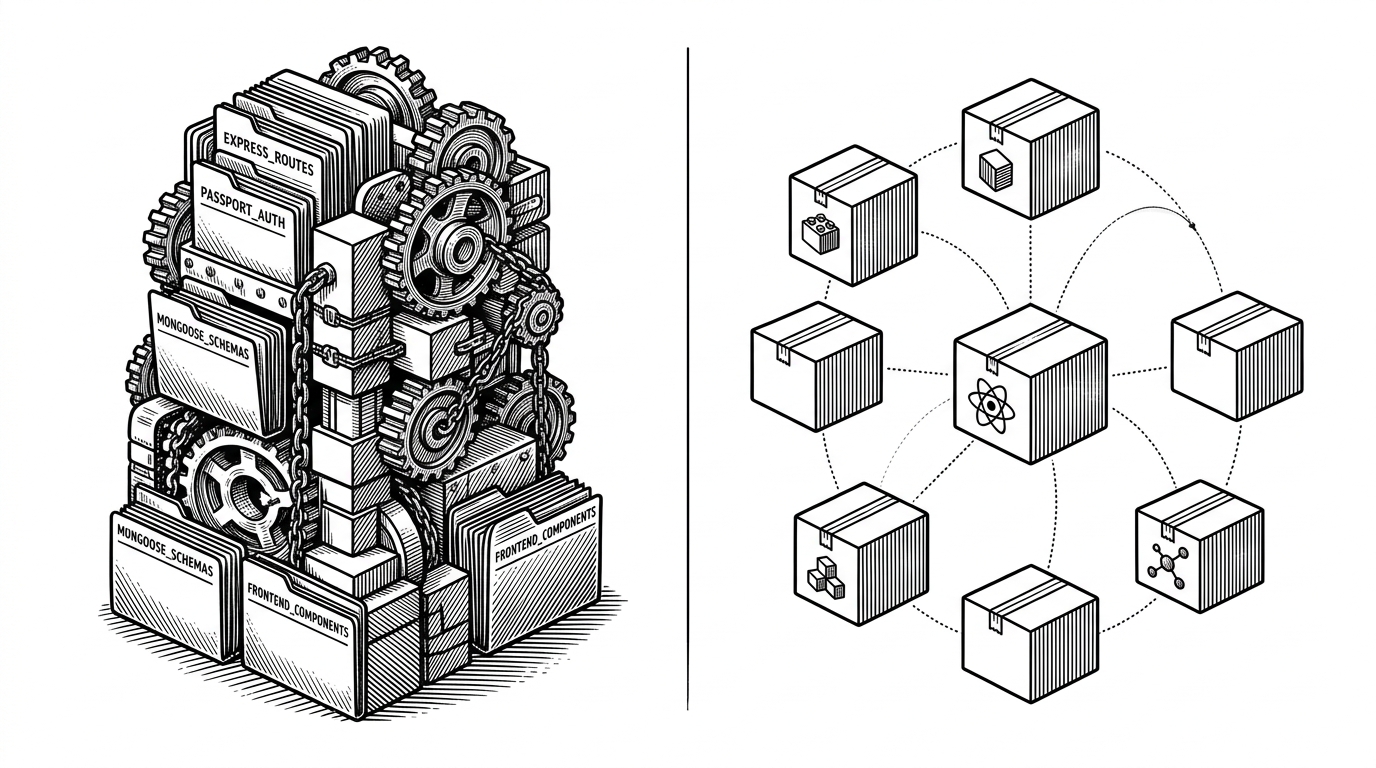
DevSocial belongs to a familiar era of full-stack JavaScript: Express APIs, Passport auth, Mongoose schemas, Redux-era frontend assumptions, and a monolithic deployment model that tries to keep everything understandable in one place. That stack is no longer the default, but it still teaches well because the boundaries are visible.
| Classic MERN DevSocial | More modern product stack |
|---|---|
| One Node backend owns the app | Services or framework conventions split responsibilities |
| Passport and JWT are central | Auth may live in framework defaults or managed identity |
| Schema design is the product core | Product logic often lives across API and client boundaries |
| Monolith is easier to inspect | Distributed pieces are easier to scale selectively |
| Great for learning the full path | Great for shipping at larger organizational scale |
The repository feels representative rather than exceptional, and that is what makes it worth reading. It captures a stage of the stack where backend, schema, and routing all still sat in one visible system, before newer defaults blurred those lines.
DevSocial’s appeal is not that it predicts the future. It is that it shows a developer identity product being designed by someone who thinks in schemas, routes, and resource boundaries first. That makes the repo modest, useful, and very easy to understand.