nvalchemi-toolkit: The Chemistry Stack Built Like a GPU Queue
NVIDIA’s ALCHEMI toolkit treats atomistic simulation as a live pipeline, with inflight batching, composable stages, and model wrappers that keep GPU work flowing.
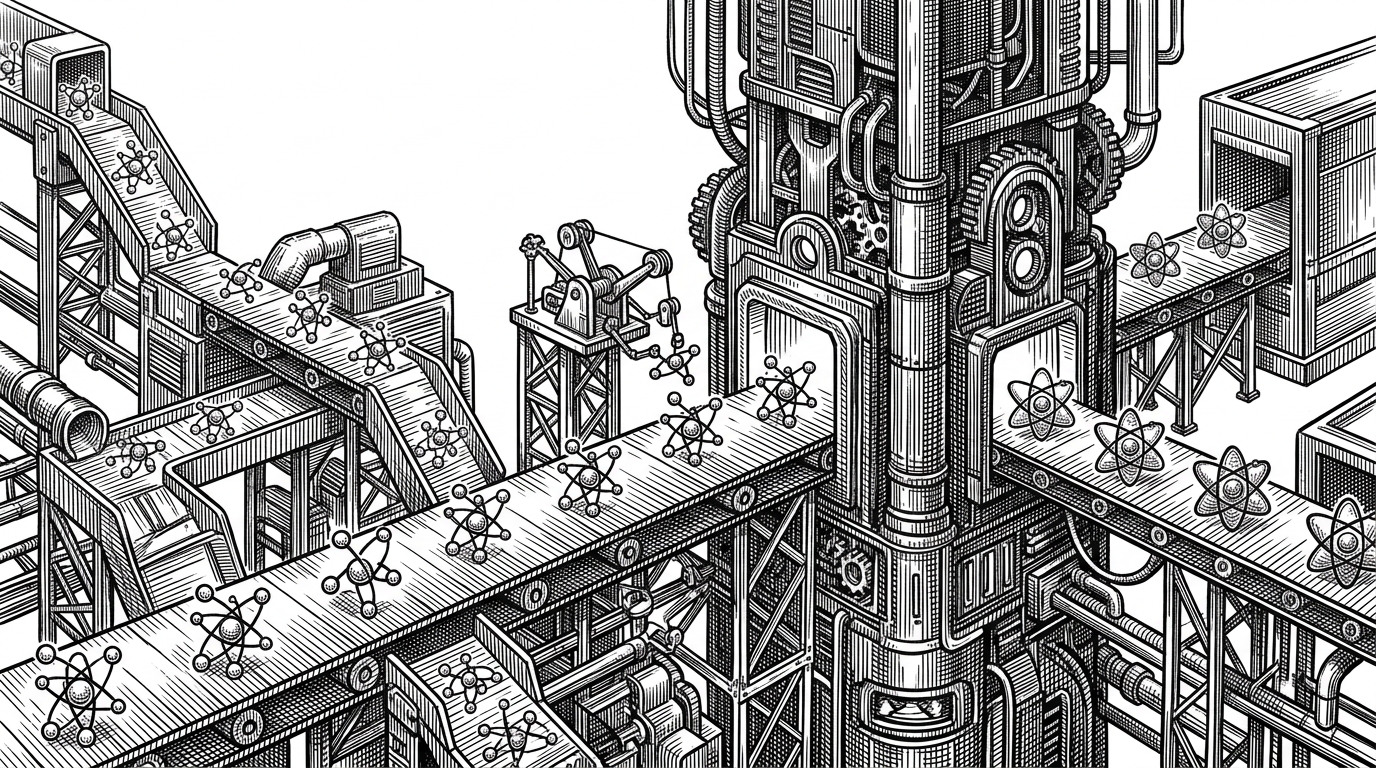
- ALCHEMI treats atomistic simulation as a scheduling problem, not just a physics problem.
- Its batch is elastic, so finished systems can be replaced without tearing down the GPU pipeline.
- The toolkit’s real abstraction is composability: stages, hooks, and wrapped models sit on top of one data model.
- Zarr and GPU-resident storage make data movement part of the performance design, not an afterthought.
Most simulation software is built around one run, one model, one file. ALCHEMI is built for the opposite case: many systems moving through many stages while the GPU stays busy. That is why the interesting part of nvalchemi-toolkit is not just the chemistry. It is the orchestration.
The GPU should never wait
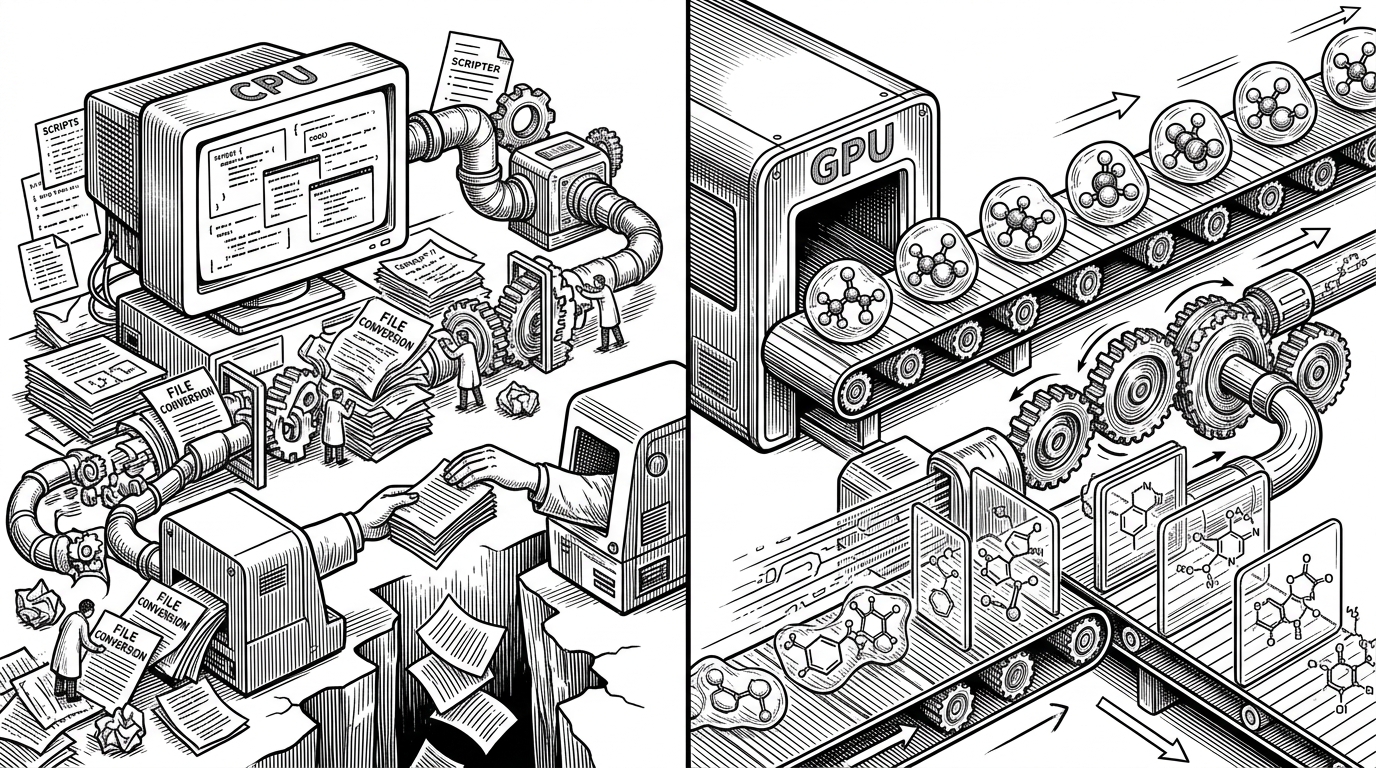
The opening problem is simple: hybrid chemistry workflows often pair a GPU model with CPU-bound plumbing. That leaves expensive hardware waiting on serial data movement, conversion steps, and short-lived batches. NVIDIA’s own framing is blunt about that bottleneck: “High-throughput simulations of small- to medium-sized atomic systems quickly become bottlenecked by inefficient GPU usage in hybrid workflows where the model is GPU-accelerated in PyTorch but the simulation tooling is serial and CPU-based.”
High-throughput simulations of small- to medium-sized atomic systems quickly become bottlenecked by inefficient GPU usage in hybrid workflows where the model is GPU-accelerated in PyTorch but the simulation tooling is serial and CPU-based.
ALCHEMI answers that with a different mental model. It treats atomistic simulation as a pipeline of graph data, model calls, force evaluation, and stage transitions. The question is not only whether the physics is right. The question is whether the batch can keep moving.
A batch that can swap itself out
The repository’s most distinctive idea is inflight batching. A batch is not a fixed pile of systems that must start and finish together. It is a live queue of active slots backed by GPU-resident storage, so finished simulations can be replaced without tearing down the whole batch. That is a subtle shift, but it changes the throughput profile completely.

That is why the data model matters so much. `AtomicData` and `Batch` are not just containers. They are the mechanism that lets the toolkit treat simulations like a living queue instead of a static array of jobs. Once you see that, the rest of the design starts to make sense.
Stages, hooks, and the operator trick
The pipeline layer turns simulation into composition. `BaseDynamics` provides the scaffold, while stage composition lets users chain work in a way that reads like process logic, not framework boilerplate. The `+` operator fuses stages on a single GPU. The `|` operator sends data across a distributed pipeline.
# Conceptual sketch of the operator model
relax = RelaxationStage(model, hooks=[NaNDetectorHook()])
heat = HeatingStage(model)
prod = ProductionStage(model, hooks=[logger])

workflow = relax + heat | prod
The hook system is the second half of that design. Instead of stuffing logging, convergence checks, or safety logic into the integrator itself, ALCHEMI gives those concerns insertion points around the step lifecycle. That keeps the physics code focused and makes the simulation easier to inspect, interrupt, and extend.
Why wrapping models matters
ALCHEMI does not ask model authors to agree on one tensor contract. It wraps them. That is what `BaseModelMixin` and `ModelCard` are doing under the hood: negotiating capabilities so the toolkit can adapt batch data to what a model actually supports. In practice, that means the framework can sit in front of models like MACE or AIMNet2 without forcing every upstream tool to speak the same dialect.
That choice sounds mundane until you compare it with the usual workflow. In a normal setup, every new model is a new adapter, every adapter is a new failure mode, and every failure mode leaks into the simulation loop. ALCHEMI cuts that glue layer down and moves the adaptation logic into one place.
| Dimension | Typical MLIP stack | ALCHEMI toolkit | Why it matters |
|---|---|---|---|
| Model interface | Each model brings its own shapes and helper code. | `BaseModelMixin` and `ModelCard` normalize capabilities across wrapped models. | Less adapter sprawl, fewer one-off branches. |
| Batch behavior | Batches are often static and run to completion. | Inflight batching replaces finished work without collapsing the batch. | GPU utilization stays high. |
| Orchestration | Stage logic lives in custom scripts. | `BaseDynamics`, `+`, and `|` make workflows composable. | The workflow reads like a system, not a script. |
| Observability | Safety checks and logging get embedded in the core loop. | Hooks attach at step boundaries. | Physics stays clean, observability stays separate. |
The data layer is part of the performance story
The choice of Zarr is not an implementation footnote. It is a scaling decision. Chemistry and materials workflows quickly generate large trajectories, many intermediate states, and enough array data to make file layout matter. Chunked, compressed storage makes random access and parallel reads easier to reason about than monolithic files that want to be read in one pass.
That matches the rest of the toolkit’s philosophy. If the compute path is GPU-native, the data path should not fight it. ALCHEMI keeps the storage layer close to the simulation layer so data movement does not become the hidden tax that ruins throughput later.
Who built this, and what ecosystem is it aimed at?
The public face of the project is NVIDIA’s ALCHEMI effort, with contributors including laserkelvin and dallasfoster in the repo history. But the more revealing signal is the extra scaffolding around the code: the `.claude/skills` layer, the docs, and the explicit effort to make the library legible to agents as well as humans. That says the toolkit is not just a library. It is a working surface for automated scientific workflows.
This is exactly the layer that matters as AI-driven chemistry moves from demos to deployable systems. GPU-native acceleration of atomistic primitives (neighbor lists, electrostatics, dispersion) is foundational, especially when moving from research workflows to validated, deployable systems.
That comment gets at the real shift. The toolkit is not trying to replace chemistry or physics. It is trying to turn the infrastructure around them into something reusable, faster, and easier to automate.
How it compares
ALCHEMI is best understood by contrast. Direct MLIP scripts are fine when you want one model and one short path from input to output. Traditional MD stacks are mature, but they often treat GPU acceleration as one stage among many, not the organizing principle. ALCHEMI sits between those worlds and makes throughput the first-class concern.
| Workflow | Strength | Weakness | Best fit |
|---|---|---|---|
| Direct MLIP scripts | Fast to prototype and easy to understand. | Adapter code and data handling are usually bespoke. | Single-model experiments and small runs. |
| Traditional MD stack | Battle-tested physics and broad ecosystem support. | Often CPU-centric in the control plane. | Established simulation workflows with stable inputs. |
| ALCHEMI toolkit | GPU-native orchestration, inflight batching, wrapped models, and composable stages. | You buy into a newer abstraction layer. | High-throughput MLIP pipelines where utilization matters. |
That is the core takeaway. ALCHEMI is not asking chemistry to become software engineering. It is borrowing the best parts of software engineering, queues, stages, hooks, and contracts, so chemistry workloads can behave like systems that scale.