`generalized-pde-emulator`: The Neural Operator That Reads the Equation
Google Research turns PDE coefficients into a control signal, then uses FiLM, spectral layers, and physics-informed losses to push one model across held-out parameters and even new equation families.
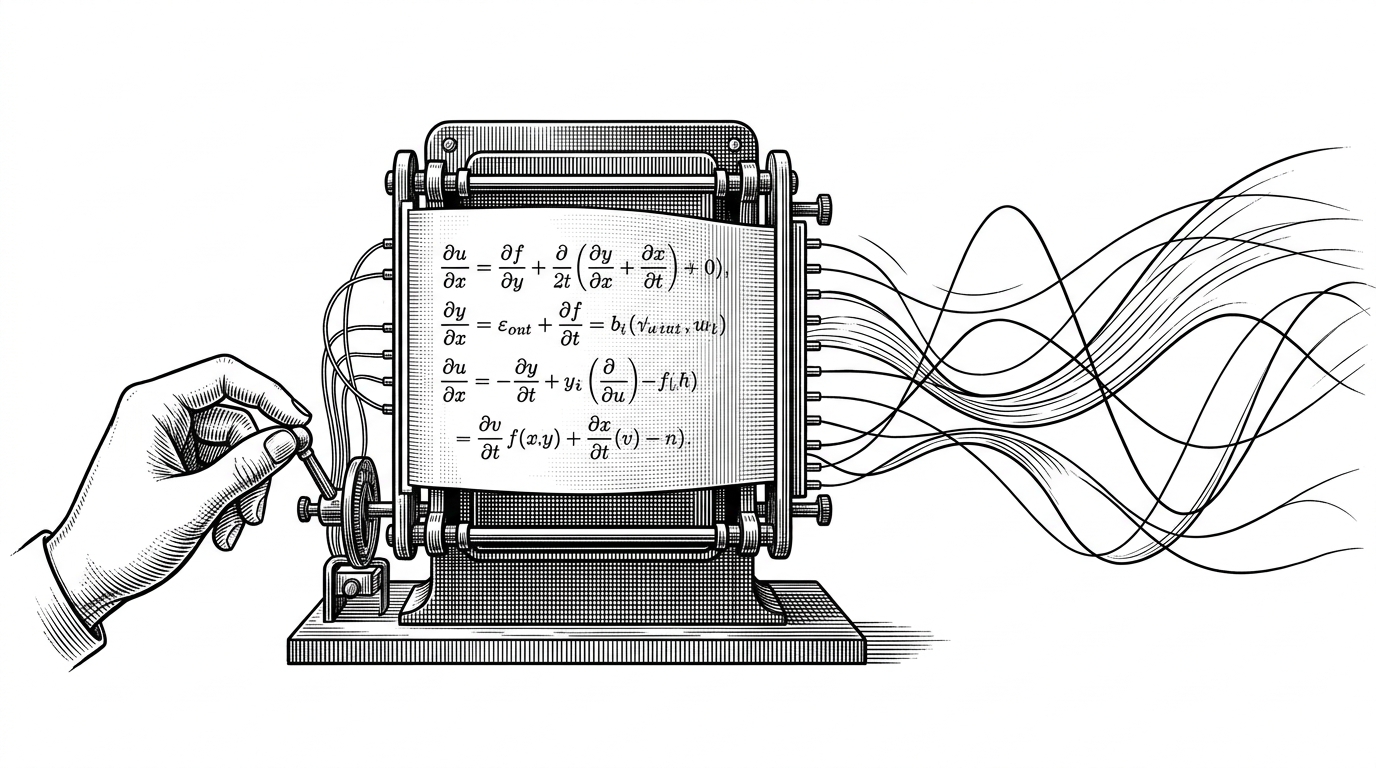
- The repo's central move is to make the PDE itself an input, so generalization becomes a conditioning problem instead of a retraining problem.
- FiLM layers and equation encoders bridge coefficients and activations, which lets one neural operator change behavior across families of equations.
- The paper's claim is not just better interpolation, but held-out parameter stability and zero-shot transfer to a new PDE family.
- JAX, Equinox, Optax, and APEBench make the system feel like research infrastructure, not a one-off demo.
Most PDE surrogates learn one equation family at a time. This repo flips the premise. It encodes the equation's terms and coefficients, then feeds that signal into the network so the model can behave differently when the physics changes.
The unusual part is not the solver. It is the input.
That sounds subtle, but it changes the whole problem statement. Instead of asking a neural operator to memorize one fixed system, `generalized-pde-emulator` asks it to learn an abstraction for equation identity. In the paper's framing, that is how one model can cover held-out parameter settings and, more unusually, transfer to an unseen PDE family.
We present a framework for equation-aware emulation that generalizes to unseen PDEs, conditioning a neural model on a vector encoding representing the terms in a PDE and their coefficients.
Inside the repository, the equation becomes a vector
The codebase is compact and modular. `pde_emulator/models` holds four model families, `pde_emulator/utils` carries training, schedules, and residual losses, and `examples` wires the training runs together. The stack is unapologetically scientific Python: JAX for transformation and compilation, Equinox for class-like modules that still behave like pytrees, Optax for schedules and optimization, and Exponax for Fourier-heavy numerical work.
Four variants, one idea
| Approach | What it conditions on | What it is best at | Main limit |
|---|---|---|---|
| Standard FNO | A fixed training distribution | Fast operator learning for one equation family | It does not read equation structure as an explicit input |
| DeepONet | A chosen problem class | Learning operators with branch and trunk networks | It usually specializes to one family of PDEs |
| PINNs | A PDE residual in the loss | Single-equation solving with physics regularization | Generalization across families is not the goal |
| generalized-pde-emulator | Terms and coefficients encoded into an embedding | Held-out parameters and, in the paper, an unseen PDE family | It is still research code, not a turnkey solver |
That comparison is the real story. The project is not trying to beat every surrogate on a narrow benchmark. It is trying to make equation identity itself learnable, then use that identity to steer the network through FiLM, spectral gating, local convolutions, and physics-informed losses.
Why the comparison matters
APEBench matters because it gives the paper a standardized family of 1D PDEs to train and test on. But the repository's ambition is larger than a single benchmark suite. It wants one model to absorb equation structure, hold up on unseen parameter sets, stay stable in rollout, and then keep working when the PDE family itself changes.
We present a baseline of four distinct modeling technqiues, trained on a family of 1D PDEs from the APEBench suite. Our approach achieves strong performance on parameter sets held out from the training distribution, with strong stability for rollout beyond the training window, and generalization to an entirely unseen PDE.
What the codebase suggests about maturity
This is research infrastructure, not product software. The repository is clean, explicit, and built for reproducibility, which is exactly what you want from a codebase that is trying to move a scientific idea from paper to runnable artifact. The interesting part is not polish for its own sake. It is that the architecture makes the idea legible: condition on the equation, then let the model adapt.
That makes the project feel bigger than a better PDE surrogate. If the input includes equation identity, then generalization stops being a narrow parameter sweep and becomes a representation problem. That is the right kind of ambition for scientific ML.