TimesFM: Google’s Forecasting Model That Thinks Like an LLM
A decoder-only time-series foundation model that replaces per-dataset training with zero-shot prediction, patch-based decoding, and probabilistic forecasts.
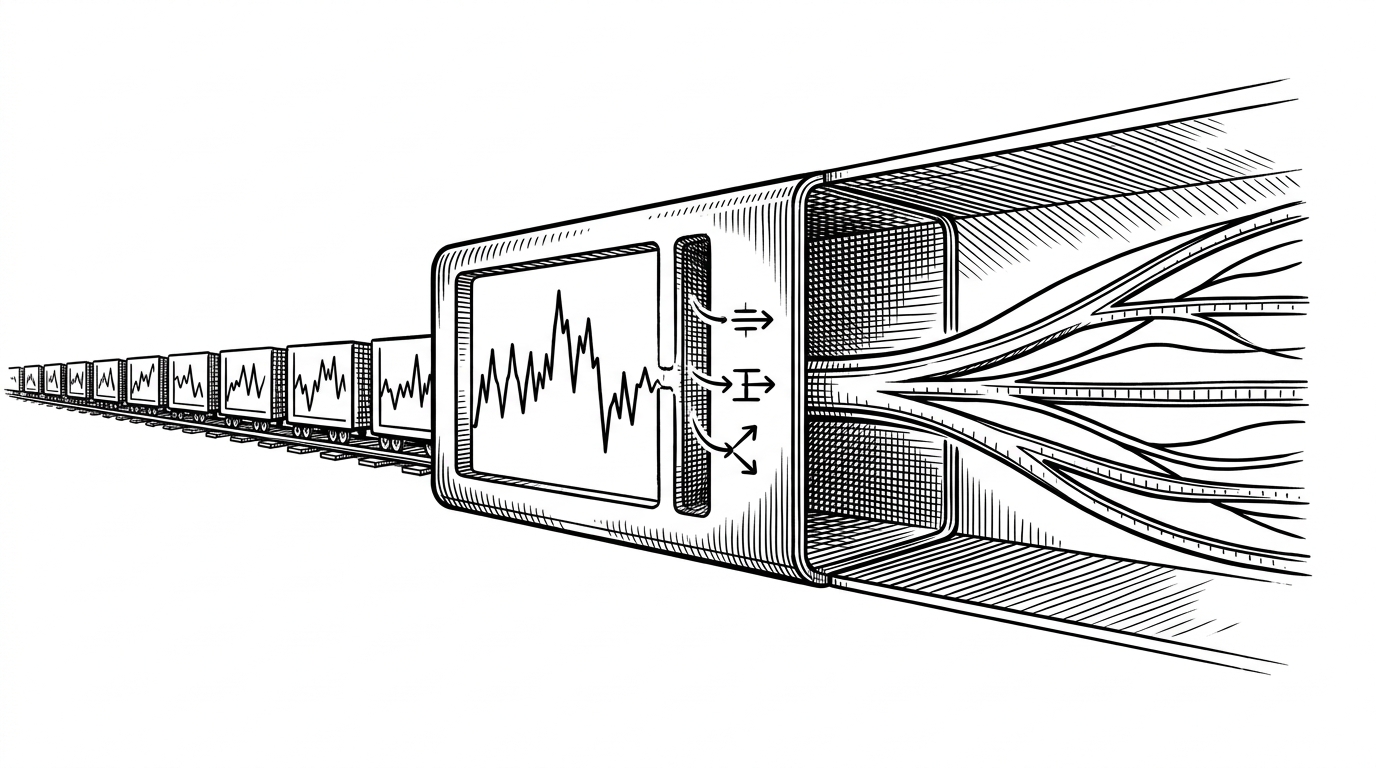
- TimesFM turns forecasting into decoding, which lets one pre-trained model produce useful zero-shot forecasts without dataset-specific retraining.
- Version 2.5 is less about brute-force scale and more about architectural efficiency, with longer context, quantile output, and automatic frequency handling.
- The repo borrows the best LLM machinery, including patches, rotary position handling, KV caching, and decoder-style inference.
- RevIN and forecast constraints make the model behave more like an operational system than a pure research demo.
The interesting part of TimesFM is not that Google made another forecasting model. It is that the repo behaves like an LLM stack that learned to speak in time steps instead of words. The model is built to forecast unseen series with no task-specific training, and that makes it feel less like a specialized predictor and more like a reusable forecasting layer.
TimesFM is a forecasting model, pre-trained on a large time-series corpus of 100 billion real world time-points, that displays impressive zero-shot performance on a variety of public benchmarks from different domains and granularities.
The weird idea: forecasting as decoding
TimesFM starts from a blunt premise. If language models can generate the next token from context, a forecasting model can generate the next point from history. That shift matters because the unit of work is no longer a dataset-specific regressor. It is a pre-trained decoder that can be dropped onto a new series and asked to continue the pattern.
That is the zero-shot claim in plain English. You do not retrain TimesFM for every new product line, sensor fleet, or demand curve. You feed it the past, let it infer the structure, and ask for a distribution over what comes next.
Why TimesFM 2.5 matters more than TimesFM 2.0
| Feature | TimesFM 2.5 | Why it matters |
|---|---|---|
| Parameters | 200M | Smaller than the earlier 500M line, but easier to deploy and iterate on. |
| Context length | 16K | It can look much farther back without resorting to task-specific retraining. |
| Forecast output | Quantiles to 1K horizon | The model returns uncertainty bands, not just a single line. |
| Frequency handling | Automatic | The model no longer needs a manual frequency token in the common path. |
| Inference style | Rebuilt API | The repo feels more like a production interface than a paper artifact. |
The story here is efficiency, not bloat. TimesFM 2.5 cuts parameter count while expanding context, which is the kind of trade-off you expect from a mature system, not a novelty project. It is trying to become easier to run, easier to integrate, and more structurally robust.
The model’s DNA lives in config, not just weights
from timesfm.configs import ForecastConfig

cfg = ForecastConfig(
    force_flip_invariance=True,
    infer_is_positive=True,
    horizon=1000,
)

# The configuration is not just plumbing.
# It encodes output behavior the model should respect at inference time.
That small config object is doing real work. `force_flip_invariance` pushes the model toward symmetry. `infer_is_positive` keeps it from inventing negative demand or sales where that would make no sense. In other words, the repo bakes common-sense constraints into the output path.
This is one reason TimesFM reads as production-minded. It is not only learning from data. It is also being told what kinds of answers are physically or operationally admissible.
How the model turns a signal into tokens
The patching step is the crucial translation layer. By grouping contiguous time points into blocks, TimesFM reduces a long numeric sequence into something the decoder can process more efficiently. That is the same trick that made patch-based vision and time-series models practical, but here it is wired into an autoregressive forecasting stack.
A foundation model for time-series forecasting, in contrast, can provide decent out-of-the-box forecasts on unseen time-series data with no additional training, enabling users to focus on refining forecasts for the actual downstream task like retail demand planning.
The engine room: RoPE, RMSNorm, KV cache
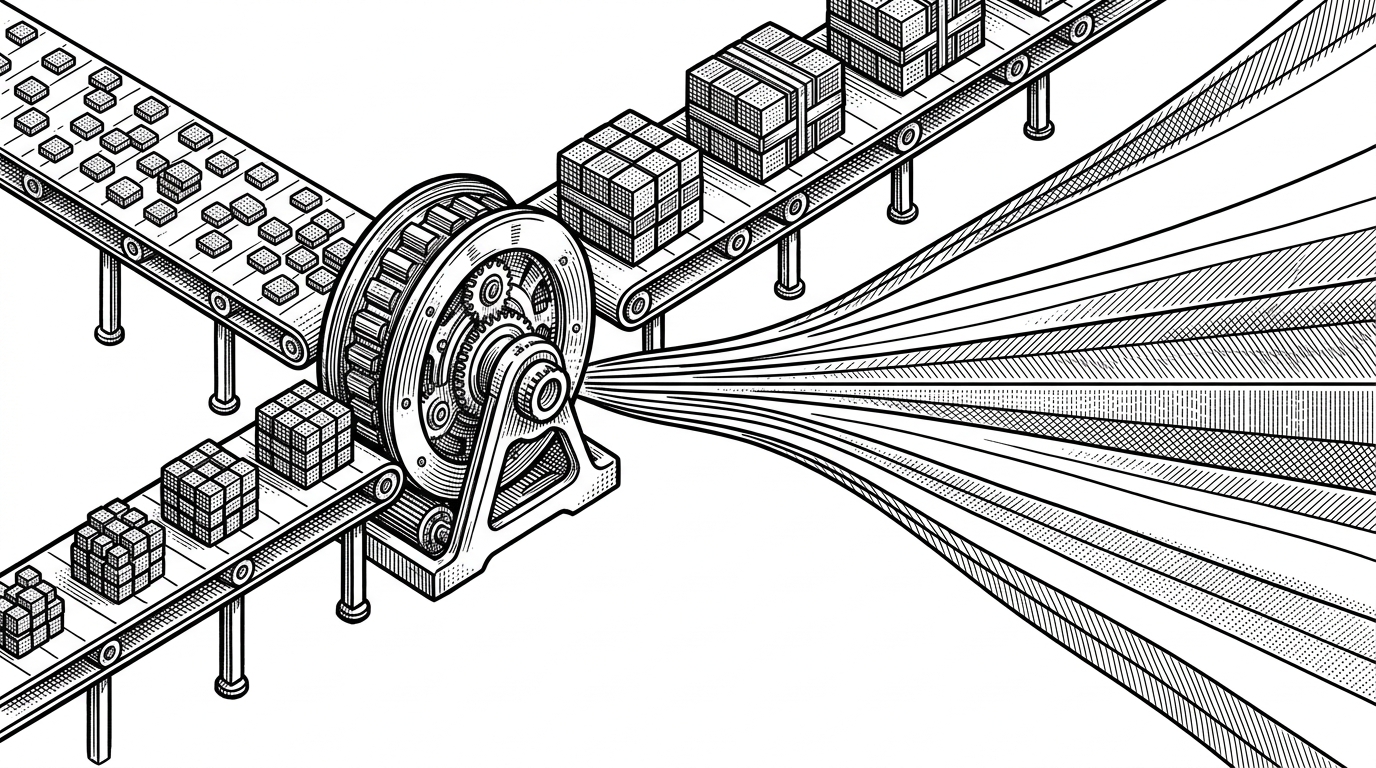
Under the hood, the repo rolls its own Transformer primitives rather than leaning on a generic black box. Rotary positional embeddings help the model keep track of long context. RMSNorm gives the stack a modern normalization choice. The decode cache splits prefill from incremental generation, which is exactly the kind of detail you expect when the model is meant to behave like a decoder, not a one-shot regressor.
That is the LLM analogy made concrete. The model first absorbs context, then steps forward one forecast chunk at a time while reusing cached state. The architecture is not pretending to be language modeling. It is borrowing the most useful parts of that playbook.
RevIN is the quiet trick that makes the whole thing usable
RevIN is easy to overlook because it sounds like housekeeping. It is not. In practice, time-series data arrives on wildly different scales, and a model that ignores that problem becomes brittle fast. TimesFM normalizes the input, forecasts in that stabilized space, and then denormalizes the result back into the original units.
That reversible flow is what makes the system feel sane. The model can work across sales, traffic, weather, and sensors without pretending those signals live in the same numeric universe.
What it beats, what it borrows, and what it refuses to be
| Model family | What it is good at | Where TimesFM differs |
|---|---|---|
| ARIMA / ETS | Strong classical baselines | TimesFM avoids per-series fitting and aims for zero-shot use. |
| DeepAR | Flexible supervised forecasting | TimesFM is pre-trained once and reused across domains. |
| PatchTST | Strong long-horizon transformer forecasting | TimesFM borrows the patch idea but packages it as a foundation model. |
| llmtime-style LLM forecasting | Zero-shot prompting | TimesFM is much smaller and purpose-built for time series. |
The cleanest way to place TimesFM is as a reusable forecasting layer. It borrows the patch idea from transformer forecasting, the decoding mindset from LLMs, and the uncertainty framing from modern probabilistic forecasting. What it refuses to be is a one-off model that needs babysitting every time the data changes.
The bridge from research repo to enterprise workflow
BigQuery support matters because it changes the shape of the product story. This is not just a paper implementation sitting in a lab repo. It has an official path into a warehouse workflow, which means the same core idea can be used where business data already lives.
That bridge is the real signal. TimesFM is trying to move forecasting out of bespoke model projects and into infrastructure. Once that happens, the hardest part is no longer training a separate model for each team. It is deciding where a foundation forecast is good enough, and where human judgment still needs to take the wheel.