Inside larksuite/project-oapi-sdk-java: The Java SDK That Turns POJOs Into Authenticated API Calls
A look at the annotation-driven request translator, token manager, and transport layer that make Lark Project integrations feel native in Java.
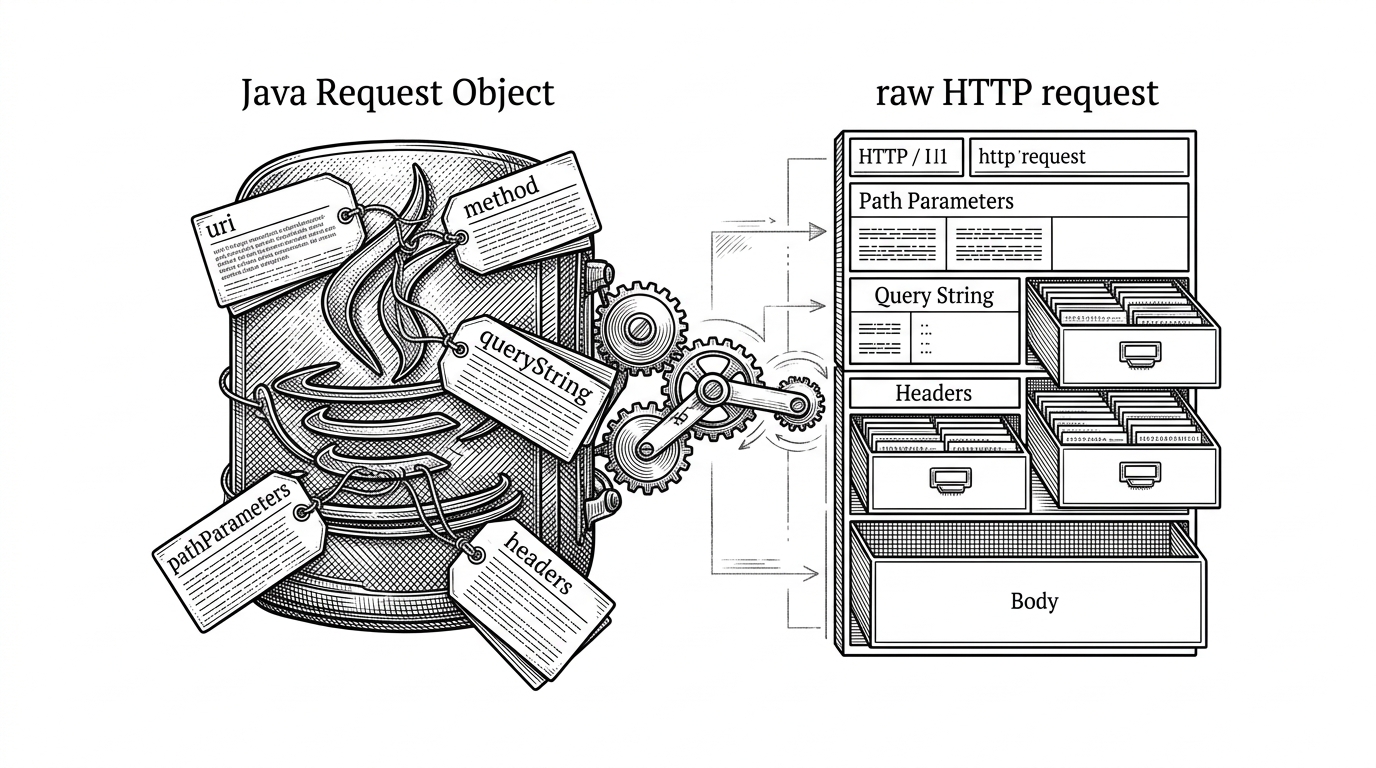
- The repo's real product is a translation layer that turns annotated Java objects into authenticated HTTP requests.
- Centralized token management keeps auth policy out of service code and makes the SDK safer to use at scale.
- Multipart support, event handling, and transport abstraction show an official SDK encoding edge cases callers would otherwise relearn.
- The Java 8, Apache HttpClient, and Maven stack fits enterprise teams that value stability and predictable integration points.
The hidden engine behind a simple Java client
Most SDKs look useful because they list endpoints. This one is useful because it disappears. The public surface is a chain of services and builders, but the work happens below that layer, where annotations, reflection, token injection, and transport all collaborate to turn plain Java objects into API calls.
为简化开发者接入飞书开放平台的操作步骤,我们提供了服务端SDK,开发者可使用 SDK,快捷地开发功能。
That is the right ambition for an official SDK. It should reduce the number of places where callers can make a mistake, especially around auth, request shape, and serialization rules. In this repo, the important surface area is not endpoint count. It is how consistently the plumbing treats every module the same way.

Why official beats convenient
The practical case for an official SDK is not that it is prettier. It is that the platform owns the awkward parts. Token handling, header injection, multipart edge cases, event compatibility, and broad API coverage all stay in one place instead of being reinvented by every team that needs to ship against the same platform.
| Approach | Auth handling | Request modeling | API coverage | Multipart/file support | Maintenance risk |
|---|---|---|---|---|---|
| Hand-rolled Java HTTP | Caller manages tokens, refresh, and headers | Ad hoc POJOs or maps | Whatever the team builds | Usually brittle and inconsistent | Highest |
| Community wrapper | Often partial or inconsistent | Mixed, depends on the maintainer | Variable by module | Sometimes missing edge cases | Medium to high |
| Official larksuite/project-oapi-sdk-java | Centralized token manager and injection | Annotated request objects | Broad and aligned with the platform | Built in, including tricky upload paths | Lower |
Java SDK将复杂的HTTP API调用封装为简洁的链式方法调用,大大提升了开发效率。

How the SDK is assembled
The codebase follows a familiar enterprise shape, but the interesting part is how tightly the pieces are separated. `Client` acts as the entry point, services hang off that root, `ReqTranslator` turns structured input into a raw request, `GlobalTokenManager` owns auth state, and `Transport` plus `IHttpTransport` handle the actual send.
public final class Client {
  private final Config config;
  private final ReqTranslator translator;
  private final Transport transport;
  private final GlobalTokenManager tokenManager;

  public <T> T call(RequestModel<T> model) {
    RawRequest raw = translator.translate(model, config);
    tokenManager.apply(raw, config);
    return transport.doSend(raw, model.responseType());
  }
}
That shape matters because it keeps policy centralized. The service layer can stay narrow, while the core knows how to map fields, cache tokens, serialize bodies, and swap transport implementations without forcing every endpoint to relearn the same logic.
The request translator is the real product
This is the repo's most interesting move. `ReqTranslator` uses reflection and custom annotations to decide where each field belongs, then assembles a request that already knows its path variables, query parameters, headers, and body. The caller writes a Java object. The SDK decides how that object becomes a network message.
That design reads like Retrofit's logic stripped down for platform SDK work. It is especially powerful for edge cases. File uploads can be handled as form data instead of an afterthought, and event and callback flows can share the same request machinery instead of branching into a second architecture.

What the official SDK leaves behind
The strongest argument against rolling your own is not aesthetics. It is ownership. With raw HTTP, the caller owns every failure mode. With this SDK, the library owns the translation rules, the auth state, the transport contract, and the awkward corners like multipart behavior and request encoding.
Why this design fits enterprise Java
The stack tells you exactly who this is for. Java 8, Maven, Apache HttpClient, Gson, and SLF4J are not fashionable choices, but they are dependable ones. That is the right trade-off when the SDK needs to live inside long-lived enterprise systems where stability matters more than novelty.
Even the transport details show that mindset. Support for multipart uploads uses `HttpMultipartMode.RFC6532`, which is the kind of quiet decision that prevents non-ASCII filenames from turning into support tickets. The repo is not trying to be clever. It is trying to make the hard parts boring.
What official SDKs teach us
The bigger lesson is that an official SDK is a policy layer as much as a convenience layer. It teaches callers how the platform expects requests to be shaped, how auth should be handled, and which edge cases deserve first-class support. In that sense, this repo is less a wrapper than a compact model of the platform itself.