quiche: The Rust QUIC Engine That Became a Multipath Research Lab
A close look at how this fork turns a production-grade transport stack into a playground for multipath routing, multicore execution, and plugin-style protocol experiments.
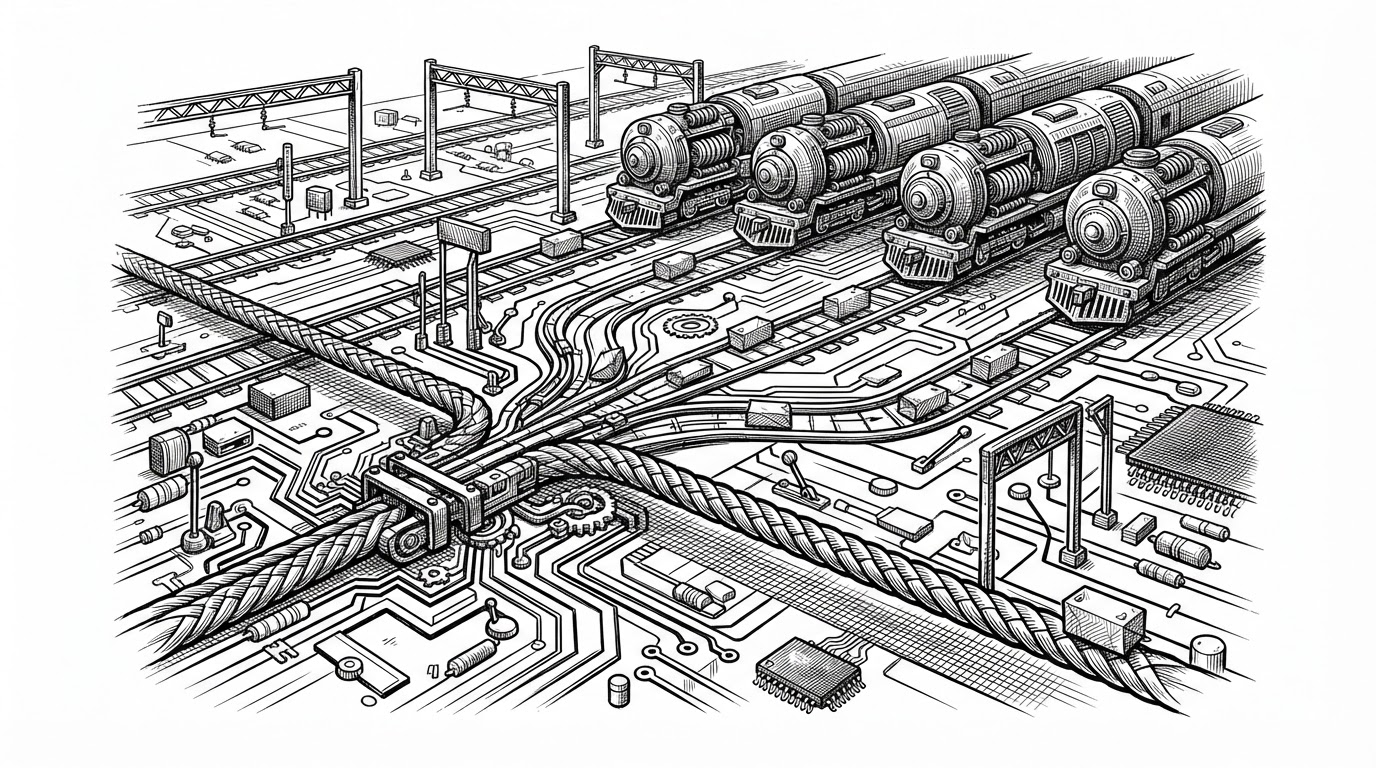

Multipath QUIC is an extension to the QUIC protocol that enables hosts to exchange data over multiple networks over a single connection.
- This fork matters because it treats QUIC as a research substrate that can be reworked for multipath, multicore, and plugin-style protocol experiments.
- The base library keeps the application in charge of sockets, timers, and event loops, which makes the transport engine portable and easy to reshape.
- The interesting leap is not just adding more paths, but separating paths, cores, and extension behavior so they can be recombined.
- Against production-first QUIC stacks and academic multipath prototypes, this repository sits in the narrow lane where Rust safety meets research flexibility.
Most QUIC projects try to disappear into the background. qdeconinck/quiche does the opposite. It exposes the transport stack as a thing you can bend, split, and recombine for research.
Why this fork exists
The project sits inside Quentin De Coninck’s research line on Multipath QUIC and Core QUIC. That matters, because it changes the goal from shipping a default HTTP/3 stack to testing how far the protocol can be pushed when one connection spans more than one path, more than one core, and more than one style of extension.
That framing explains the fork’s personality. It inherits a serious Rust QUIC engine, but it treats the engine as a lab bench. The point is not only to move packets quickly. The point is to test how transport behavior changes when you stop assuming there is one path, one scheduler, and one place where protocol logic must live.
The unusual idea: QUIC as a platform, not a product
This is the article’s core idea: the repo makes QUIC feel like a platform. Multipath support, multicore scaling, and pluginized protocol behavior are not separate features here. They are one design move, which is to break the transport stack into pieces that can be reasoned about independently and then reassembled.

That is why the research angle feels different from a normal QUIC fork. The codebase is not only asking how to add another route. It is asking how to make the stack itself more malleable, so the transport machinery can be split across execution domains without collapsing into a tangle.
A concrete example from the research trail
Our prototype implementation is based on Cloudflare's open-source Quiche library with Multipath QUIC support.
That line tells you what this repo is for. It is a working base for extending a real QUIC implementation, not a toy stack invented only for a paper. That distinction matters because research transport code becomes more useful when the underlying library already behaves like production software.
What the base library actually does
The architecture is intentionally I/O agnostic. The application owns the socket, the timers, and the event loop. The library owns the protocol state machine. In practice, that means the app reads from UDP, calls recv(), asks the connection what to send next, and then calls send() when the stack is ready.
// Simplified event-loop shape used by quiche-style applications
match sock.recv_from(&mut buf) {
    Ok((len, from)) => {
        let read = conn.recv(&mut buf[..len], recv_info(from))?;
        let (write, send_info) = conn.send(&mut out)?;
        sock.send_to(&out[..write], send_info.to)?;
        if let Some(at) = send_info.at {
            schedule_timer(at);
        }
    }
    Err(_) => {
        if let Some(timeout) = conn.timeout() {
            arm_timer(timeout);
        }
    }
}
That inversion of control is the quiet superpower. Because the stack does not own the I/O layer, it can fit into a plain server, a specialized scheduler, or a research harness. The same design also makes pacing hints first-class, which matters when packet bursts and retransmission timing are part of the experiment rather than an implementation detail.
How it negotiates real protocols
None of this works unless the handshake is real. QUIC is negotiated, not assumed. ALPN chooses application behavior. Congestion control tunes the shape of traffic. Configuration knobs decide how much data, how much buffering, and which control algorithm the connection should use.
The point is not to romanticize configurability. The point is that multipath research only becomes convincing when the transport stack can still speak normal QUIC, still negotiate its role, and still expose the tuning surfaces that production deployments depend on.
Why fuzzing matters here
Protocol code is attack surface. That is why the fuzz corpus matters more than a casual README mention usually would. When a repository contains malformed packet cases, it signals that edge conditions are part of the design, not an afterthought.
Our solution, mcMPQUIC, achieves a goodput of up to 20 Gbps with ten paths/cores, surpassing the baseline MPQUIC performance by more than five times.
That kind of claim only matters if the code path can survive hostile inputs, strange reorderings, and packet formats that look valid until they do not. Fuzzing is the bridge between a clever transport idea and something you can trust to sit near real traffic.
How it stacks up
| Project | Primary goal | Language | Path model | Core model | Extensibility |
|---|---|---|---|---|---|
| qdeconinck/quiche | Multipath and multicore research on top of a real QUIC stack | Rust | Single path plus multipath experimentation | State machine can be distributed across cores | Plugin-style protocol exploration |
| Cloudflare quiche | Production-oriented QUIC and HTTP/3 | Rust | Mostly single-path first | Optimized for deployment, not research partitioning | Stable library API |
| picoquic / quic-go | Academic or open-source multipath exploration | C / Go | Multipath support with different trade-offs | Less focused on state-machine parallelism | Research-friendly, but different implementation priorities |
This is not a ranking. It is a map of intent. Cloudflare’s upstream project optimizes for production transport. Research implementations optimize for learning and benchmarking. This fork sits between them: grounded enough to be real, flexible enough to let new transport ideas breathe.
What this project says about QUIC
The bigger lesson is that transport stacks are becoming programmable research surfaces. QUIC already blurred the old boundary between transport and crypto. This fork pushes the idea further by making the stack itself more composable, so the interesting unit is no longer just a connection. It is the relationship between paths, cores, and the logic that binds them.
That is why this repository stands out. It does not just implement QUIC. It asks what else QUIC can become when the implementation is treated as an instrument instead of an endpoint.