ax-agent: AX: Building the Fireproof Kitchen for Autonomous Agents
How a security-first architecture and signature-based prompting are turning untrusted LLMs into reliable, always-on digital employees.
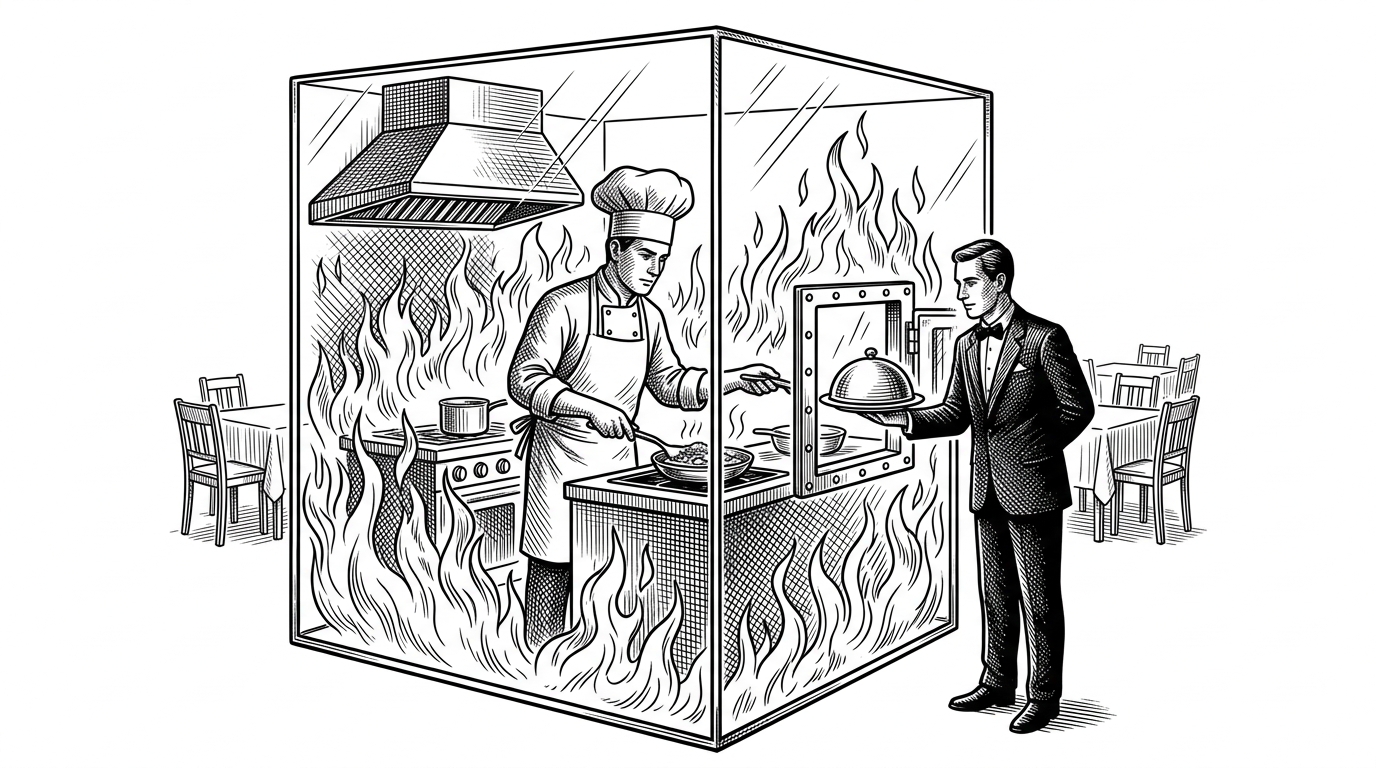
- AX treats the LLM as a fundamentally untrusted component by isolating it within a secure container.
- The framework replaces brittle prompt engineering with type-safe TypeScript Signatures to enforce deterministic outputs.
- A lean 35,000-line codebase reduces the attack surface compared to bloated legacy agent frameworks.
- Strict inter-process communication proxies prevent the agent from accessing sensitive host credentials or external networks directly.
The 170,000-Line Warning
Most AI agent frameworks are a security disaster waiting to happen. They give a large language model access to a terminal and simply hope for the best. This approach works for harmless demos but fails catastrophically in production environments.
The lineage of AX begins with a cautionary tale. Predecessors like OpenClaw proved that highly autonomous agents were capable of complex tasks. However, they also revealed the extreme danger of unauditable bloat. A sprawling 170,000-line codebase combined with an unpredictable LLM creates a massive surface area for remote code execution vulnerabilities.
AX was built to solve this exact problem. By treating the LLM as a fundamentally untrusted component, the framework reduces its core footprint to a highly auditable 35,000 lines of TypeScript. It replaces blind trust with architectural guarantees.
Architecture of the Trust Zone
The core innovation of AX is its Provider Contract Pattern. The framework acts like a fireproof kitchen. The LLM can cook whatever it wants inside, but it cannot burn the house down. It is physically trapped in a container with no direct network access.
This isolation is achieved through strict Trust Zones. The host process remains entirely trusted and handles sensitive credentials. The agent and browser automation run in isolated, untrusted containers. They communicate with the host exclusively through a heavily monitored inter-process communication proxy.
Signatures: Coding the LLM's DNA
Securing the execution environment is only half the battle. Controlling the LLM's actual reasoning requires a departure from traditional prompt engineering. AX abandons brittle string templates in favor of type-safe TypeScript interfaces called Signatures.

AX uses these Signatures to define strict inputs and outputs. Developers declare what the model must consume and produce using standard TypeScript types. The framework's compiler enforces these rules at runtime.
import { Signature } from 'ax';

interface EmailTask extends Signature {
  input: { context: string; recipient: string };
  output: { subject: string; body: string; isUrgent: boolean };
}
If the model hallucinates a malformed response, the data never reaches the execution layer. The response processing pipeline validates the raw JSON against a strict schema, ensuring the agent only acts on perfectly typed objects.
The Always-On Employee
This combination of architectural security and deterministic output enables a new paradigm. AX is not just a command-line tool you run once. It is designed to be an always-on digital employee.
The framework features native multi-channel routing. An AX agent can maintain persistent state while interacting across Slack, WhatsApp, and automated browser sessions simultaneously.
| Feature | First-Gen Agents | AX Framework |
|---|---|---|
| Security Model | Hope-based (System Prompts) | Architectural (Container Isolation) |
| Codebase Size | 170k+ lines (Unauditable) | ~35k lines (Auditable) |
| Execution | Direct Host Access | Strict IPC Proxy |
| State | Single-session CLI | Always-on Multi-channel |
The transition from AI as a chatty toy to a secure utility requires fundamental architectural shifts. By prioritizing isolation and type safety, AX provides a blueprint for the next generation of autonomous infrastructure.