VideoIntuit Turns Video Into a Private Search Engine for Ideas
A local-first RAG pipeline that transcribes, cleans, indexes, and chats with video, then expands the answer space by pulling in related YouTube context.

- VideoIntuit is interesting because it treats video as a searchable local corpus, not just a source for summaries.
- Its most distinctive move is merging an uploaded video with related YouTube transcripts inside one shared retrieval space.
- The stack is intentionally thick, with Whisper, spaCy, FAISS, Ollama, FFmpeg, and Docker doing the heavy lifting locally.
- That design buys privacy and control, but it also shifts setup and compute costs onto the user.
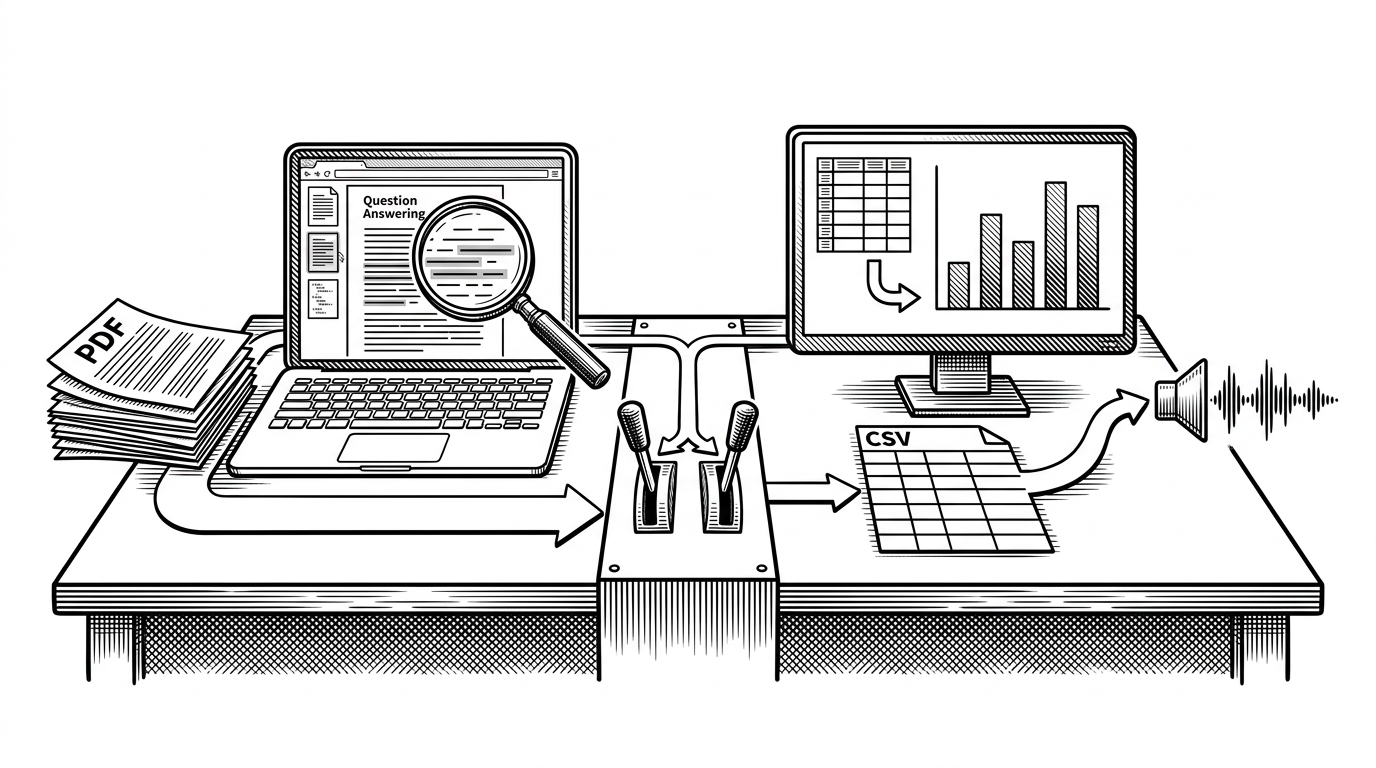
Most AI video tools stop at transcription. VideoIntuit keeps going. It cleans the transcript, chunks it, embeds it, and stores it in FAISS so a question can search across meaning instead of keywords. Then it can widen the scope by pulling in related YouTube videos, which turns a single clip into a topic-specific research surface.
When a Video Becomes a Corpus
That is the whole bet. A video is usually treated like a file with a timeline. VideoIntuit treats it like a body of evidence.
Once the audio is extracted and transcribed, the system does not leave the text alone. It repairs obvious transcription noise, chunks the content into retrieval-sized pieces, and indexes those pieces for later search. The result is less like a media player and more like a private notebook that can answer back.
Why Local-First Is the Point
VideoIntuit is not a thin hosted wrapper around someone else’s API. The stack is local by default: Whisper for transcription, spaCy and spell correction for cleanup, Sentence Transformers for embeddings, FAISS for vector search, Ollama for generation, and FFmpeg plus yt-dlp for video handling. Docker ties it together so the system behaves like an appliance rather than a pile of scripts.
| Dimension | VideoIntuit local-first stack | Typical hosted AI video assistant |
|---|---|---|
| Data sovereignty | Stays on your machine or your containerized environment. | Content and prompts pass through third-party services. |
| API dependence | No external LLM API is required for the core flow. | Core functionality usually depends on hosted APIs. |
| Hardware demand | Higher local compute and storage pressure. | Lower local demands, since the cloud carries the load. |
| Research depth | Built to search, merge, and reuse transcripts as a corpus. | Often optimized for summaries and single-video Q&A. |
| Related-video expansion | Can fold adjacent YouTube context into the same vector space. | Usually stops at the current upload or session. |
| Setup complexity | More moving parts, more deliberate setup. | Easier to start, harder to own fully. |
That tradeoff is the point. You get reproducibility, privacy, and no vendor lock-in on the core retrieval path. You also accept that this is a thick application, not a casual browser toy.
From Audio to Answer
The pipeline is straightforward in concept and layered in execution. Video comes in, audio gets extracted, Whisper turns speech into text, and a cleanup pass removes enough noise to make retrieval useful. Then the text is chunked, embedded, written to FAISS, and retrieved later when a question arrives.
# Conceptual flow, simplified from the repo
video -> ffmpeg audio extraction -> faster-whisper transcript
transcript -> cleanup (spaCy + spell correction)
clean text -> chunking -> embeddings -> FAISS index
question -> similarity search -> top chunks -> Ollama answer
The interesting part is not any single library. It is how they are arranged. The transcription layer improves the text, the retrieval layer narrows the context, and the generator only sees what the index believes is relevant.

The Clever Part: One Vector Space, Many Videos
This is the project’s best idea. The related-video feature does not create a separate assistant or a side panel of trivia. It feeds additional transcripts into the same retrieval layer, so the model can answer like a topic researcher instead of a file helper.
That matters because semantic search gets more useful as the corpus gets denser. A question about a narrow topic often benefits from adjacent videos, especially when one source is incomplete or poorly spoken. VideoIntuit uses that overlap to make the answer space feel broader without making the user manually stitch sources together.
What the Stack Buys You, and What It Costs
The stack buys control. If you care about private lectures, meeting recordings, or other sensitive video, keeping the full path local is not a minor detail. It is the product.
| Tradeoff | What you gain | What you pay |
|---|---|---|
| Privacy | Your data stays inside the deployment boundary. | You own the infra and the failures. |
| Expandability | Related videos can enrich the corpus quickly. | Broader retrieval can also add noise. |
| Reproducibility | A containerized stack is easier to reason about. | The image is heavier than a thin wrapper. |
| Performance | FAISS makes semantic retrieval fast enough for interactive use. | Local compute and storage are not free. |
| Developer control | Each stage of the pipeline is inspectable. | The system is less friendly to casual users. |
That is a very deliberate product choice. VideoIntuit is aimed at people who want a research instrument, not a polished consumer service. The closer you look, the more it reads like a prototype that knows exactly what it is.
Where This Fits in the AI Video Landscape
The broad category is crowded, but the differences still matter. Many tools summarize video. Some answer questions about a clip. Fewer turn the content into a reusable local knowledge base, and fewer still widen that base with adjacent sources while keeping the whole workflow offline-friendly.
| Tool shape | Primary strength | Limitation |
|---|---|---|
| Simple transcription tool | Fast conversion from speech to text. | Little or no semantic retrieval. |
| Hosted AI video assistant | Low friction and quick setup. | External dependency and weaker data control. |
| VideoIntuit | Private, expandable research over video sources. | Heavier setup and higher local compute cost. |
So the comparison is not about who wins every benchmark. It is about intent. VideoIntuit is for users who want control over the corpus and are willing to pay for it with setup and hardware.
The Prototype Signal
The use of SQLite and LocMemCache points to an early-stage system that is optimized for a single user or a small local deployment. That is not a flaw. It is a clue about the intended shape of the product.
The codebase looks like a functional end-to-end pipeline built by someone who wanted the full loop to work before chasing scale. That choice keeps the architecture legible. It also makes the project feel honest about its audience: builders, researchers, and people who care enough about their videos to host the stack themselves.