RAG-Anything: The Framework That Refuses to Pretend Documents Are Text
A tour of the ingestion pipeline, multimodal processors, and resilience machinery that turn messy files into graph-ready knowledge.

Our paper on RAG-Anything has been accepted to ACL 2024 (Findings). Check out the code and paper!
- RAG-Anything treats ingestion as the main engineering problem, because multimodal RAG fails when documents are messy before retrieval even begins.
- Its parser registry, modality processors, and cache-and-status machinery make file handling feel like a routing system, not a single brittle conversion step.
- The mixin-based architecture keeps querying, processing, and batch workflows separated while still exposing one coherent API.
- Compared with broader RAG ecosystems, the project is more opinionated about normalization and graph-backed retrieval than about being a general platform.
The real problem is not retrieval. It is document chaos.
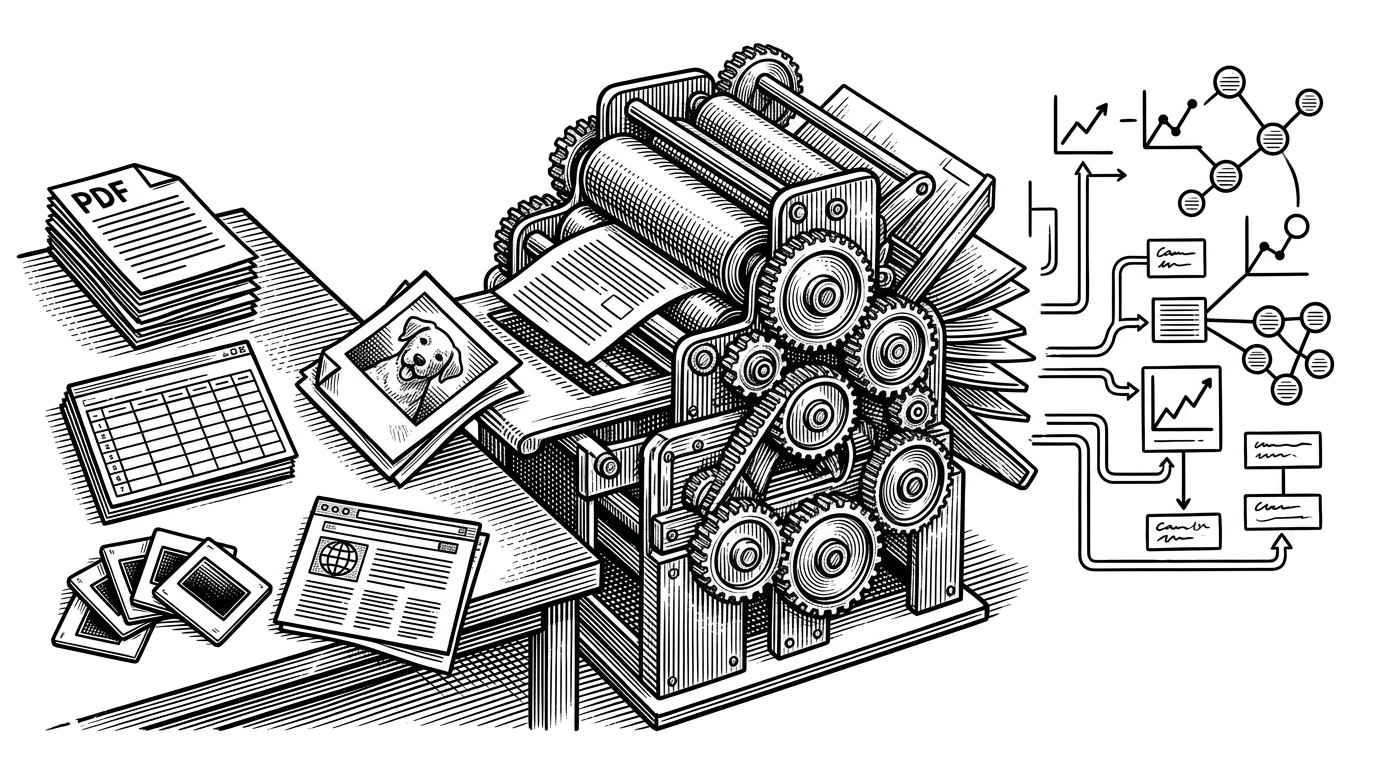
Most RAG stacks quietly assume the hard part is choosing the right chunks. RAG-Anything starts one layer earlier: the input is often a mess of PDFs, screenshots, tables, equations, scans, Office files, and downloads that do not want to become text on demand.
That shift matters. If a pipeline cannot preserve structure from the start, retrieval can only answer questions about a flattened version of the source. RAG-Anything is built to keep that structure alive long enough to matter.
We present RAG-Anything, a unified framework for any-modality Retrieval-Augmented Generation.
RAG-Anything turns ingestion into a routing problem
# Conceptual flow, simplified
parser = registry.select(source)
parsed = parser.load(source)
context = modal_processor.enrich(parsed)
normalized = chunker.build(context)
rag.ingest(normalized)
The codebase is organized around that split
The core package keeps the orchestration readable by separating concerns into mixins. `QueryMixin` handles asking questions, `ProcessorMixin` handles document processing, and `BatchMixin` handles bulk workflows. The result is one `RAGAnything` entry point without a single god object swallowing every concern.
That architecture is boring in the best way. It keeps the public surface small while still leaving room for special handling in the parser, the multimodal processors, and the resilience layer.
The parser layer is where “anything” becomes literal
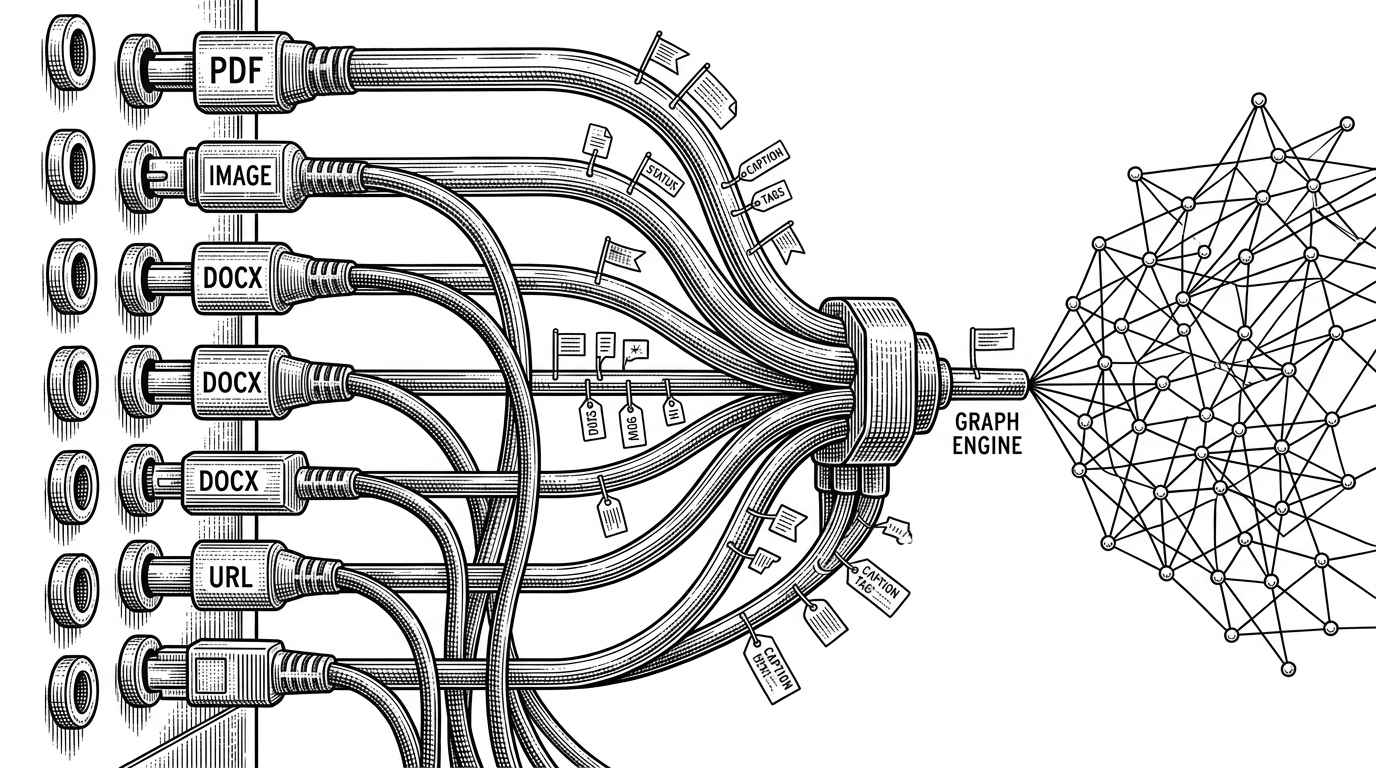
`parser.py` is the front door. It handles file downloads, MIME inference, and conversion paths for hostile formats, including office documents and remote URLs. The registry pattern is the key design choice: new parsers can be registered without rewriting the core library.
That matters because the repo is not pretending every input should be treated the same. A PDF, a DOCX, and a web page may all end up in the same retrieval system, but they should not take the same route to get there.
Multimodal context is not just OCR with better branding
The multimodal processors are where the system stops feeling like a file converter and starts feeling like a document interpreter. Images and tables are not handled as isolated blobs. They are enriched with surrounding text, captions, and layout context before they are indexed.
That extra context is the difference between “we extracted the pixels” and “we preserved the document’s meaning.” It is also why the framework can support retrieval over tables, equations, and figures without flattening everything into generic text too early.
The pipeline is built to fail gracefully
RAG-Anything does not assume every file behaves. The resilience layer, plus `DocStatus` and cache key design, turns batch ingestion into a controlled process. Files can be pending, processing, or processed, and a failure in one branch does not have to collapse the whole run.
That is the difference between a demo and an operational system. The codebase is telling you that document pipelines live in the real world, where downloads break, parsers disagree, and offline environments are normal rather than exceptional.
Why this sits between research prototype and production framework
The repo has the markers of a project trying to grow up without losing its research ambition. It ships with type checking, linting, tests, and offline-friendly setup paths. It also includes example integrations with local model stacks, which suggests a design tuned for constrained environments, not only cloud demos.
That balance is the point. RAG-Anything reads like a lab system that has absorbed the lessons of deployment, especially around caches, parsers, and failure isolation.
How it compares with the rest of the RAG stack
| Project | Primary focus | Multimodal handling | Where the intelligence lives | Best fit |
|---|---|---|---|---|
| RAG-Anything | Any-modality ingestion plus graph-backed retrieval | Built in and opinionated | Parser registry, modality processors, resilience, and normalization | Messy document collections that need structured retrieval |
| LlamaIndex / LangChain | General-purpose RAG ecosystems | Usually via extensions and integrations | Breadth of connectors and abstractions | Teams that want a wide platform and many third-party options |
| Unstructured | Document ingestion and preprocessing | Strong document parsing, less about downstream retrieval | Extraction and cleanup pipeline | Organizations that need ingestion tooling for many file types |
| ColBERT | Efficient retrieval | Not a full multimodal framework | Retrieval model and indexing strategy | Retrieval specialists optimizing recall and latency |
The comparison is simple. RAG-Anything is not trying to be the biggest ecosystem. It is trying to be the most opinionated about turning messy multimodal inputs into a unified retrieval substrate.
Why the HKUDS context matters
This project makes more sense when you read it as a lab-built system rather than a startup SDK. The HKUDS context explains the emphasis on paper-linked architecture, offline resilience, and a graph-oriented retrieval story instead of a generic platform pitch.
That is why the repo feels category-defining. It is not just adding another RAG wrapper. It is arguing that the front end of RAG is where multimodal systems either become reliable or fall apart.