ClinicFlow: The Open-Source Clinic Manager That Treats Time Like a Hard Constraint
FastAPI, React, and MongoDB are the surface. The real story is how ClinicFlow keeps identity, scheduling, and patient reminders from drifting out of sync.

- ClinicFlow’s real innovation is constraint enforcement, because it rejects impossible bookings before they become database state.
- The repo links identity, scheduling, and notifications into one workflow, so each layer protects the next instead of acting as a separate feature.
- Its dual-auth setup reads like a migration pattern, not just a security layer, which makes the project easier to evolve from prototype to production.
- The main trade-off is operational maturity, since in-memory scheduling works well here but will eventually need a distributed job system.
When a Clinic Booking Becomes a Constraint Problem
Most clinic software looks simple until two people try to use the same slot. ClinicFlow starts with the harder truth: appointment software is only useful if it can refuse bad bookings before they land in the database. That is why the scheduler matters more here than the dashboard.
The backend treats time as a finite resource. It checks requested slots against existing booked appointments, uses timedelta arithmetic to measure overlap, and only then allows persistence. The shape of the system is less “save form” and more “gatekeep reality.”
The Scheduler Decides What Can Exist
The key function is not booking. It is validation. In practical terms, check_slot_available acts like a policy engine: if an existing appointment already occupies the requested window, the new one never becomes real. That is the right place to enforce the rule, because cleanup after insertion is already too late.
| Problem | Typical simple app | ClinicFlow approach | Why it matters |
|---|---|---|---|
| Two patients claim the same time slot | Insert the record, then fix conflicts later | Reject overlaps before database write | Prevents invalid state from ever existing |
| Appointment duration changes the collision window | Hard-code a form field and hope for the best | Use time arithmetic to compute boundaries | Keeps availability logic consistent |
| Booked and available states drift apart | Let the UI decide what looks open | Make the API gate the booking | Backend stays authoritative under load |
That difference sounds small until the system gets used for real. A clinic does not need more rows in MongoDB. It needs fewer impossible rows.
Auth Without a Rewrite
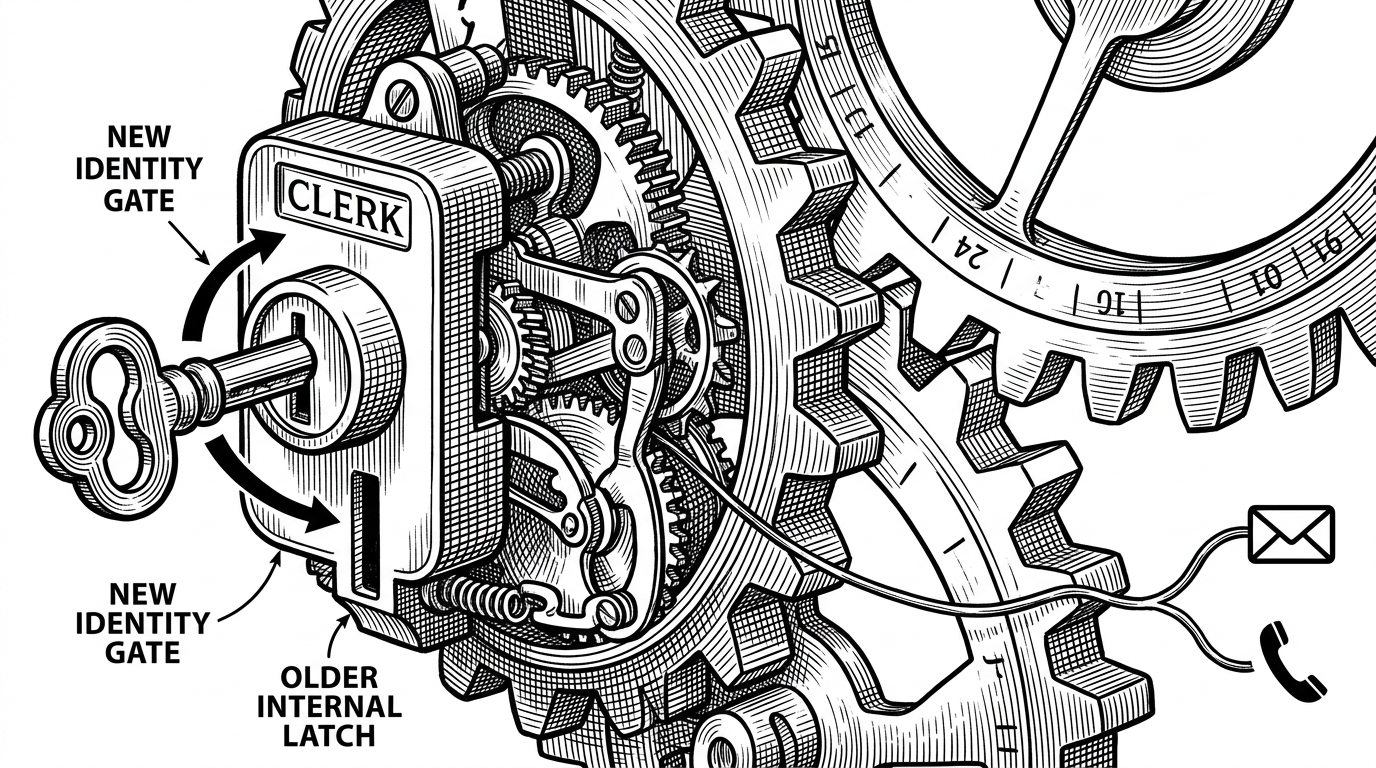
ClinicFlow’s authentication story is quietly practical. It supports Clerk JWTs for modern identity, then falls back to an internal JWT path when needed. That is not just a security detail. It is a migration pattern for a repo moving from an early prototype toward a cleaner production boundary.
| Problem | Typical simple app | ClinicFlow approach | Why it matters |
|---|---|---|---|
| Identity needs to evolve without breaking users | Replace the old auth system in one shot | Try Clerk first, then fall back to internal JWT | Lets the project transition safely |
| Roles must survive across layers | Store a token and infer the rest in the UI | Sync local metadata with clinic-specific roles | Backend and frontend share the same model |
| Access control has to be explicit | Depend on route names and client state | Use dependency checks and role-aware routes | Reduces accidental privilege drift |
The interesting part is the shape of the transition. ClinicFlow does not force the codebase to choose between an internal login and an external identity provider. It uses both until the new path can stand on its own.
WhatsApp Is Not a Bolt-On Here
Reminders are part of the product loop, not a marketing extra. An APScheduler job checks for pending appointments in a 60-minute window, then sends notifications by email and WhatsApp. The point is not just to alert people. It is to close the gap between a booked slot and an actual patient showing up.
That design is smart because it recognizes where clinic software lives in the real world. Email is useful. WhatsApp is often more immediate. ClinicFlow treats both as first-class output channels instead of pretending one channel fits every patient.
def send_pending_reminders():
    appointments = find_appointments(
        reminder_sent=False,
        start_within_minutes=60,
        status="booked",
    )

    for appointment in appointments:
        send_email(appointment)
        send_whatsapp(appointment)
        mark_reminder_sent(appointment)
Frontend Guards That Match Backend Roles
The frontend is not decorative here. Protected routes check the user’s role, and a mismatch triggers a dedicated banner instead of a silent failure. That sounds minor, but it keeps the interface aligned with the backend’s permission model instead of inventing a second one.
For a clinic, that matters. Receptionists and doctors can share a system without sharing the same surface area. ClinicFlow uses that split cleanly, so each user sees the work they are actually allowed to do.
| Problem | Typical simple app | ClinicFlow approach | Why it matters |
|---|---|---|---|
| A user opens the wrong dashboard | Render the page and fail later | Detect the role mismatch immediately | Fewer confusing dead ends |
| Role state has to persist across navigation | Let the UI infer access from one session check | Use route guards plus a mismatch banner | Makes permission errors legible |
| Frontend and backend permission rules drift | Duplicate logic in disconnected places | Keep the same role model on both sides | Cuts down on security and UX mismatch |
What ClinicFlow Gets Right, and What It Will Have to Outgrow
The repo is strongest when it behaves like an operations engine. FastAPI dependency injection keeps authorization and role checks composable. MongoDB gives the model room to grow. The reminder loop shows real product thinking, not just CRUD hygiene.
The main limitation is also obvious. In-memory scheduling is fine for a small deployment, but it will eventually need a distributed job system if usage grows. That is not a flaw so much as the next boundary the project will have to cross.
That is what makes ClinicFlow worth attention. It does not merely store clinic data. It encodes the rules that keep clinic data sane.