The Sisyphus Strategy: Inside the High-Stakes Orchestration of oh-my-openagent
How a recursive "Planner-Executor" architecture and a fleet of parallel sub-agents are turning the terminal into an autonomous engineering department.
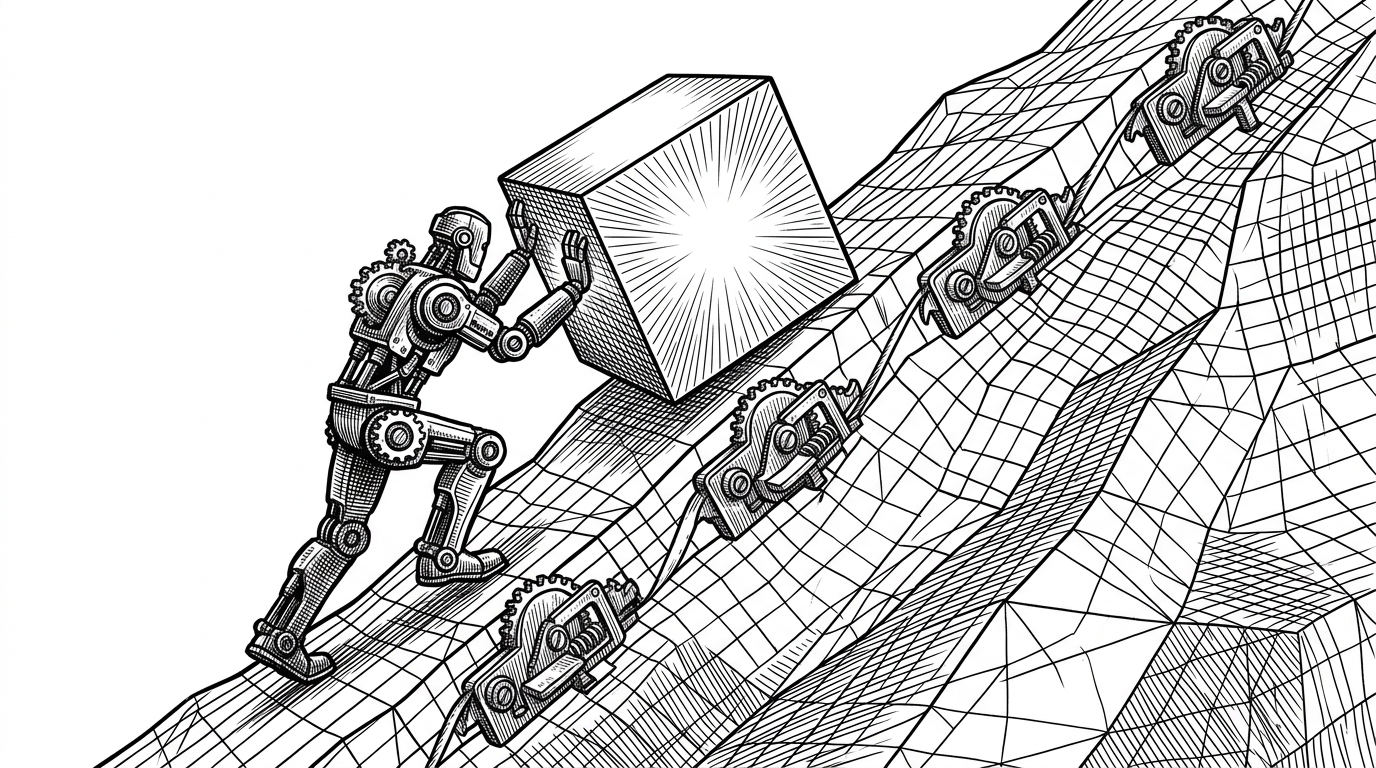

In greek mythology, Sisyphus was condemned to roll a boulder up a hill for eternity as punishment for deceiving the gods. LLM Agents haven’t really done anything wrong, yet they too roll their ‘stones’—their thoughts—every single day. My life is no different. Looking back, we are not so different from these agents.
- The Boulder system uses a persistence layer to prevent context drift and resume tasks from the exact point of failure.
- A strict architecture separates the read-only Prometheus planner from the Atlas executor to ensure human-verifiable coding contracts.
- Hephaestus sub-agents execute implementation and testing tasks in parallel to achieve significantly faster completion speeds than sequential agents.
- The framework employs model-agnostic prompting to optimize its behavior for both Claude and GPT-based architectures.
Rolling the Boulder: Solving the State Exhaustion Problem
The fundamental flaw in most AI coding assistants is amnesia. When a task requires modifying dozens of files, standard agents eventually lose the plot, hallucinate context, or crash entirely. In oh-my-openagent, this is known as the "context drift" problem.
To solve this, the project relies on the "Boulder" system, tracked via a boulder.json persistence layer. It acts as an iron ratchet for the agent's progress. If a massive refactor is interrupted by a power loss or an API timeout, the agent doesn't restart from scratch. It "resumes rolling the boulder" from the exact point of failure.
The Prometheus-Atlas Split: Architecture as a Contract
The architecture forces a strict separation of concerns between Planning and Execution. This is the Strategic Planner / Master Executor split.
Prometheus (The Planner) is an architect agent that interviews the user and maps the codebase. Crucially, Prometheus is read-only. It cannot write code. It only outputs a markdown plan into a .sisyphus/ directory. This markdown file acts as a verifiable contract.
Once the plan is approved, Atlas (The Executor) takes over. Atlas reads the contract and delegates the actual coding tasks to specialized sub-agents. This mimics a professional PR review workflow entirely within the agentic loop.
Hephaestus and the Parallel Strike
Standard CLI agents process tasks sequentially. oh-my-openagent utilizes a specialized sub-agent named Hephaestus to execute tasks in parallel. When Atlas receives a complex goal, Hephaestus fires 2-5 parallel workers to attack it simultaneously.
This approach trades higher token costs for extreme speed, allowing the agent to handle implementation, testing, and documentation concurrently.
If Claude Code does in 7 days what a human does in 3 months, Sisyphus does it in 1 hour. It just works until the task is done. It is a disciplined agent.
Escaping the Walled Garden
The project explicitly positions itself as a "jailbreak" from proprietary walled gardens. Instead of locking developers into a single ecosystem, the harness is model-agnostic. It employs a dynamic prompting strategy via an isGptModel() check, swapping its entire approach based on the active model's "personality" (e.g., procedural instructions for Claude vs. principle-driven prompts for GPT).
| Feature | oh-my-openagent | Claude Code | Aider |
|---|---|---|---|
| Model Agnosticism | High (Multi-provider) | Low (Anthropic only) | High |
| State Persistence | The Boulder (Cross-session) | Session-only | Git-based |
| Execution | Parallel (Multi-agent) | Sequential | Sequential |
The Ghost in the Repo: Meet Jobdori
Perhaps the most meta aspect of oh-my-openagent is its origin. The repository is largely maintained by an AI assistant named Jobdori, a customized fork of OpenClaw. The maintainer leverages this recursive development loop to build the harness that builds the harness.
Unlike blind search-and-replace or naive rename operations, `/refactor` operates like a human engineer would:
By combining precise tool integrations like AST-Grep with relentless, parallel execution, the Sisyphus strategy offers a glimpse into a future where the terminal is less of a prompt interface and more of a fully autonomous engineering department.