`ljg-skill-rank`: The Claude Code skill that reduces a domain to its bones
Instead of summarizing a topic, it hunts for the irreducible generators, tests them against counterfactuals, and exposes the structure hiding under the noise.
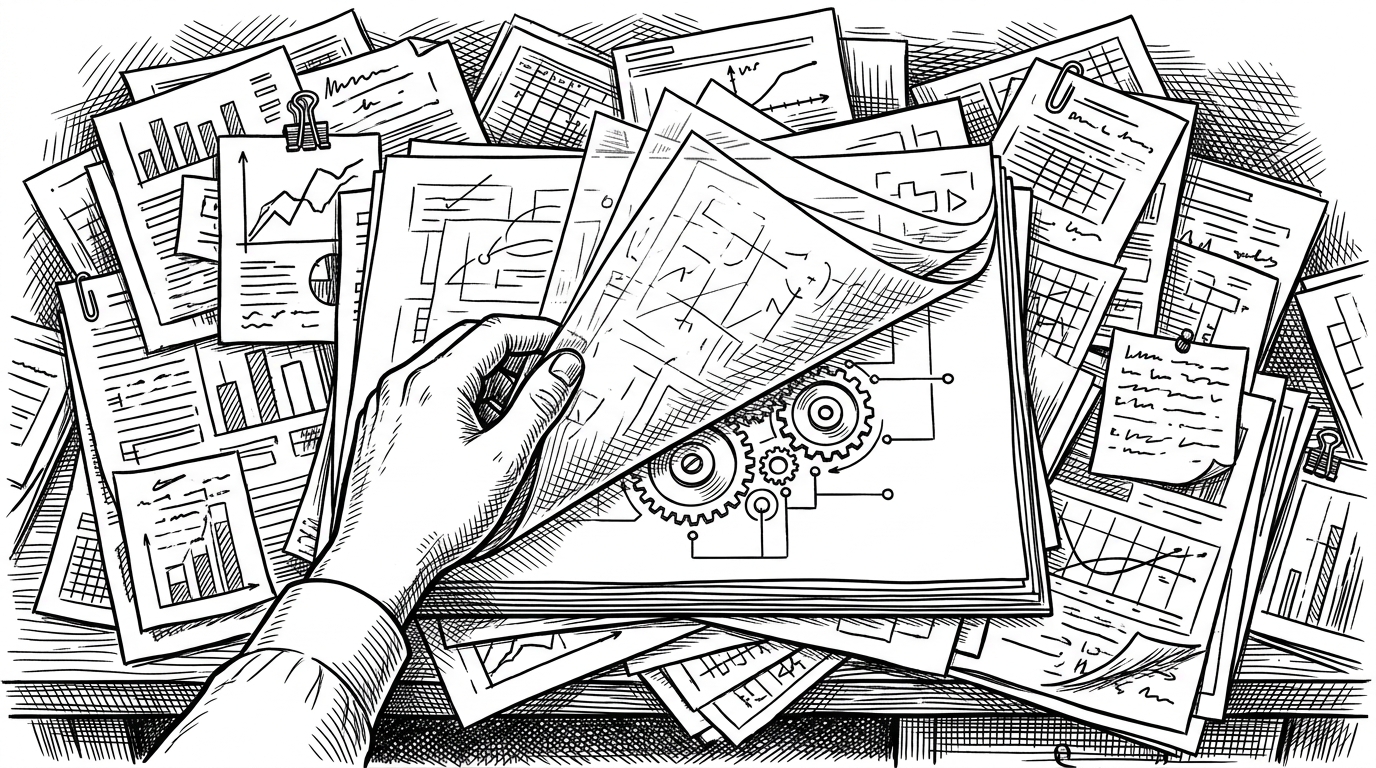
- ljg-skill-rank treats understanding as compression, then refuses to accept the result until it survives counterfactual tests.
- The template is not formatting sugar. It is the mechanism that forces the model to expose dimensions, constraints, and proof.
- The repo is most interesting as a test harness for concepts, not as a prompt pack.
- Its real difference from ordinary summarizers is that it tries to preserve the generators of a domain, not the verbal surface of that domain.
Understanding, but compressed
Most AI tools compress language. This skill tries to compress structure. It starts from a domain, pulls out the phenomena that keep repeating, then asks a harsher question: which pieces are truly doing the work, and which ones are just decoration?
That is the philosophical bet behind ljg-skill-rank. It treats understanding as a search for irreducible independent generators, then uses verification to see whether the candidate set actually earns that name. The output is not a nicer summary. It is a smaller model of reality.
值钱的不是 7 个 skill 本身,而是它把“理解内容 → 重写表达 → 视觉转译”做成了一套可拼装的工作流。
How the rank engine thinks
The workflow is simple on paper and sharp in practice. It does not begin with an answer. It begins with a field, then forces the model through a sequence of reductions until the field is readable as a topology instead of a paragraph.
- Collect phenomena from the domain.
- Extract candidate dimensions from those phenomena.
- Detect constraints that link or limit the dimensions.
- Identify the rank, or the smallest set that still explains the field.
- Verify the result with back-testing, counterfactuals, and orthogonality checks.
The practical trick is that each stage narrows the search space. The skill does not ask the model to be inspiring. It asks the model to be separable. If a supposed generator can be removed without changing the structure, it was never a generator at all.

Why the template is part of the algorithm
The repository does not just ask the model to think differently. It asks it to format differently. The Org-mode template, the proof drawer, and the ASCII topology map are not cosmetic choices. They are guardrails that make the reasoning visible and harder to fake.
That matters because a good reduction can still be a bad argument. The template forces the output to separate claim from evidence, and evidence from topology. If the model cannot lay the structure out cleanly, the rank is probably not stable enough to trust.

The skill is really a test harness
The most interesting part of the repo is the refusal to stop at a plausible model. It back-tests. It checks blind spots. It asks counterfactual questions. It runs orthogonality checks to see whether the generators are actually independent or just different names for the same thing.
That is why the project feels more like a debugger for concepts than a note-taking tool. A conceptual model is only useful if it fails in informative ways. This skill is built to expose those failures before the prose hardens into confidence.

Built inside the ljg-skills ecosystem
This repo makes more sense when you see it as part of a larger system of Claude Code skills from Li Jigang. The broader project is interested in workflows, not isolated prompts. That is the real pattern here: understanding, rewriting, visualization, and reduction as reusable methods.

我的 Claude Code 自定义技能集。
What it replaces, and what it doesn't
The easiest mistake is to file this under summarization. That misses the point. A summarizer condenses surface meaning. A rank reducer tries to isolate the smallest set of concepts that still generates the field.
| Tool type | Primary goal | What it outputs | What it misses | Why ljg-skill-rank is different |
|---|---|---|---|---|
| Generic summarizer | Compress text | A shorter recap | Structure, constraints, and independence | It tries to preserve the generators, not the prose |
| Prompt library | Provide reusable instructions | Copyable templates | Verification and method | It packages a reasoning loop, not just instructions |
| Tool or MCP server | Expose capabilities and data | Access to external systems | Conceptual reduction | It is about thinking better, not reaching more tools |
| ljg-skill-rank | Reduce a domain to its irreducible core | Rank, topology, and proof | It can still depend on model discipline | It turns understanding into a falsifiable workflow |
That distinction is the whole story. This repo does not promise total knowledge. It promises a method for finding what still matters after the extra layers have been removed.
Why this matters
The deeper shift is not about Claude Code at all. It is about people starting to encode methods of thought as software artifacts. That is a powerful move because it makes intellectual discipline repeatable, inspectable, and harder to bluff.
Seen that way, ljg-skill-rank is small but sharp. It turns a philosophical claim into an executable habit: if the model cannot explain a domain by its surviving generators, the explanation is not finished yet.