Orca: The Agent Fleet That Runs While Your Laptop Sleeps
An open-source desktop environment that splits a task across isolated git worktrees, then lets you steer every agent from your phone. The relay never learns your machine's address.
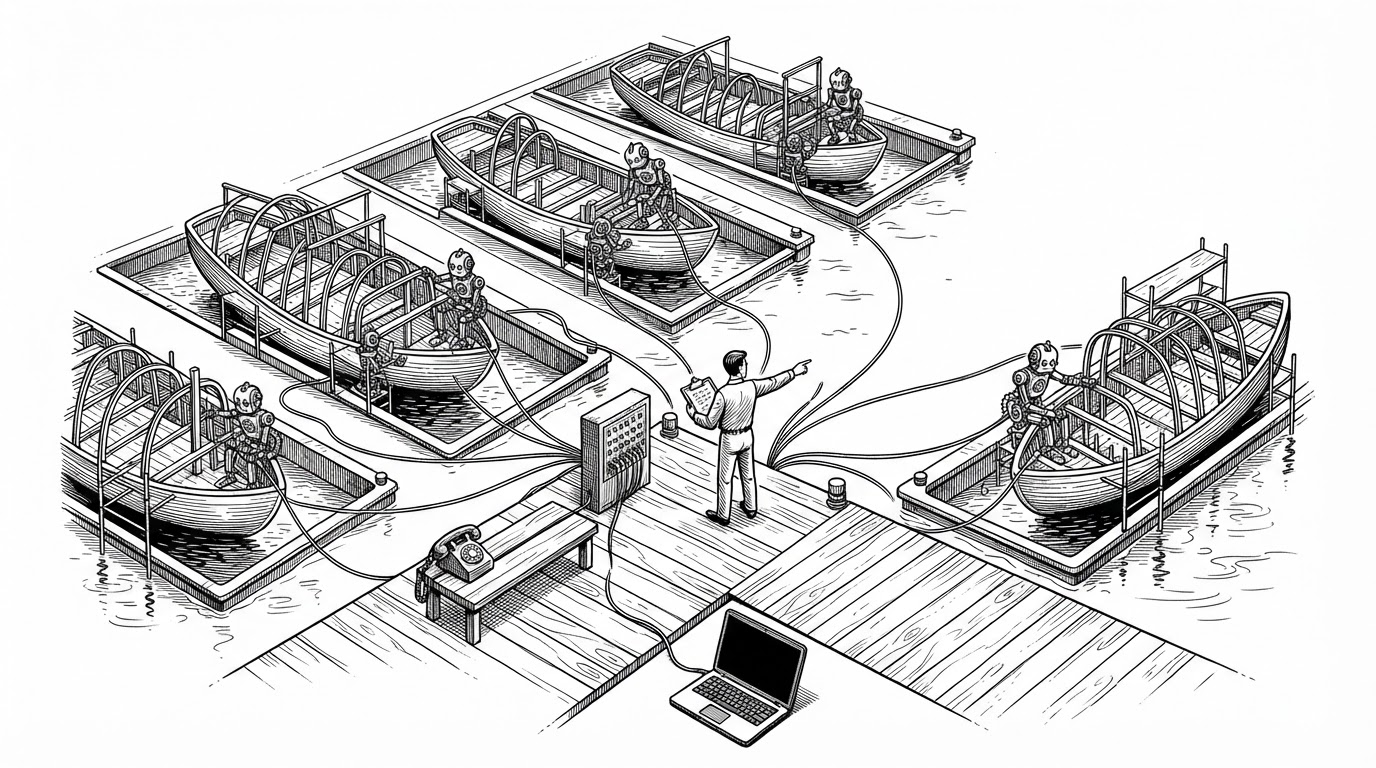
- Orca coordinates a fleet of CLI coding agents, each in its own git worktree, from a desktop app or a phone.
- Every connection is outbound, so the laptop never opens an inbound port and its agents keep working while it sleeps.
- The relay keeps the control plane and the data plane in separate objects, so a flooding phone can only reset its own slot.
- The repository is governed by an AGENTS.md rulebook written for its AI contributors, not just its humans.
A laptop goes to sleep. The agents it was running keep working. From a phone, a developer answers the one question a worker asked, and the work continues. No port on that laptop was ever opened, no firewall rule was added, and the relay that carried the message never learned the machine's address.
That is the surprise hiding inside stablyai/orca. Orca bills itself as a desktop environment for running multiple coding agents side by side, and on the surface it looks like every other orchestrator in a crowded category: a coordinator splits a task, workers spin up, diffs come back. The thing that makes it different is not what it manages. It is how it connects. The distance between "control your agents remotely" and "zero inbound ports" is where all the interesting engineering lives.
A Fleet, Not a Chatbot
Orca is a desktop app that runs the coding agents you already pay for. Claude Code, Codex, Cursor CLI, and a longer list of others sit side by side in one window, each with its own terminal, browser tab, and git worktree. A coordinator agent takes a task, breaks it into pieces, and starts workers in separate worktrees so two agents never edit the same files at once.
The bots are the other half. Point Orca at Slack, Linear, or GitHub, and a request can arrive as a message, get worked by an agent, and come back as a tested pull request. The same conversation can move between a chat UI and the raw CLI, so you are never locked into one surface.
- 3 desktop platforms: macOS, Windows, Linux
- 2 mobile operating systems: iOS and Android
- 1 relay that pairs the two sides
- 0 inbound ports on your machine
The founder is Jinjing Liang, and the pitch is deliberately anti-lock-in: Orca is a layer over the tools you already use, not a replacement harness. When any supported agent improves, Orca improves with it.
Orca can benefit when any supported tool improves. It does not require users to abandon Claude Code for a new harness
Zero Inbound Ports
Here is the invariant, stated flatly in the project's own cloud documentation: "Phones and desktops never talk to each other directly: each opens an outbound WebSocket to a relay cell, the relay pairs the two sessions, and it splices frames between them."
Read that again, because it is doing a lot of quiet work. A laptop behind NAT, on hotel wifi, with no port forwarding, needs no inbound access at all. Both endpoints dial out. A director service assigns each host to a relay cell, and the cell pairs the sessions and passes frames between them. NAT traversal comes free. No exposed surface, no firewall rules to explain to IT. And because nothing depends on the laptop staying awake to accept a connection, its agents survive sleep.
The relay itself is three kinds of Cloudflare Durable Object behind a stateless router. A HostRelay owns the desktop's control socket. A SpliceRelay is a pool with one slot per phone connection. A UserHosts object indexes them. Routing is by name, so a given host always reaches the same object with no lookup table.
The design note next to the code is the whole idea: phone connections live in a pool so that "a flooding phone cannot reset this one and a connect never creates a new object." The control plane and the data plane are physically separate objects. A noisy phone can thrash its own slot all day and never touch the desktop's control socket.
The Details Are the Design
The relay is not just clever in outline. The small decisions around it are the evidence that it was built by people who have been paged at 3am.
Take the close codes. When a host's assignment check against the database times out, the connection closes with code 4429, a transient class, and deliberately not 4401, the authentication class. The comment next to the code spells out why: a slow database must never look like a bad credential. Get that wrong and every desktop in the fleet decides its user was signed out during a two second database blip.
| Code | Class | Client behavior |
|---|---|---|
| 4401 | Permanent | Treat as signed out; prompt re-auth |
| 4429 | Transient | Retry; do not surface as an auth failure |
| WRONG_CELL | Routing | Re-resolve the director, then reconnect |
| DRAINING | Ops | Reconnect once the drain completes |
// A timed-out assignment check is transient, never permanent.
if (Date.now() > attachment.deadline) {
  // 4429 tells the client to retry; 4401 would look like a bad credential.
  return close(WS_TRANSIENT, 'assignment-check-timeout')
}
The admin plane gets the same care. Every director operation is signed, and each host call claims its token's jti in durable storage before doing anything, so a copy of the token is refused with a 409 even while the first call is still in flight. There is one cost-aware exception: an idle drain of a host nobody pushed changes nothing, so it skips the write and never wakes the object's storage.
And the keepalive is pushed onto the runtime's auto-response path, so the socket stays alive without waking the Durable Object just to prove it is still there. Staying alive should not cost money for the privilege of being alive.
The Repo That Runs on Its Own Agents
Then there is the recursion. Orca ships an AGENTS.md, a rulebook written for the project's AI contributors as much as for its humans. The product manages agents. The project is itself managed by agents, under written rules.
The rules are specific and a little opinionated. A check run is cached, so agents are told not to rerun it "to be sure." Tests are the exception: prove a change by running it, not by committing a test, and any test that does exist must fail if the fix is reverted. UI-behavior tests and mock-call assertions are banned. Electron validation must launch in the background and never steal monitor focus. Vague names like helpers and utils are forbidden, and the ban is enforced in CI.
// Banned: asserting that a mock was called.
expect(fetchHost).toHaveBeenCalledWith(url)

// Required: a test that fails if the fix is reverted.
expect(resolveWorktree(input)).toBe(expected)
It is a style guide aimed at a workforce that will happily generate tests as noise. The documentation makes the philosophy plain.
Orca runs agents you already use — bring your own Claude, Codex, or OpenCode subscription.
How Orca Compares
The category is crowded, so the honest format is a table. Read the last column, because that is the one Orca owns.
| Project | Approach | Harnesses | Open source | Platforms | Remote / phone |
|---|---|---|---|---|---|
| Orca | Desktop ADE, multi-harness | Claude Code, Codex, Cursor CLI, and others | MIT | macOS, Windows, Linux | SSH, cloud VMs, phone via relay (zero inbound ports) |
| Conductor | Mac workspace | Claude Code, Codex, Cursor, OpenCode | No | macOS | Cloud workspaces (paid tiers) |
| Offrun | Mac session manager | Multiple | No | macOS (Apple Silicon) | Local |
| Herdr | Terminal multiplexer | Many | Apache-2.0 | macOS, Linux, Windows (beta) | SSH (optional) |
| Claude Squad | TUI wrapper | Claude Code | AGPL-3.0 | Cross-platform CLI | Local |
| git worktrees + tmux | DIY baseline | Any | N/A | Any | Manual |
Orca is not the only open tool, and it is not the only one that isolates tasks in worktrees. What no other row matches is the last column: a phone-controlled remote path that opens no port on your machine. Plenty of tools let you reach a remote host over SSH. Orca is the one where the laptop can be closed, asleep, and off the network, and you can still answer your agents from the train.