PopcornIQ: The Movie Recommender That Lets MongoDB Do the Thinking
A full-stack Netflix-style app built on aggregation pipelines, TMDB enrichment, and a surprisingly polished React interface.
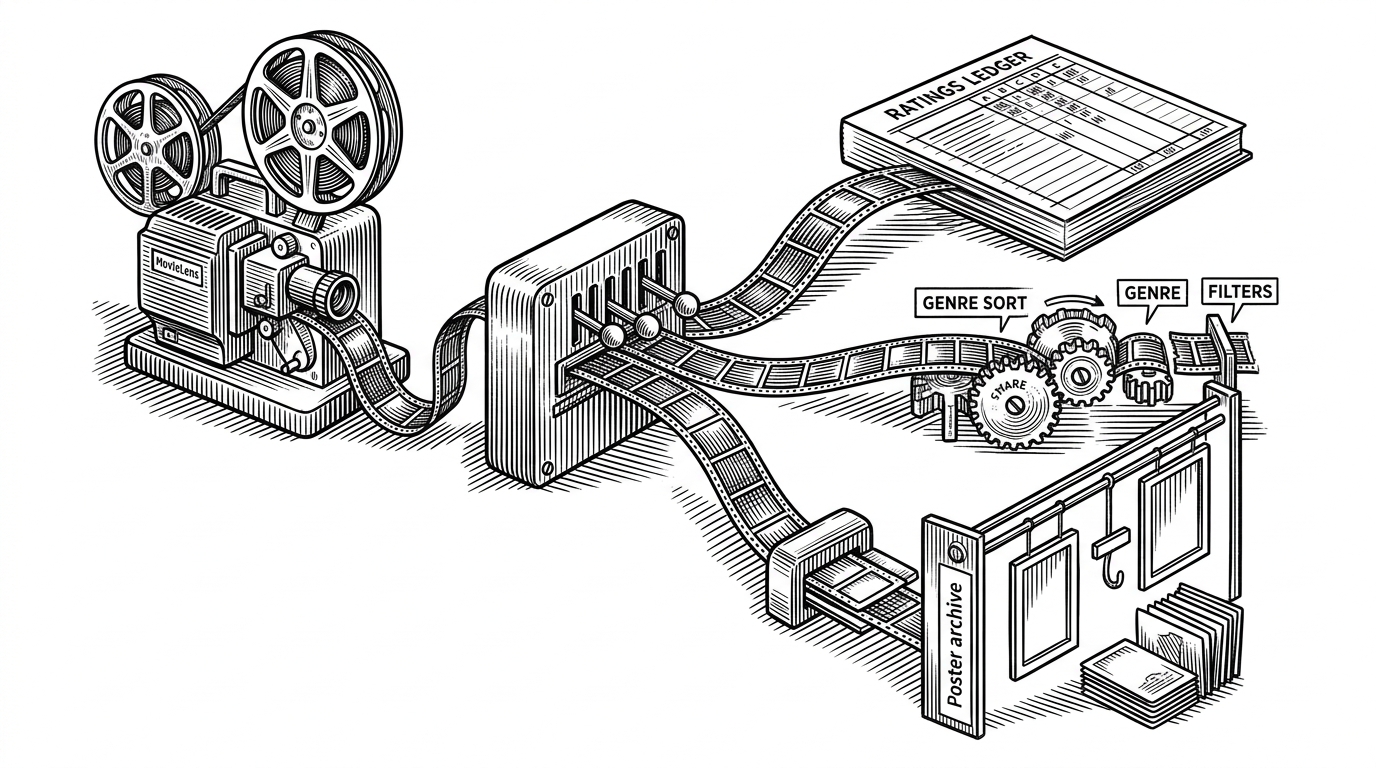
- PopcornIQ gets its intelligence from data shaping and aggregation logic, not from a heavyweight model stack.
- The TMDB enrichment layer is what turns a static dataset into something that feels like a living catalog.
- Its frontend polish matters because recommendation quality is partly a product-design problem, not just an algorithm problem.
- The repo stands out because it treats security and resilience as part of the demo, not an afterthought.
Most movie recommenders try to impress you with the model. PopcornIQ does something cleaner. It makes a familiar dataset feel like a streaming product by pushing the smart work into MongoDB-backed application logic, then wraps it in a frontend that looks and behaves like something people would actually use.
Why this recommender is worth paying attention to
The interesting part is not that PopcornIQ recommends movies. It is that it gets there without a sprawling ML platform. The repo uses MovieLens as a base, then layers in enough product logic and metadata enrichment to make the experience feel current, legible, and shippable.
That matters because a lot of teams do not need a recommendation research project. They need a system they can explain, tune, and extend. PopcornIQ reads like a blueprint for that middle ground.
The brain lives in MongoDB
The core move is in recommendationController.js. Instead of delegating everything to an opaque service, the app uses aggregation pipelines to turn ratings into ranked candidates. Top-rated lists use a minimum vote threshold so noisy outliers do not dominate. Personalized recommendations pull from the user’s strongest genres, then exclude titles the user has already rated.
const topGenres = await Rating.aggregate([
  { $match: { userId } },
  { $match: { rating: { $gte: 4 } } },
  {
    $lookup: {
      from: 'movies',
      localField: 'movieId',
      foreignField: 'movieId',
      as: 'movie'
    }
  },
  { $unwind: '$movie' },
  { $unwind: '$movie.genres' },
  {
    $group: {
      _id: '$movie.genres',
      count: { $sum: 1 }
    }
  },
  { $sort: { count: -1 } },
  { $limit: 5 }
]);
That query shape tells you almost everything about the product philosophy. Ratings are not just stored. They are transformed into preference signals. Then those signals are used to build a candidate set that is small enough to be useful and broad enough to feel personal.
How MovieLens becomes a streaming catalog
Raw MovieLens data is useful, but it is visually thin. The TMDB enrichment script closes that gap by attaching poster paths, cast, and overviews. That is the difference between a spreadsheet and a browsing experience.

This is where product thinking shows up in the data layer. Enrichment does not just make things prettier. It changes what the interface can say about a title, which changes whether the app feels exploratory or mechanical.
Why the app feels more finished than a typical portfolio project
The frontend work is not decorative. Lenis smooth scrolling, Framer Motion transitions, overlay management, and body-scroll locking all help the app feel coordinated. The experience moves like a product with intent, not a demo stitched together from separate screens.
useEffect(() => {
  const lenis = new Lenis({
    lerp: 0.08,
    smoothWheel: true
  });

  function raf(time) {
    lenis.raf(time);
    requestAnimationFrame(raf);
  }

  requestAnimationFrame(raf);
  return () => lenis.destroy();
}, []);
That kind of attention matters because recommendation apps live or die on trust. If navigation feels clumsy, the suggestions feel less credible. If motion and overlays are controlled, the catalog reads as intentional and easier to explore.
The app is careful where most demos are careless
The security layer is a strong signal. The server sanitizes query input to reduce NoSQL injection risk, rate limits sensitive routes, and shuts down cleanly when the process receives termination signals. That is the difference between a clever prototype and a repo that understands operational basics.
| Approach | Data source | Recommendation method | Operational complexity | Best fit |
|---|---|---|---|---|
| Typical movie app | Static catalog or simple API | Search, sort, or hard-coded picks | Low | Basic browsing |
| Heavy ML-first recommender | Large behavioral datasets and model training | Collaborative filtering or deep ranking models | High | Large-scale personalization |
| PopcornIQ | MovieLens plus TMDB enrichment | Aggregation pipelines and rule-based ranking | Moderate | Shippable, explainable personalization |
The comparison is the real story. PopcornIQ sits in the useful middle. It is more intelligent than CRUD, less operationally expensive than a full ML platform, and far more explainable than most black-box recommenders.
What PopcornIQ gets right, and what it leaves open
What it gets right is unusually strong: the data pipeline is legible, the UI feels polished, and the server code shows real defensive habits. The repo understands that recommendation quality is not only about ranking. It is also about what data exists, how it is shaped, and how confidently the app can present it.
What remains open is the harder personalization story. The current system is still mostly a smart, explainable heuristic engine. There is room for deeper collaborative filtering, larger-scale behavioral signals, and actual evidence that the recommendations improve with real user activity.
| Strength | Why it matters | Open question |
|---|---|---|
| Readable recommendation logic | Easy to reason about and extend | How far can rules and aggregation go before model-based ranking is necessary? |
| Rich data enrichment | Makes static records feel alive | Does the catalog stay fresh as data grows? |
| Frontend polish | Builds trust in the experience | Can the interaction model support deeper discovery flows? |
| Security and resilience | Raises the project above demo quality | How does it behave under real traffic and messy inputs? |
That is a good place to stop. PopcornIQ is not trying to out-Netflix Netflix. It is showing how far a careful team can get when the database, the metadata layer, and the interface are all pulling in the same direction.