awesome-architecture: The Repo That Treats Architecture as a Decision System
A bilingual knowledge base that replaces library shopping with tradeoff thinking, ASCII diagrams, and AI-ready system design templates.

- This repo reframes architecture as a repeatable decision process, not a search problem.
- Its template design pushes readers away from library-first thinking and toward quality attributes, constraints, and tradeoffs.
- The AI-era sections matter because they treat AI systems as first-class architectural concerns, not bolt-ons.
- The tutorial and decision cards turn the project into a curriculum for judgment, not a static bookmark list.
study8677/awesome-architecture looks like an ordinary awesome list until you notice what it keeps refusing to do. It does not reward library shopping. It rewards architecture thinking: problem framing, constraints, quality attributes, candidate patterns, and explicit tradeoffs.
A curated list of awesome software architecture resources.
Architecture is the product
That framing matters because the repo is not trying to be comprehensive in the usual GitHub sense. It is trying to be useful in the way a senior architect needs: by making judgment easier to practice. The result is a knowledge base that behaves more like a training system than a link dump.
The project’s most interesting claim is also its quietest one. As code generation gets cheaper, architecture judgment gets more valuable. This repo is built around that shift.
Why the repo feels built for the AI era
The architecture maps cover topics like AI gateways, RAG, vector databases, inference serving, and agent patterns. That makes the repo feel current without chasing novelty. It recognizes that modern system design now includes model orchestration, retrieval, latency, and control planes.
| Dimension | General awesome lists | study8677/awesome-architecture |
|---|---|---|
| Primary purpose | Collect resources | Train architectural judgment |
| Content style | Broad link index | Structured decision-making templates |
| AI coverage | Often incidental | Explicit and first-class |
| Teaching style | Browse and read | Frame, compare, decide |
| Outcome | Find a reference | Produce an architecture artifact |
This is the real differentiator. Other lists can tell you what to read. This one keeps asking what you are optimizing for, and what you are willing to give up.
The template that changes how people write architecture
The center of gravity is templates/_TEMPLATE.md. It does not just standardize documentation. It constrains thought. The template forbids library name-dropping, pushes authors toward language-agnostic descriptions, and requires ASCII-only diagrams that work anywhere a markdown file can render.
## Quality Attributes
- Latency
- Operability
- Scalability
- Cost

## Architectural Tradeoffs
- Why this pattern fits
- What it optimizes
- What it makes harder

## Diagram
```text
Client -> API Gateway -> Services -> Data Stores
```
The important thing is not the ASCII itself. It is the discipline behind it. A text-first diagram forces clarity, keeps the artifact portable, and makes the result easier to reuse in AI-assisted workflows.
Decision cards turn architecture into a forcing function
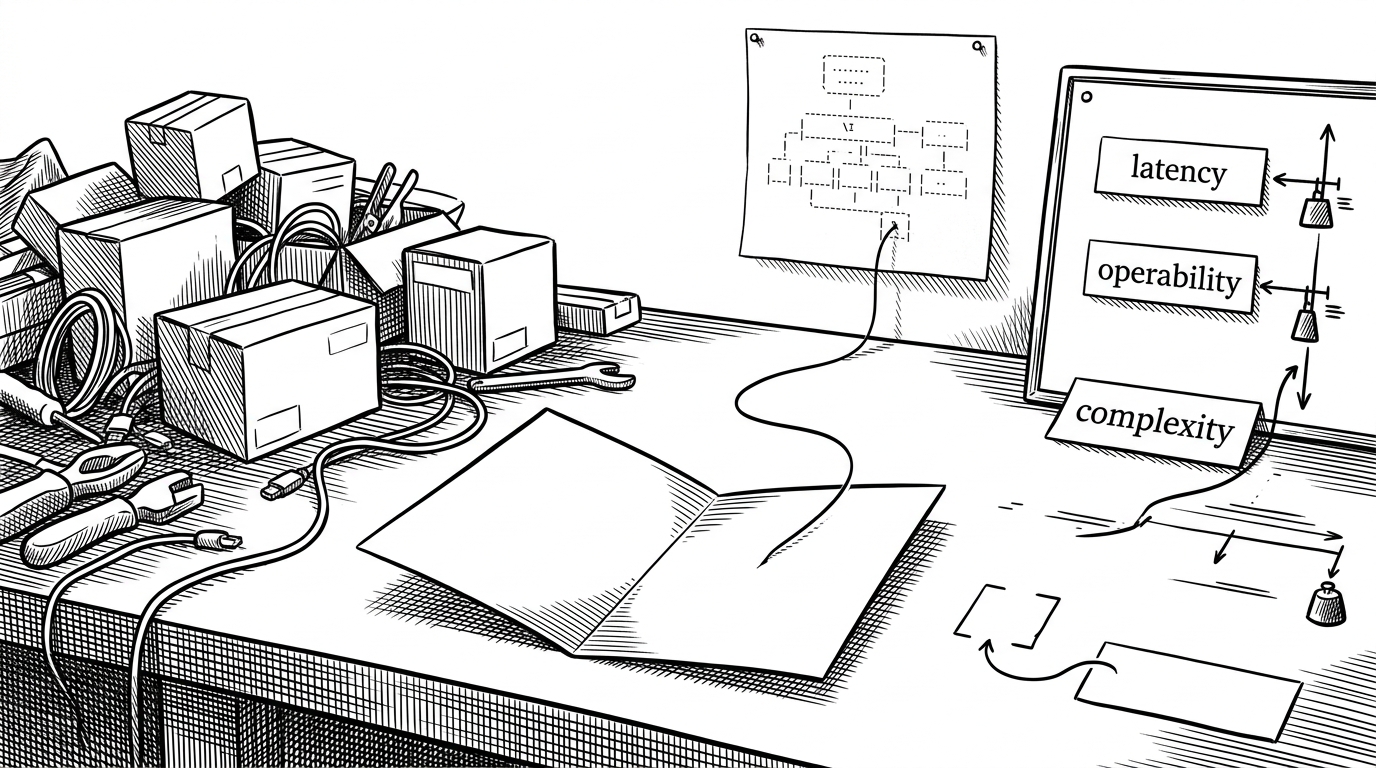
The DecisionCard.vue pattern is simple, but it is doing real pedagogical work. It delays the answer until the reader has already committed to a choice. That mirrors actual architecture work, where the problem is rarely picking the best tool in isolation.
| Question | Library-first habit | Decision-card habit |
|---|---|---|
| What do I reach for? | A named tool | A tradeoff frame |
| What do I optimize? | Features | Quality attributes |
| What do I document? | The answer | The reasoning |
| What do I reuse? | A stack | A decision pattern |
That shift is subtle, but it changes the muscle the reader is building. The repo is training people to justify architecture, not just memorize it.
The tutorial is a curriculum, not documentation
The bilingual tutorial path matters because it mirrors the arc of becoming an architect. It starts with C4 basics, moves through distributed systems, and ends in practical drills. That is not the shape of a folder tree. It is the shape of a learning journey.
That structure also gives the repo a second life. It is not just a catalog of ideas. It is a path through them, with a built-in sense of progression from abstraction to implementation constraints.
Where it stands among architecture lists
Compared with broader peers such as awesome-software-architecture, awesome-system-design, and awesome-microservices, this repo is narrower in scope and sharper in intent. It does not try to win on breadth. It wins by turning architecture into a practice, not a shelf.
| Repo | Best for | Teaching style | Distinctive edge |
|---|---|---|---|
| awesome-software-architecture | Broad surveying | Reference browsing | Scale and coverage |
| awesome-system-design | Practical design prep | Problem lists and patterns | Interview-adjacent system thinking |
| awesome-microservices | Microservices depth | Specialized reference | Focused domain depth |
| study8677/awesome-architecture | Architectural judgment | Decision-first curriculum | ASCII-first, AI-aware, language-agnostic templates |
That difference is what makes the project interesting. It is less like an encyclopedia and more like a set of drills for the role senior engineers increasingly need to play.
Bottom line
This repo is useful because it teaches a habit of thought. It treats architecture as a decision system, and that makes it more durable than a list of links. In an AI-heavy workflow, that is exactly the kind of repository worth keeping close.