Inside microsoft/vscode: The TypeScript Fortress That Keeps a Giant Editor Fast, Strict, and Self-Maintaining
VS Code is more than an Electron app. Its repo shows a disciplined platform built from layering rules, disposable lifecycles, Rust helpers, and AI-oriented maintenance flows.

- VS Code survives its own scale by turning architecture into enforceable rules, not tribal knowledge.
- The repo treats lifecycle cleanup as a first-class design constraint, which is how a huge Electron app stays responsive over time.
- Rust and other native helpers handle heavy work so TypeScript can stay focused on orchestration and UI.
- AI-oriented skills and classifiers are becoming part of the maintenance system, not just a feature layer for users.
The editor that behaves like a controlled platform
Most people know VS Code as a fast editor that happens to be built on Electron. The repo tells a sharper story. It is a giant, long-lived system that keeps itself coherent through rules, boundaries, and a surprising amount of self-discipline.
That matters because the real problem at this scale is not shipping one more feature. It is preventing small violations from turning into permanent architectural debt. VS Code is interesting because it has built machinery for that problem inside the repo itself.
Why the repo has to police itself
The custom rules under .eslint-plugin-local/ are the clearest sign that the project treats architecture as something that must be enforced, not merely documented. Rules such as code-layering.ts and code-no-standalone-editor.ts make the codebase behave like a series of controlled zones.
The important thing is not that these rules are picky. It is that they stop the wrong kind of coupling before it lands. In a codebase this large, prevention is cheaper than cleanup.
and from there on. basically. there was continuous retooling right because our mission was to run like a startup. and the first thing we built was the Monaco editor. because as a startup you want to have. customers. you want to have people that depend on you to be relevant. and that's why we invested heavily in the Monaco editor. to make this a great web editor
The disposable pattern is the real runtime story
VS Code’s runtime discipline shows up in the lifecycle model. The repo treats resources like event listeners, buffers, and other objects as things that must be cleaned up deliberately. That is why IDisposable matters so much.
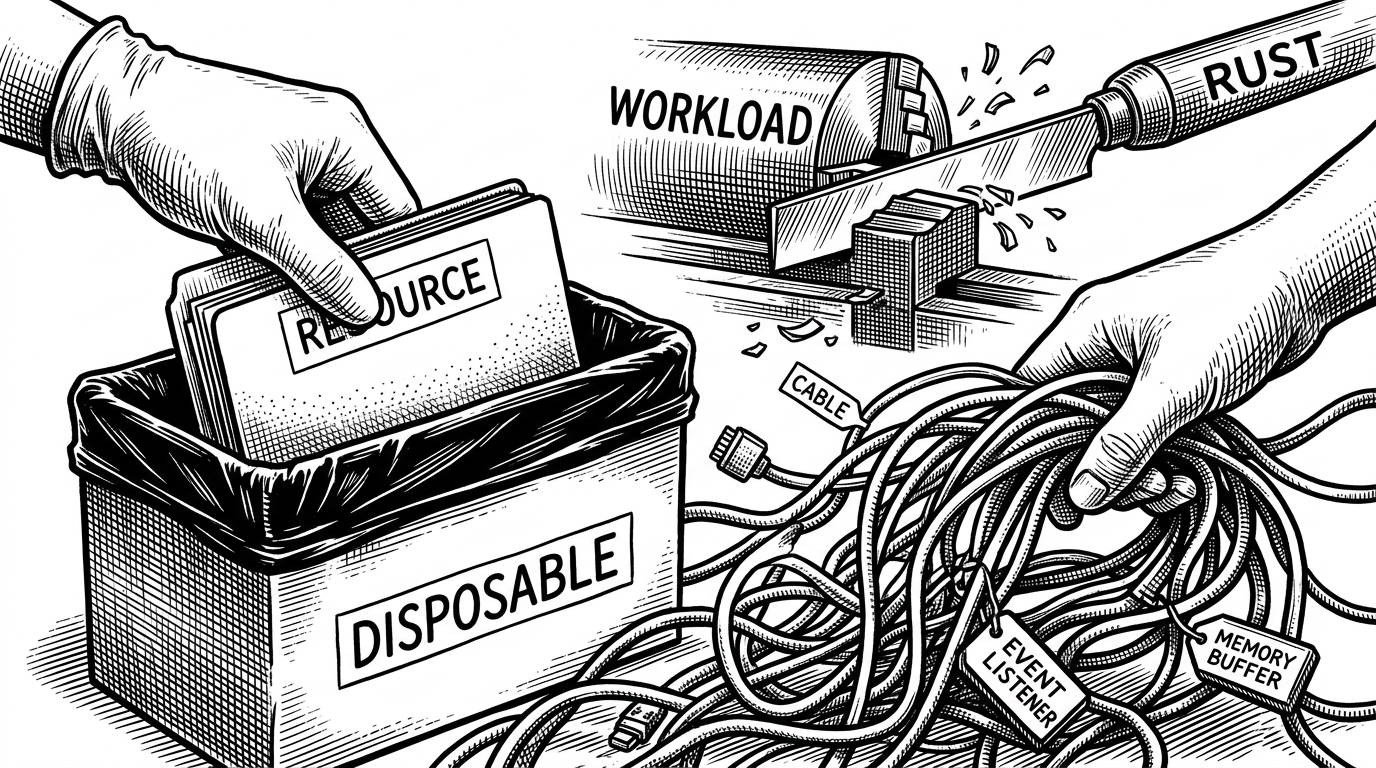
That design choice is more than style. In a long-running Electron app, forgetting teardown is how you get memory leaks, ghost listeners, and the kind of sluggishness that users feel long before a profiler explains it. VS Code bakes the discipline into the code culture.
class Example extends Disposable {
  private readonly listener = this._register(emitter.event(() => {
    // handle event
  }));

  override dispose(): void {
    super.dispose();
    // all registered resources are cleaned up here
  }
}
Rust does the heavy lifting
The repo is not pure TypeScript all the way down. It treats TypeScript as the orchestration layer and uses native or lower-level tooling where the work gets expensive. Search is the obvious example, but the broader pattern is what matters.
| Model | What TypeScript does | What native or Rust tooling does | Why it matters |
|---|---|---|---|
| Loose web-style app | Mostly everything, even costly work | Usually little or nothing | Convenient early on, but expensive at scale |
| VS Code's hybrid model | UI, coordination, product logic | Search, perf-sensitive tasks, and other heavy lifting | Keeps the app responsive while preserving developer velocity |
| Pure native desktop app | All logic close to the metal | Everything is native by default | Fast, but often slower to evolve and harder to extend |
This is the hidden bargain of the repo. TypeScript buys reach and iteration speed. Rust and other native helpers buy performance where the user can feel it. Together they make the product feel lighter than the architecture underneath it.
AI is becoming part of the maintenance model
The most modern part of the repo is not the UI. It is the maintenance machinery around it. The .github/skills, .agents, and classifier infrastructure show a codebase that is being organized for machine-assisted stewardship as much as human editing.
That matters because scale changes the job. At a certain size, you do not just need more engineers. You need better routing for issues, better analysis of perf regressions, and better ways to turn a vague bug report into a bounded task.
The striking idea here is that the repo is beginning to encode how work should move, not just how code should compile. That is a different kind of maintainability.
| Governance model | Strength | Weakness |
|---|---|---|
| Loose app codebase | Easy to start and easy to change in the short term | Architectural drift shows up late |
| VS Code's guarded codebase | Layers, disposables, and lint rules keep the system coherent | Requires constant discipline |
| AI-assisted maintainable codebase | Skills and classifiers can route and accelerate specialized work | Still depends on human ownership and review |
Code - OSS and the business of open core
The repo also sits inside a product strategy. The open core, branded as Code - OSS, lives alongside Microsoft’s proprietary distribution. That split is not an accident. It is how the project balances openness, control, and commercial gravity.
Erich Gamma has said the naming split itself causes confusion, and that tension is part of the story. The codebase is open enough to attract contributors and ecosystems, but the distribution model still gives Microsoft room to steer the product.
That makes VS Code unusual in a useful way. It is both a public platform and a commercial engine, and the repo is where those two identities meet.
Why VS Code feels so complete
VS Code feels lightweight because the repository is full of invisible machinery that keeps it that way. Layering rules prevent architectural leakage. Disposables keep the runtime healthy. Rust handles the heavy work. AI-aware maintenance helps the system stay governable as it grows.
That is the real trick. VS Code is not merely a successful editor. It is a codebase that has been engineered to survive its own success.