kimi-k3-in-c: How a C99 Engine Turns RAM Into a Dial for a 2.78T-Parameter Model
A zero-dependency inference engine streams weights, caches experts, and keeps outputs reproducible, even when the model is far larger than memory.
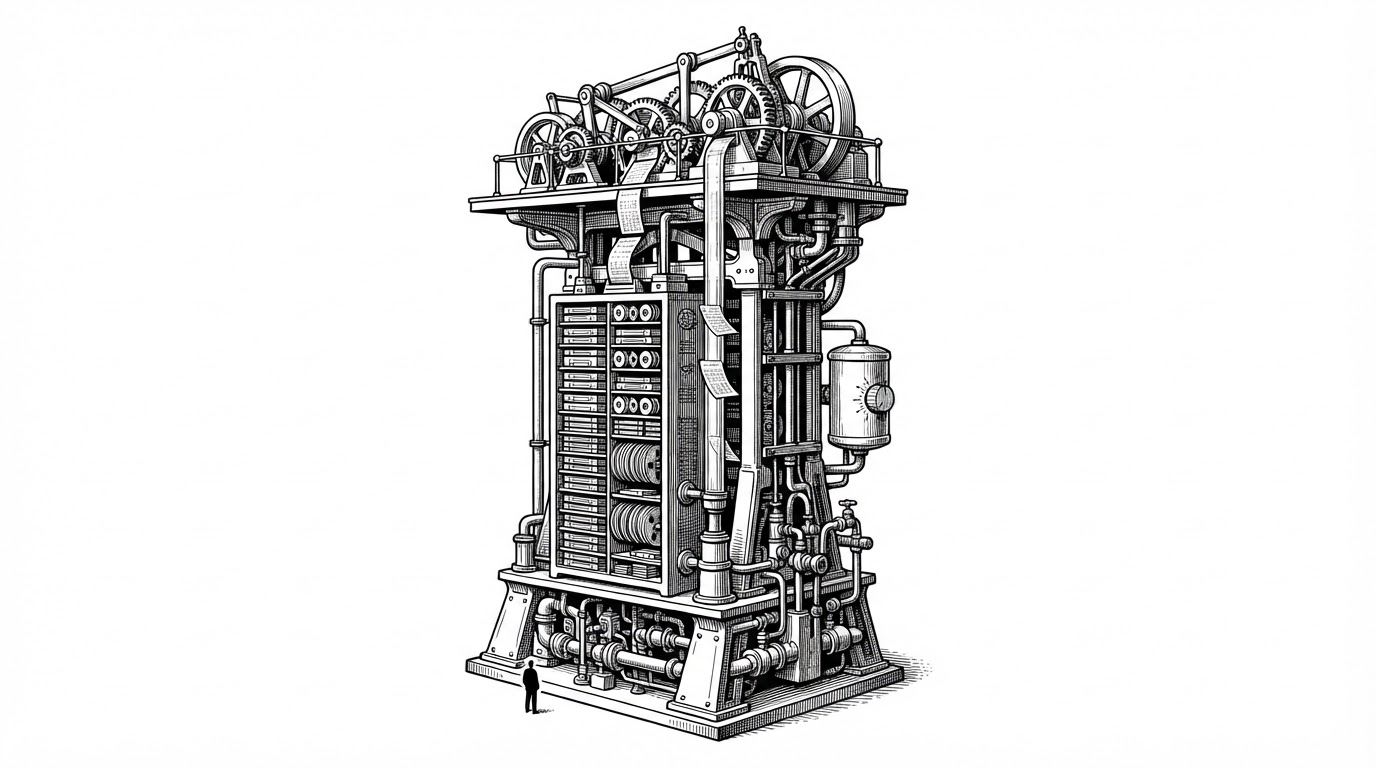
- kimi-k3-in-c makes memory elastic by turning disk, RAM, and cache into a single inference system.
- The repo's real trick is not compression alone, but preserving output while changing where weights live and when they move.
- Sparse expert routing lets the engine stream most of the checkpoint from NVMe and keep only the active path hot.
- The project earns trust by treating reproducibility as part of the architecture, not a postscript.
The headline feat is not just that Kimi K3 can run locally. It is that the engine reframes a 2.78T-parameter MoE model as a storage and scheduling problem, not a raw-memory problem. That shift is what makes the project interesting to systems people, not just local AI hobbyists.
The Model That Refuses to Fit
Kimi K3 ships as a checkpoint that would normally be too large to treat as a single resident object. `kimi-k3-in-c` accepts that constraint and makes it movable. The dense trunk streams from disk, the routed experts come and go through cache, and the output stays byte-identical across very different RAM budgets.
That is the core thesis: the project does not ask how to shrink the model until it fits. It asks how to control what must be resident, what can be prefetched, and what can stay on NVMe without changing the result.
The Memory Ladder, Not the Memory Floor
The best way to understand the repo is as a ladder. Spend more RAM, and more of the hot path stays resident. Spend less RAM, and the engine leans harder on asynchronous I/O and streaming. The model's behavior does not change, but the shape of the pipeline does.
That is a more useful abstraction than a simple yes-or-no fit test. It turns the hardware question into a policy choice: how much memory do you want to buy back with latency?
The entire frontier MoE runs by streaming experts from disk. active experts get loaded. Everything else stays on NVMe. Byte-identical output whether you give it 8 GB or 224 GB, This shouldn't be possible yet it is.
Inside the Trunk
The trunk is the dense part of the model, and it is the part most systems would rather avoid. In this repo, the trunk is streamed layer by layer from storage, with background prefetch hiding I/O behind compute. That matters because the trunk is big enough that a naive load strategy would dominate the whole runtime budget.
// Simplified shape of the trunk path
prefetch_next_layer_async(layer + 1);
run_current_layer(layer, activations);
wait_for_prefetch_if_needed(layer + 1);

// Dense weights never need to stay fully resident.
// The pipeline is built around overlap, not bulk loading.
This is why the project feels more like a storage engine than a traditional model runner. The unit of work is not just a tensor. It is a weight page arriving just in time for compute.
Inside the Expert Cache
The MoE side is where the sparsity pays off. Only 16 of 896 experts activate per token, so the engine can keep a small hot set in RAM and push the rest to disk. The LRU cache then becomes the real control surface for throughput.
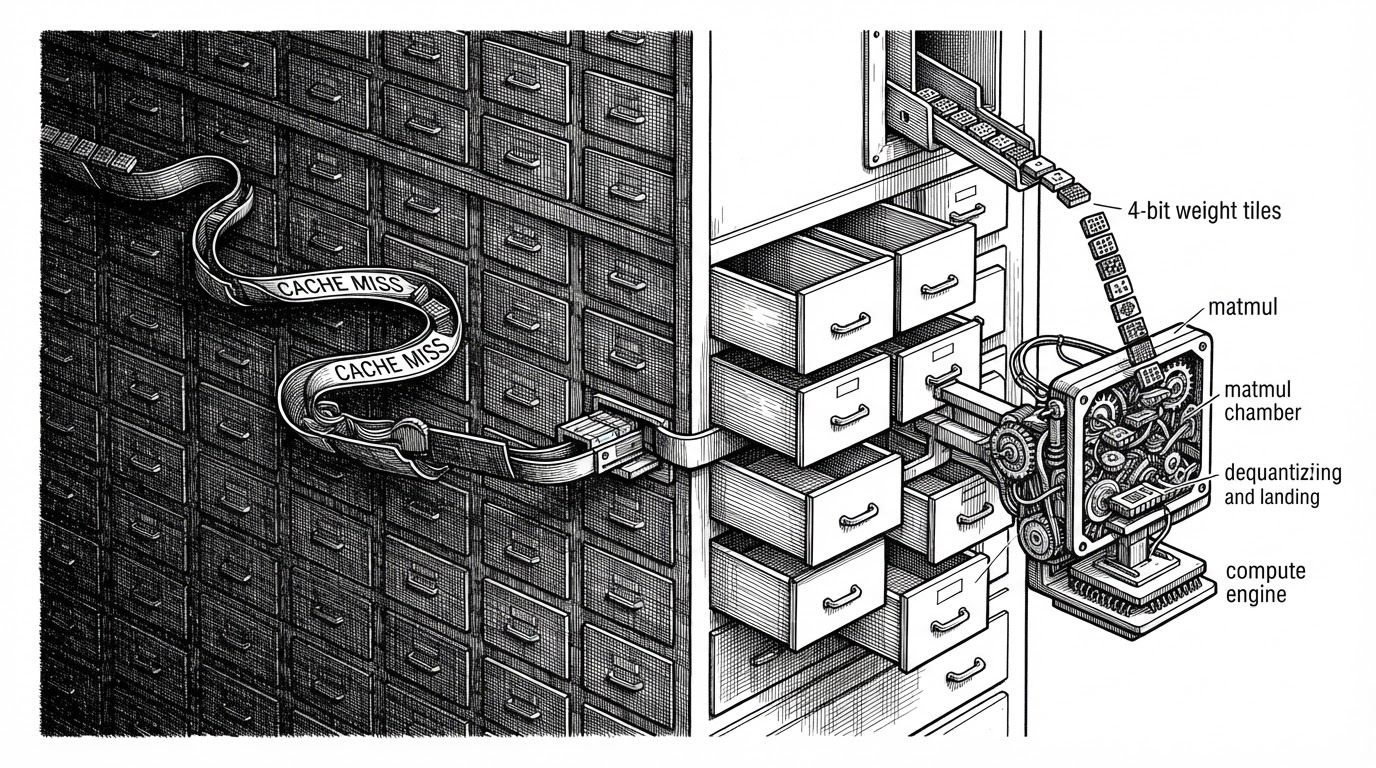
// Expert path, simplified
expert_id = route(token);
if (cache_hit(expert_id)) {
    weights = cache_get(expert_id);
} else {
    weights = stream_from_nvme(expert_id);
    cache_put_lru(expert_id, weights);
}
weights = dequantize_mxfp4(weights);
matmul_with_active_token(weights, hidden_state);
The important detail is that dequantization happens on the path to use, not as a separate staging step. That keeps bandwidth pressure down and avoids turning the cache into a second model loader.
Why the Math Has to Be Exact
The project is unusually strict about correctness. It uses configuration guards that refuse missing fields, disables floating-point contraction, and keeps double accumulators where precision could drift. The fast path and the scalar path are designed to agree, not merely to approximate each other.
That discipline changes the feel of the repo. It is not a demo that got lucky. It is an engineering artifact that treats reproducibility as part of the product.
// Conceptual invariants the engine protects
// 1. No guessing when config fields are missing.
// 2. No compiler-created FMA surprises.
// 3. No divergence between scalar and AVX2 reduction trees.
// 4. No silent changes in output when memory budgets change.
What It Is Better Than
The closest comparisons clarify the niche. `llama2.c` is the spiritual ancestor, but it lives in a far smaller world. AirLLM solves a neighboring problem on GPUs. WASTE and deltafin explore storage-bound inference too, but with different language choices and tradeoffs. `kimi-k3-in-c` sits in a very specific corner: CPU-first, C99, zero-dependency, exact-output inference for a frontier MoE model.
| Project | Language | Hardware target | What is streamed | Main trick | Main tradeoff |
|---|---|---|---|---|---|
| kimi-k3-in-c | C99 | CPU, RAM-starved systems | Dense trunk and routed experts | Memory as a dial, exact-output streaming, custom kernels | Very slow at the smallest RAM budgets |
| WASTE | C | CPU and storage-bound systems | Experts and weights | Streaming plus aggressive compression | Different fidelity and speed profile |
| deltafin | Rust | CPU-focused systems | Model weights and runtime state | Safer systems rewrite of the same idea | Less minimal than C, different runtime philosophy |
| llama2.c | C | Small local setups | No large-scale storage streaming | Ultra-minimal full-stack inference | Much smaller scale and model scope |
| AirLLM | Python / GPU stack | Small GPU VRAM | Layers | Layer-wise offload on GPUs | Not CPU-only, different bottleneck |
The comparison does not crown a winner. It makes the category visible. This repo is what happens when you optimize for exactness, not just convenience.
Why This Repo Matters
`kimi-k3-in-c` argues that frontier inference is not always blocked by a single scarce resource. Sometimes the bottleneck is the discipline to move weights intelligently, keep math stable, and expose memory as a policy knob. That is a bigger lesson than one model, one machine, or one benchmark number.
If the project has a lasting contribution, it is this: it shows that a huge model can be treated as a pipeline of managed state. Once that clicks, RAM stops being a wall and starts being one more variable in the system.