Laya: The Fast, Calibrated Decision Engine That Refuses to Generate Text
A deep dive into the open-source System 1 model that turns classification, scoring, and routing into a single bidirectional forward pass.

- Laya argues that many AI workflows do not need generation at all, only a fast calibrated decision.
- Its bidirectional encoder and marker-based decision head turn structured tasks into a parallel comparison problem instead of a token-by-token loop.
- Calibration is not a side feature here, because honest confidence is what makes the output safe to automate.
- The router keeps the hot path lean while still dispatching multilingual inputs to the right checkpoint.
Laya’s sharpest idea is also its most unfashionable one: for a lot of AI work, writing is wasted motion. If the job is to route, score, approve, reject, or classify, the model does not need a chat persona or a generative loop. It needs to make a decision quickly, and report confidence that a system can actually trust.
That reframing matters because it changes the engineering budget. You stop spending compute on prose, parsing, and repair, and start spending it on a single pass that is easier to benchmark, easier to calibrate, and easier to automate downstream.
Why this is not another structured-output wrapper
Most structured-output systems still begin with the wrong primitive. They ask a causal LLM to generate text, then bolt on a parser, a schema, a retry loop, and a confidence story after the fact. Laya takes the opposite route: it treats the output as a typed decision from the start.
| Project | Backbone | Output style | Calibration emphasis | Latency profile | Best use case | Main trade-off |
|---|---|---|---|---|---|---|
| Laya | Bidirectional ModernBERT | choice / score / noul | First-class | Very low | High-volume decision tasks | Specialized, not universal |
| LLM + parser | Causal generator | Free-form text then parse | Usually secondary | Higher | General language work | More failure modes |
| Jev | Proprietary System 1 model | Typed decisions | Strong | Low | Commercial deployments | Closed source |
| SemIf | Causal Qwen backbone | Constrained structured output | Moderate | Lower than Laya | Accuracy-biased workflows | Heavier decoding path |
That distinction is not philosophical. It is the difference between a model that can be recovered with retries and a model that can be trusted as an upstream control signal. In Laya, the output itself is the product.
The idea in one sentence: one pass, one decision
Laya’s core move is simple to state and easy to miss: a bidirectional encoder reads the entire input at once, then a decision head compares explicit options in hidden space. No token-by-token generation. No hidden conversational state. Just a structured pass from input to decision.
Once you see that, the rest of the repository stops looking like a collection of hacks and starts looking like a disciplined machine. The sequence is not there to elicit prose. It is there to line up the question, the options, and the state so the model can compare them directly.
How the decision head actually works
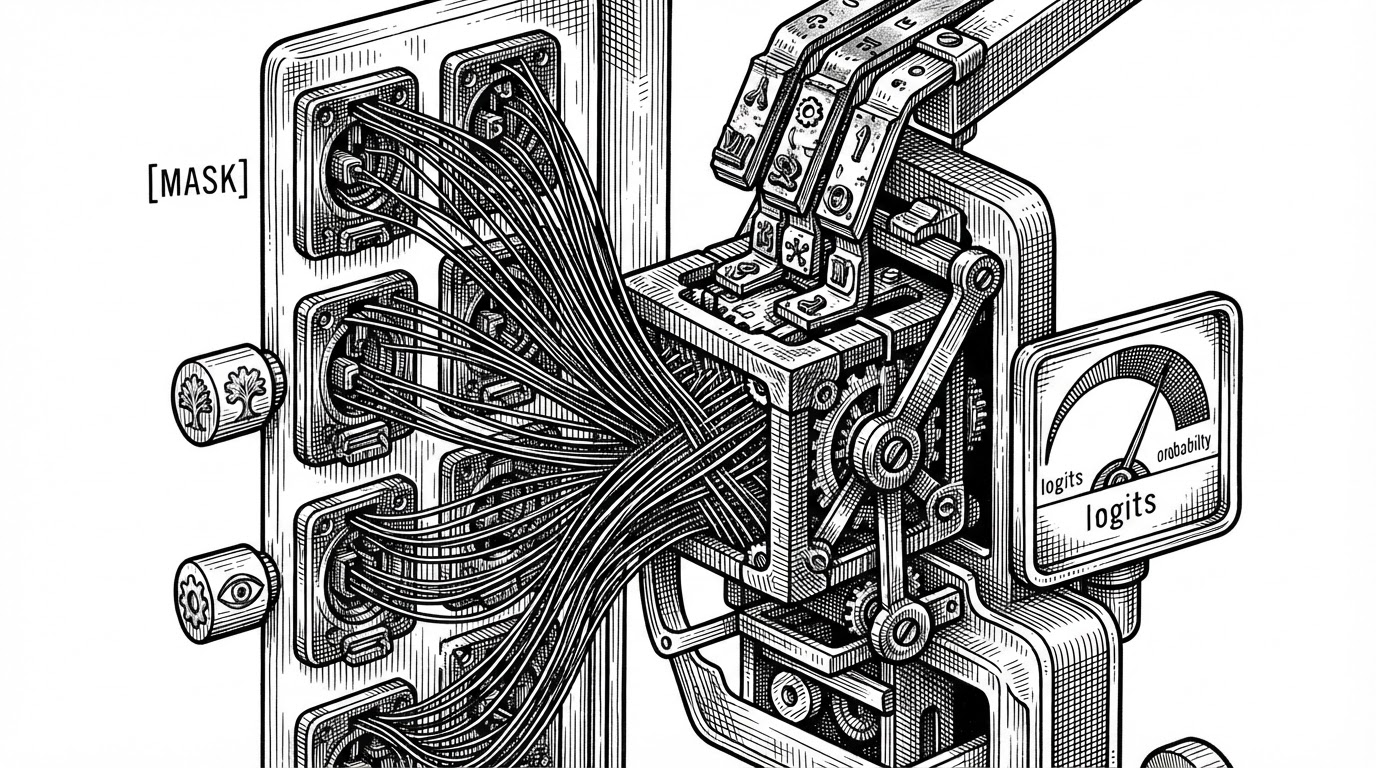
The heart of the implementation lives in `laya/common.py`, where `DecisionModel` takes over from the usual language-model head. The repo uses type embeddings to distinguish between `choice`, `score`, and `noul`, then places `[MASK]` markers in the prompt so the model can gather the hidden states for each candidate slot.
# Conceptual shape of the decision path
sequence = [CLS] + task_type + instructions + [SEP] + [MASK] + opt0 + [MASK] + opt1 + ... + [SEP] + state + [SEP]

hidden = encoder(sequence)
option_states = torch.gather(hidden, dim=1, index=marker_positions)
logits = decision_head(option_states)
confidence = calibrate(logits, temperature=temperature)
This is a comparison problem, not a generation problem. The `[MASK]` positions create fixed slots, and the decision head scores the options against the whole context. Because the encoder is bidirectional, every token can condition on the rest of the sequence at once.
Why calibration is the real product
Fast predictions are useful. Fast predictions with honest probabilities are deployable. That is the difference between a demo and a control plane, especially in triage, guardrails, and routing where a threshold can trigger an action without a human in the loop.
Laya is a fast base to specialise, not a zero-shot decision engine.
| Property | Why it matters | What Laya optimizes |
|---|---|---|
| Strictly proper scoring | Confidence should match reality | Calibration over bravado |
| Temperature handling | Raw logits are not probabilities | Reliable output scores |
| Confidence thresholding | Automation needs a cutoff | Decisions you can gate |
| E2E calibration | Evaluation should mirror deployment | Honest uncertainty |
This is where the repo’s ambition becomes clearer. Laya is not trying to be eloquent about uncertainty. It is trying to make uncertainty operational, so a system can say yes, no, or maybe with enough statistical discipline to automate the next step.
The router solves the multilingual problem without bloating the hot path
A decision engine that is fast in English but slow everywhere else is only half a product. Laya’s router and language detection layer keep the common path lean, then dispatch inputs to the multilingual checkpoint when script or language requires it.
That matters because routing should be cheaper than the decision itself. If your language detector is heavy, you burn away the speed advantage you were trying to protect. Laya avoids that trap by keeping detection dependency-free and pushing complexity only where it pays off.
What Laya beats, and what it does not
The comparison is not subtle. Against a generic LLM plus parser stack, Laya removes generation entirely. Against commercial System 1 models, it offers openness and local control. Against heavier causal backbones, it wins on latency and simplicity, but not on every open-ended task.
| Project | Where it wins | Where it loses |
|---|---|---|
| Laya | Speed, calibration, openness | General reasoning, zero-shot breadth |
| Jev | Commercial polish, maturity | Closed source |
| SemIf | Causal flexibility | Hot-path latency |
| Bespoke Nimble | Accuracy on some tasks | Latency and weight |
| Jevlike | Extremely lightweight footprint | Capacity and robustness |
That is the right trade. Laya is not pretending to be a universal reasoning machine. It is a fast base for specialization, which is a more honest and more useful claim for production teams.
I was reluctant to ask to people for help because of overthinking and adhd, you know what they say, you need to live with the curse. Just created the bmc for this.
The larger lesson is bigger than one repository. A lot of AI infrastructure has been built around the assumption that language generation is the default interface to intelligence. Laya pushes back on that assumption and shows a narrower, cleaner pattern: when the question is typed and the action is bounded, the model can just decide.