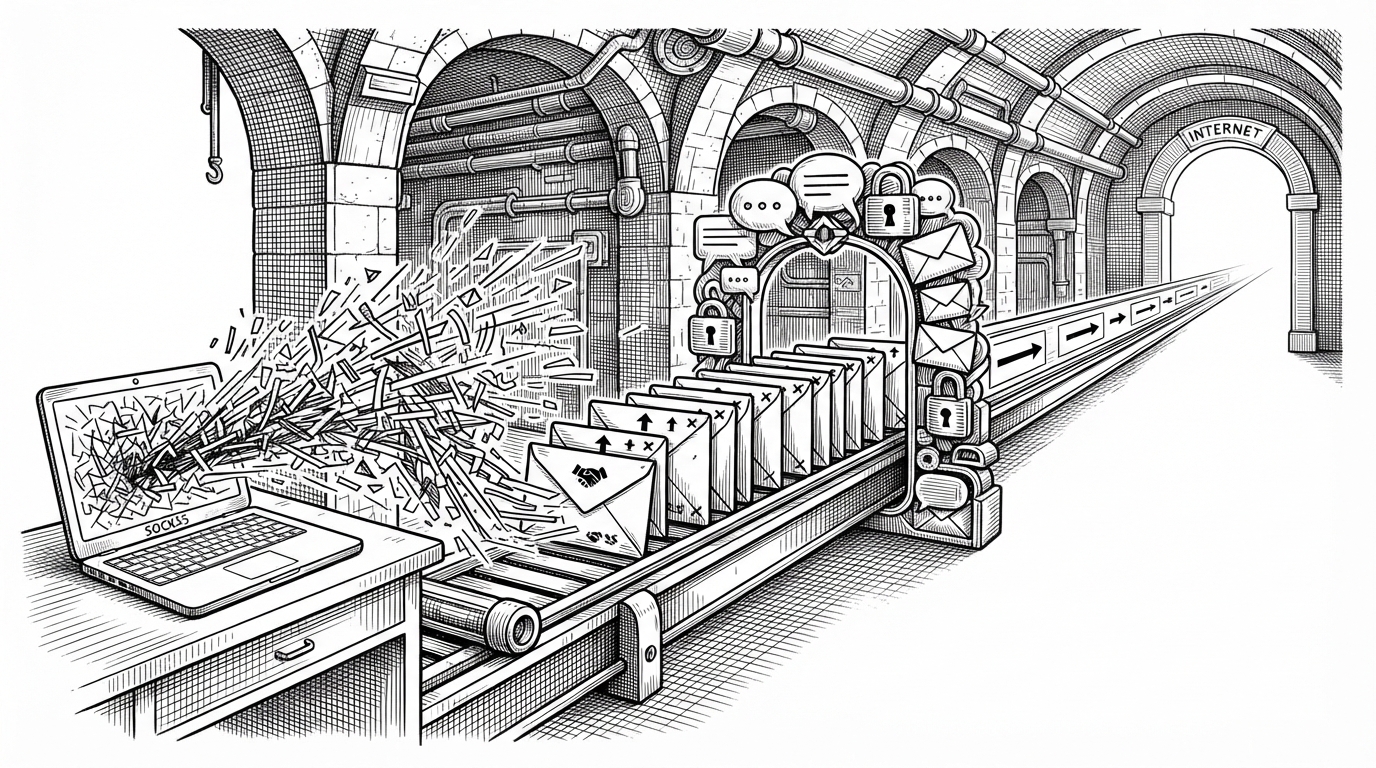
snarkVM: The zkVM That Compiles Privacy Into the Runtime
Aleo’s virtual machine splits execution, proving, and blockchain state into separate layers, so developers can write private programs once and let the system handle the zero-knowledge machinery.
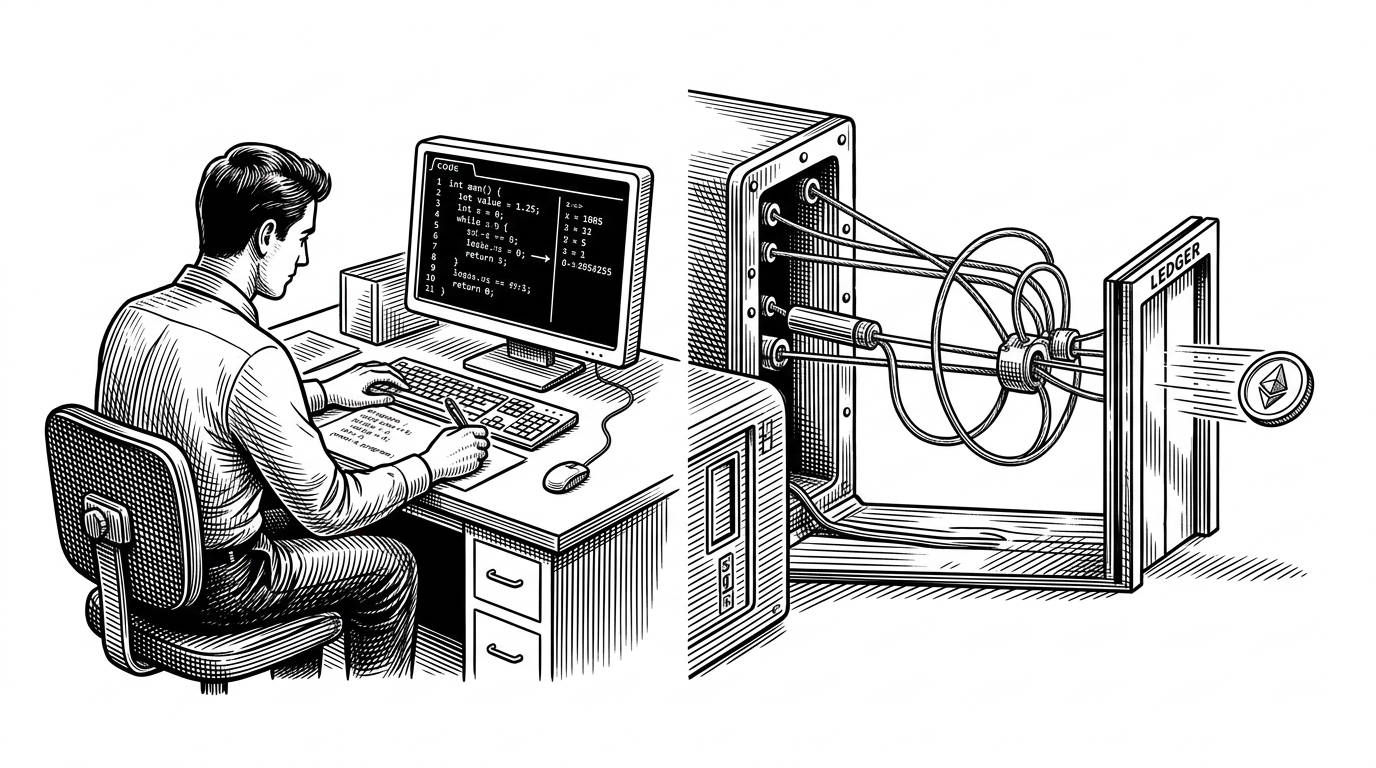
- snarkVM makes privacy feel like a compiler target by splitting ordinary execution from proof generation without splitting the developer experience.
- Its most interesting design choice is the mirrored console and circuit worlds, which let one Aleo program exist as both native logic and constraint logic.
- Varuna, Poseidon, FFTs, MSMs, and CUDA are not side quests here, because proving speed is part of the product, not a background optimization.
- Compared with general-purpose zkVMs, snarkVM is narrower in scope but deeper in integration, which is exactly why it fits Aleo.
Most zk systems start with cryptography and ask developers to adapt. snarkVM starts with a different bet: if privacy is the default, then the runtime should make that normal. The repo is built around that idea, and the strongest clue is the way it mirrors itself across console and circuit.
Two Programs in One
The diagram above is the whole project in miniature. The console side is for native execution, where types behave like normal programming constructs. The circuit side mirrors those types as constraint-friendly versions, so the same intent can be translated into a witness and a proof.
That split is what makes snarkVM feel more like a privacy-native operating system than a library. Developers do not write a second program for proving. They write one program, and the synthesizer turns it into arithmetic constraints when the network needs cryptographic evidence.
Why Aleo Needed a Different VM
Public blockchains replay everything. That works when transparency is the point, but it makes private state awkward. snarkVM takes the opposite path: execute locally, prove the result, then let the ledger verify the proof without seeing the private inputs.
That design pressure shapes the whole repository. The ledger handles consensus and state. The synthesizer handles translation. The algorithms workspace handles the cryptography. Instead of one monolith, snarkVM is a stack of focused layers that all serve the same outcome: private computation that still behaves like a networked application.
Varuna Is the Proof Engine Under the Hood
Varuna is the proving system that sits under snarkVM’s runtime story. In practice, that means an Algebraic Holographic Proof pipeline with separate indexer, prover, and verifier logic, so the system can prepare once and then generate or check proofs efficiently.
The important part is not the acronym. It is the tradeoff. Universal proving means Aleo does not need a bespoke trusted setup for every program, which makes the platform feel more like infrastructure and less like a ceremony.
The Constraint System Is the Real API
If you want to understand what programming for ZK actually means, start with the constraint system. In algorithms/src/r1cs, the core language is not loops and branches. It is variables, linear combinations, and enforced relationships.
pub trait ConstraintSystem<F: Field> {
    fn alloc<FN, A>(&mut self, annotation: FN, value_gen: A) -> Result<Variable>
    where
        FN: FnOnce() -> &'static str,
        A: FnOnce() -> Result<F>;

    fn enforce<A, AR, B, BR, C, CR>(
        &mut self,
        annotation: A,
        a: AR,
        b: BR,
        c: CR,
    ) -> Result<()>;
}

// The shape is the point:
// alloc a witness value, then enforce that A * B = C.
That is the mental shift snarkVM asks of developers. The question is not, “What should this function do?” It is, “What arithmetic relationship must hold if this function is correct?” Once you see that, the rest of the repo starts to make sense.
Why Poseidon, FFTs, and MSMs Matter
ZK performance is dominated by the boring-sounding parts. Hashes, polynomial transforms, and multi-scalar multiplication eat most of the proving budget, so snarkVM leans into primitives that are friendly to finite fields and circuit arithmetic.
Poseidon exists here because ordinary hashes are expensive inside circuits. FFTs turn execution traces into polynomial form. MSMs stitch commitments together. Taken together, they explain why the proving stack is more like a precision engine than a simple crypto wrapper.
Why CUDA Is a Product Decision, Not a Footnote
GPU acceleration is not cosmetic in snarkVM. It is part of the user experience. If proving is slow, then every private action feels heavy, and privacy becomes a tax instead of a feature.
That is why the repository treats CUDA as infrastructure. It is a signal that the team is not just proving that private computation is possible. They are trying to make it practical enough to sit underneath a real network.
How snarkVM Compares
| Project | Execution model | Native chain | Scope | Where it stands out |
|---|---|---|---|---|
| snarkVM | Aleo programs compile into native and circuit execution | Yes | Chain-specific zkVM | Deep vertical integration around private state and proofs |
| RISC Zero | General-purpose program proving | No | Broad zkVM | Flexible arbitrary computation |
| SP1 | General-purpose program proving | No | Broad zkVM | High-performance proving for Rust programs |
| Aztec / Noir | Private smart contracts on Ethereum | No | Privacy layer | Strong privacy-focused developer model |
| Zcash | Private transactions | Yes | Payments-first privacy system | Historical benchmark for ZK privacy |
The comparison is not about picking a universal winner. snarkVM is narrower than a general-purpose zkVM, but that is the point. It is optimized for a chain where privacy is not an add-on, which gives it a kind of cohesion broader platforms often lack.
The Bigger Pattern
snarkVM is best understood as a privacy-native runtime. It combines language design, constraint synthesis, proving, and ledger logic into one system, then pushes as much of the complexity as possible out of the developer’s way.
That makes the repo feel unusually ambitious. It is not just a library for generating proofs. It is a full stack that tries to make private computation feel like ordinary software engineering, with cryptography hidden in the machinery instead of exposed in the interface.