Aether: The Rust Tunnel That Keeps Proving It Still Works
A censorship-circumvention client that turns route discovery, protocol camouflage, and end-to-end validation into one automated system.
- Aether is built around a distrust of handshake success, so it only promotes routes that can carry real traffic end to end.
- Its userspace netstack lets the client own packet handling in process, which makes SOCKS5 a front door rather than the core of the system.
- Protocol agility matters here because MASQUE, HTTP/2, and WireGuard are fallback tools in one route-finding loop.
- Compared with general-purpose proxy stacks, Aether behaves more like a self-validating circumvention engine than a configuration platform.
The first rule of censorship circumvention: do not trust “Connected”
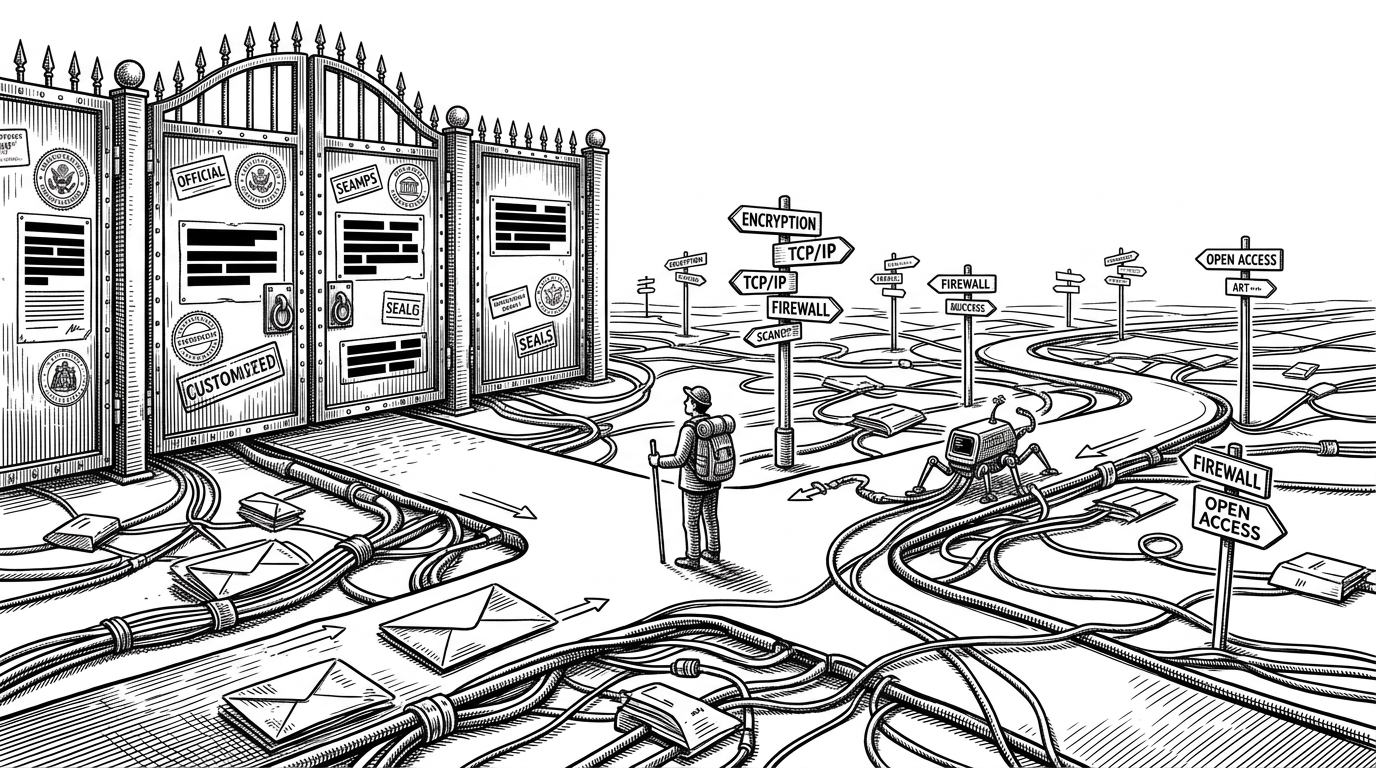
Aether starts from a blunt observation: a tunnel can finish its handshake and still be useless. In hostile networks, the real failure often happens after the status light turns green, when the first real request gets dropped, reshaped, or throttled into silence.
That is why Aether does not treat connection setup as the finish line. It treats it as the first hypothesis, then keeps testing until the path can actually move data. As the README puts it, it offers "automatic endpoint discovery" with "end-to-end data-plane validation" so a gateway is trusted only after it passes traffic.
Automatic endpoint discovery, with end-to-end data-plane validation so a gateway is only trusted once it actually passes traffic, not just once it answers the handshake.
Aether is a route-finding engine, not just a proxy
The useful mental model is not “VPN client.” It is “probe, measure, promote, repeat.” Aether scans for candidate routes, tests them under real load, and keeps a fallback path ready when the network changes underneath it.
That logic is why the project’s scan modes matter. Aether is not just searching for a server address. It is searching for a route that survives censorship pressure, then rechecking that the route has not quietly died.
Inside the userspace netstack
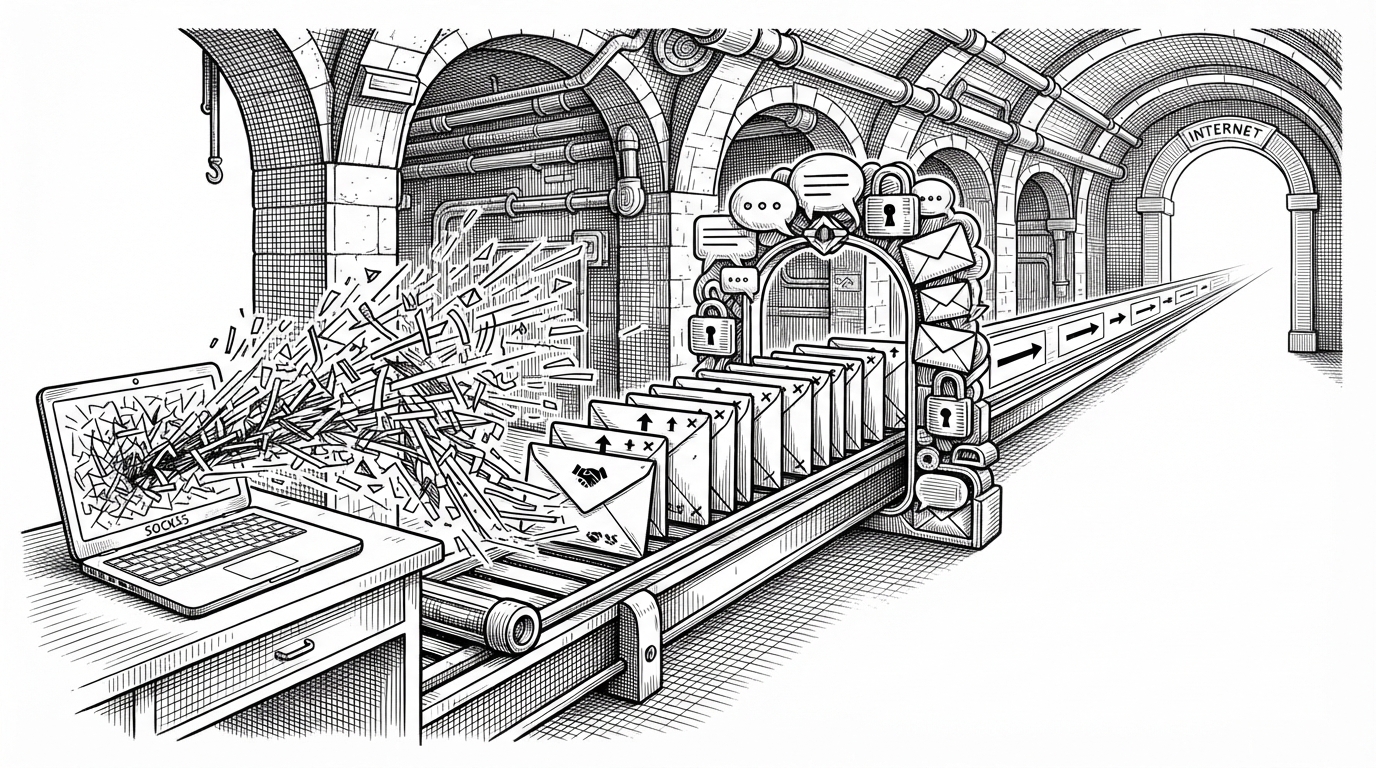
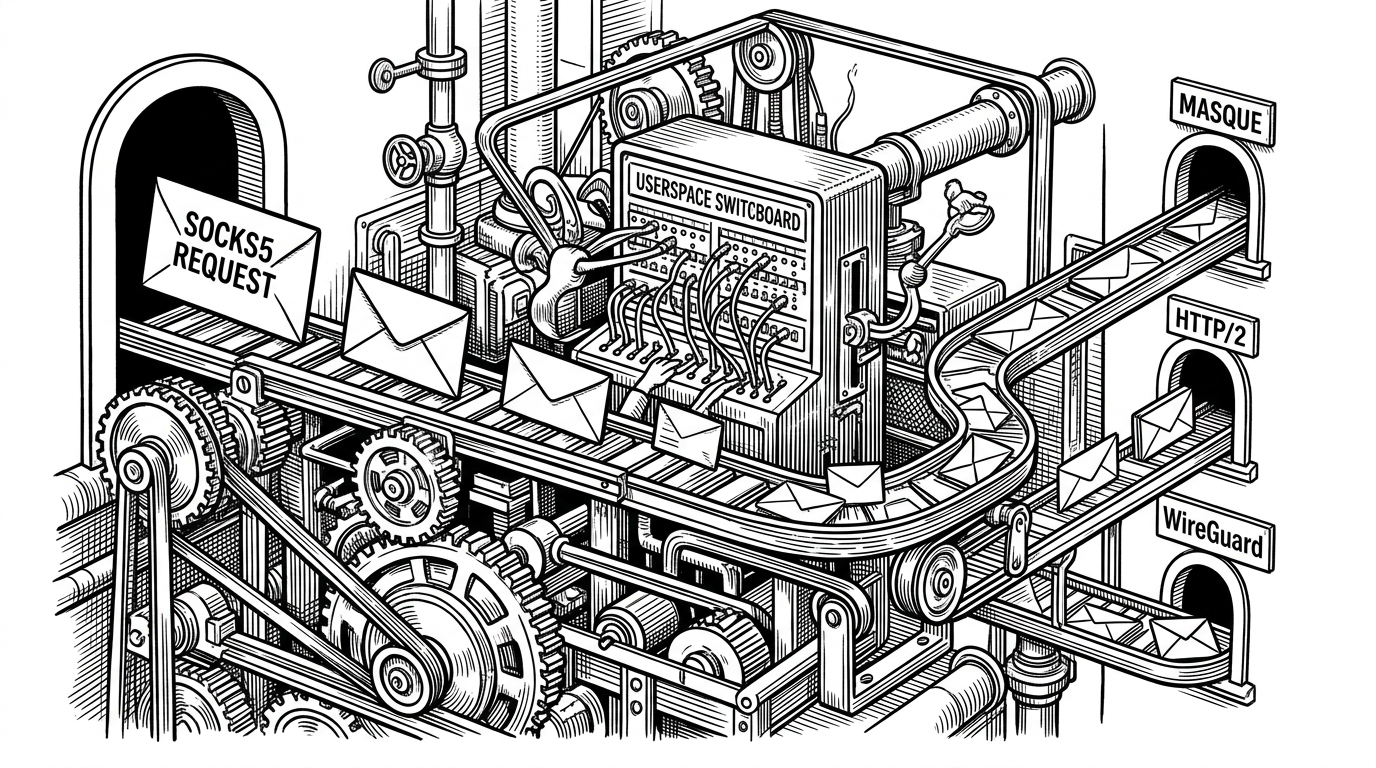
The technical unlock is smoltcp, which gives Aether a TCP/IP stack it can run in process. Instead of depending on a kernel tunnel device, Aether can synthesize packet behavior itself, then hand those packets to whatever transport layer survives the local network.
That is why the repository’s StackDevice abstraction matters. It manages buffer flow in userspace, so a SOCKS5 CONNECT can become a virtual TCP session without giving the kernel the final say over how the traffic is encapsulated or recovered.
// Conceptual shape, simplified from the repo
let stream = stack.open_tcp(target)?;
let tunnel = transport.encapsulate(stream)?;
proxy.serve_socks5(tunnel);
The architecture also explains why Aether can support nested WireGuard. Once packet lifecycle is under its own control, it can wrap one encrypted transport inside another without leaving the process.
Why MASQUE and HTTP/2 matter more than one more VPN protocol
Aether is built for fallback, not protocol purity. MASQUE over HTTP/3 gives it a modern QUIC-based path when UDP is available, while HTTP/2 gives it a TCP-based fallback when QUIC is constrained or blocked.
That matters because censors do not block every network the same way. Some networks kill UDP first. Others fingerprint TLS patterns. Aether’s job is not to be elegant in one environment. It is to keep finding a shape that survives the current one.
Aether is a censorship circumvention client designed for heavily restricted networks. It automatically discovers reachable routes, establishes an encrypted tunnel, and exposes a local SOCKS5 proxy for your applications.
The obfuscation layer is doing more than encryption
Encryption alone is not the story. Aether also manipulates observability with TLS ClientHello fragmentation, padding, timing adjustments, and the aethernoize profiles. The goal is to make the traffic harder to classify, not merely harder to read.
That is a different control problem. A blocked tunnel is often not blocked because the bytes are secret. It is blocked because the pattern is recognizable. Aether answers that by changing the pattern until the route stops looking suspicious enough to trip the filter.
Why Rust fits this problem
Rust is not the headline, but it fits the workload. Aether is juggling async networking, userspace packet handling, multiple transport stacks, and aggressive fallback logic. That is exactly the kind of codebase where memory safety and predictable concurrency are not nice extras.
The repo’s Rust stack also helps explain the project’s shape. It combines tokio, smoltcp, h2, quiche, and WireGuard tooling without turning the whole client into a fragile chain of handoffs.
How Aether compares to Xray, sing-box, and Hiddify
Aether is not trying to beat the big proxy stacks at being universal. It is trying to be more autonomous. The difference is simple: most tools assume you already know what works, then let you configure it. Aether keeps searching until it finds something that does.
| Project | Primary design goal | Configuration burden | Route discovery | Protocol agility | End-to-end validation | Best fit user |
|---|---|---|---|---|---|---|
| Aether | Self-validating circumvention | Low to medium | Built in | High | Yes | Users in hostile networks who need automation |
| Xray-core | Modular proxy core | High | External or manual | High | Usually not built in | Advanced operators who tune configs by hand |
| sing-box | Universal proxy platform | Medium to high | External or manual | Very high | Limited by setup | Power users building custom stacks |
| Hiddify | Unified client and UI layer | Low for users, higher for maintainers | Depends on core | Depends on core | Depends on core | People who want a wrapper around multiple backends |
The takeaway is not that the others are weak. It is that Aether is optimized for a narrower, harder problem. It behaves less like a general proxy platform and more like a self-validating circumvention engine.
This project does not reimplement any of Aether's tunneling logic. It drives the real aether binary in a pseudo-terminal, answers its interactive setup prompts on your behalf, and watches its output to tell you what's happening.
What this project suggests about the future of circumvention
Aether’s real innovation is not any single protocol trick. It is the control loop. Discovery, camouflage, validation, and fallback are fused into one system that treats network access as a moving target.
That matters because censorship has become adaptive. Tools that only tunnel are easier to classify. Tools that can test, mutate, and confirm their own success have a better chance of keeping up.