Doc-to-LoRA Turns Documents Into Temporary Model Weights
Sakana AI’s D2L skips the long prompt and generates LoRA adapters from the document itself.
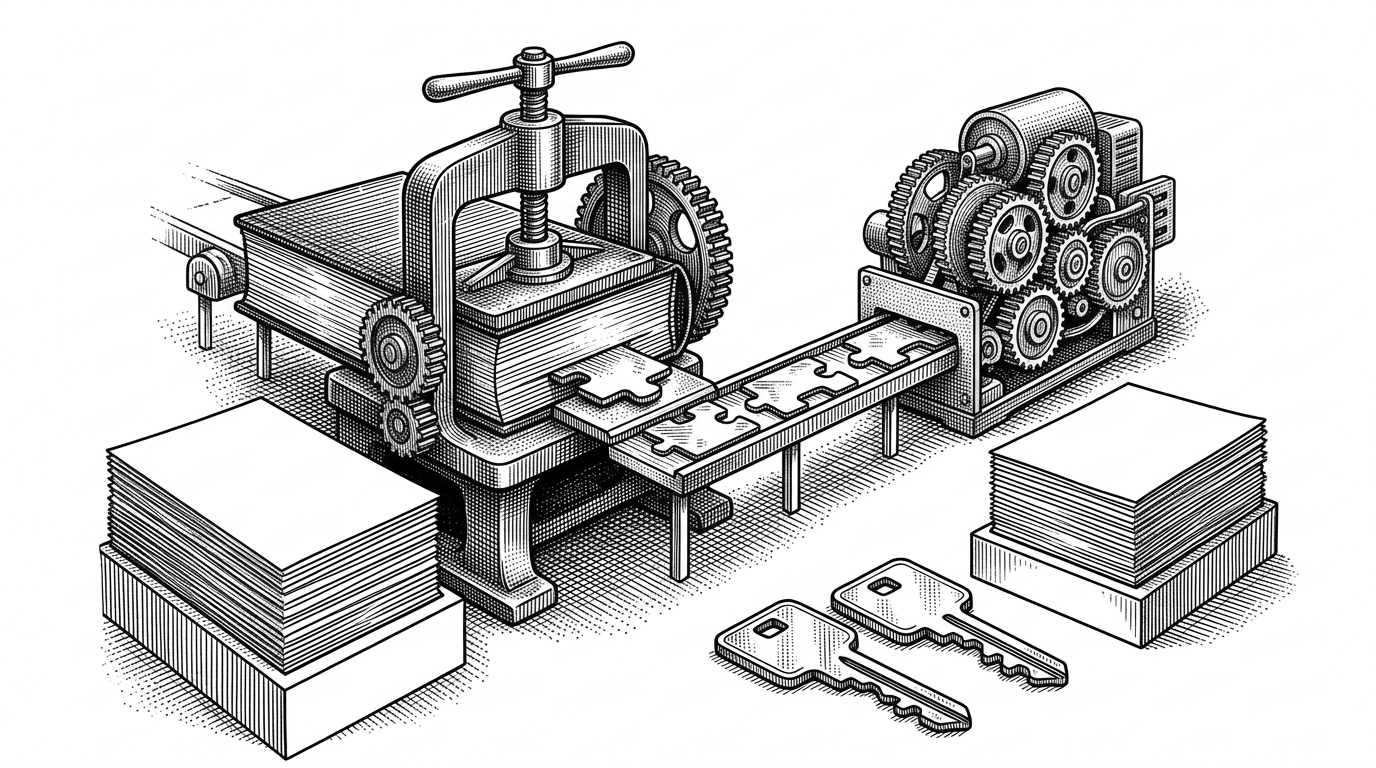
- Doc-to-LoRA reframes long-context handling as temporary weight generation instead of prompt stuffing.
- The repository’s core pipeline is a hypernetwork, a context encoder, and a LoRA injector that rewires inference without gradient updates.
- Packed sequence support and chunked adapter merging show a system built for throughput, not just novelty.
- D2L is best understood as an alternative to context windows, fine-tuning, and distillation, not as a universal replacement.
The cleanest way to read Doc-to-LoRA is as a rejection of the context window arms race. Instead of asking an LLM to hold a long document in attention, Sakana AI asks it to become a version of itself that has already absorbed the document.
Why that matters
That shift changes the bottleneck. A longer prompt grows the KV cache and taxes attention at every step. D2L tries to pay a different cost up front, once, by turning the document into a lightweight set of LoRA weights that can steer the base model for the rest of the session.
one of the biggest local-AI breakthroughs of 2026
What the repository is built from
- `src/ctx_to_lora/modeling/hypernet.py` wraps the pretrained model and connects the context encoder to LoRA generation.
- `src/ctx_to_lora/modeling/ctx_encoder.py` offers multiple ways to read the document, including early-exit and per-layer activation strategies.
- `src/ctx_to_lora/modeling/lora_layer.py` intercepts linear layer execution and applies generated adapters on the fly.
- `src/ctx_to_lora/modeling/lora_merger.py` combines chunked adapters when a document is too large to internalize in one pass.
That structure matters because the codebase is not just a demo wrapper. It is organized like a research system that expects iteration: `configs/` for experiments, `scripts/` for reproducibility, and `webui/` plus `demo/` for making the behavior visible. The stack is modern Python, with PyTorch, Transformers, PEFT, Accelerate, DeepSpeed, and `uv` sitting underneath the experiment flow.
How a document becomes weights
The basic pipeline is simple to describe and tricky to engineer. A document goes into a context encoder, the encoder emits latent features, an aggregator maps those features to LoRA A and B matrices, and a modulated pretrained model uses those matrices during inference. The session reads like normal generation, but the model is temporarily operating with document-specific parameters.
doc = load_document("manual.pdf")
model.internalize(doc)
outputs = model.generate(chat_ids)
model.reset()
That API is the project’s best argument. It compresses a messy research stack into three verbs: internalize, generate, reset. If you are building retrieval, long-form QA, or agent memory, that is a much cleaner contract than shoving more tokens into a prompt and hoping the cache holds.
Where D2L sits versus the usual choices
| Approach | What changes | Cost profile | Best fit |
|---|---|---|---|
| In-context learning | No model weights change; the document lives in the prompt. | Cheap to start, expensive at long lengths because attention and KV cache grow. | Fast prototyping and short reference material. |
| Supervised fine-tuning | Model weights are updated with task-specific training data. | Highest operational cost because each update needs data and training. | Persistent specialization on stable tasks. |
| Doc-to-LoRA | A hypernetwork generates temporary LoRA adapters from the document. | One meta-trained forward path instead of a fresh training run per document. | Reusable document memory with low-latency inference. |
The interesting part is not that D2L beats every alternative on every axis. It does not try to. Its bet is narrower and sharper: if the same document will be queried repeatedly, it is often better to internalize it once than to keep paying for a bloated prompt. Sakana AI also reports strong results on needle-in-a-haystack style retrieval and even cross-modal transfer in the broader release, which hints that the idea is larger than a single demo.
What to watch next
This is still a research release, and the repo reads like one. That is a strength, not a flaw. The abstractions are modular enough for experimentation, the optimization work around packed sequences is visible in the code, and the adapter-merging path suggests the team expects real documents, not toy prompts. The open question is adoption: whether teams will treat D2L as a practical memory layer, or keep using bigger context windows because they are simpler to deploy.