PocketFlow: The Tiny Graph Framework That Wants You to Understand Every Agent Step
A minimalist LLM orchestration engine, a string-based routing model, and a surprising second act: using Cursor rules to help AI write the workflows that AI will run.

- PocketFlow’s real argument is that orchestration gets better when the whole system is small enough to inspect in one sitting.
- Its core Node, Flow, and Batch abstractions turn agent work into a readable state machine instead of a hidden inheritance tree.
- The repo’s .cursor/rules layer adds a second surprise by teaching AI coding tools how to extend the framework itself.
- PocketFlow competes less on breadth than on clarity per line of code, which is the point.
Why PocketFlow Feels Like an Anti-Framework
PocketFlow does something rare in the agent framework world. It reduces the core problem to a graph you can actually reason about, then refuses to bury behavior behind layers of base classes and clever indirection. That makes it feel less like a platform and more like a disciplined argument.
That argument is simple: if the workflow matters, the workflow should be visible. PocketFlow is built for people who want to know exactly where state is read, where LLM calls happen, and where the next step comes from. The payoff is control, but the deeper value is legibility.
PocketFlow is an open-source framework designed to simplify building and deploying autonomous AI agents.
A Core So Small You Can Hold It in Your Head
The repo’s center of gravity is the core engine in pocketflow/__init__.py, supported by a larger set of instruction files under .cursor/rules/ and example workflows in cookbook/. The architecture is intentionally spare. Node, Flow, and Batch cover most of the story.
class ReviewNode(Node):
    def prep(self, shared):
        return shared["draft"]

    def exec(self, draft):
        return llm_review(draft)

    def post(self, shared, draft, result):
        shared["review"] = result
        return "needs_revision" if result["changes"] else "done"

flow = draft_node >> review_node
review_node - "needs_revision" >> revise_node
review_node - "done" >> publish_node
That tiny shape matters. A Node does three things in order: prep reads state, exec performs the expensive work, and post writes results back and returns an action. The framework gets its clarity from that split. Retries are easier to reason about because the heavy work is isolated from shared state, and branching is explicit because the next step is a string, not a hidden callback.
The Node Pattern: Prep, Exec, Post
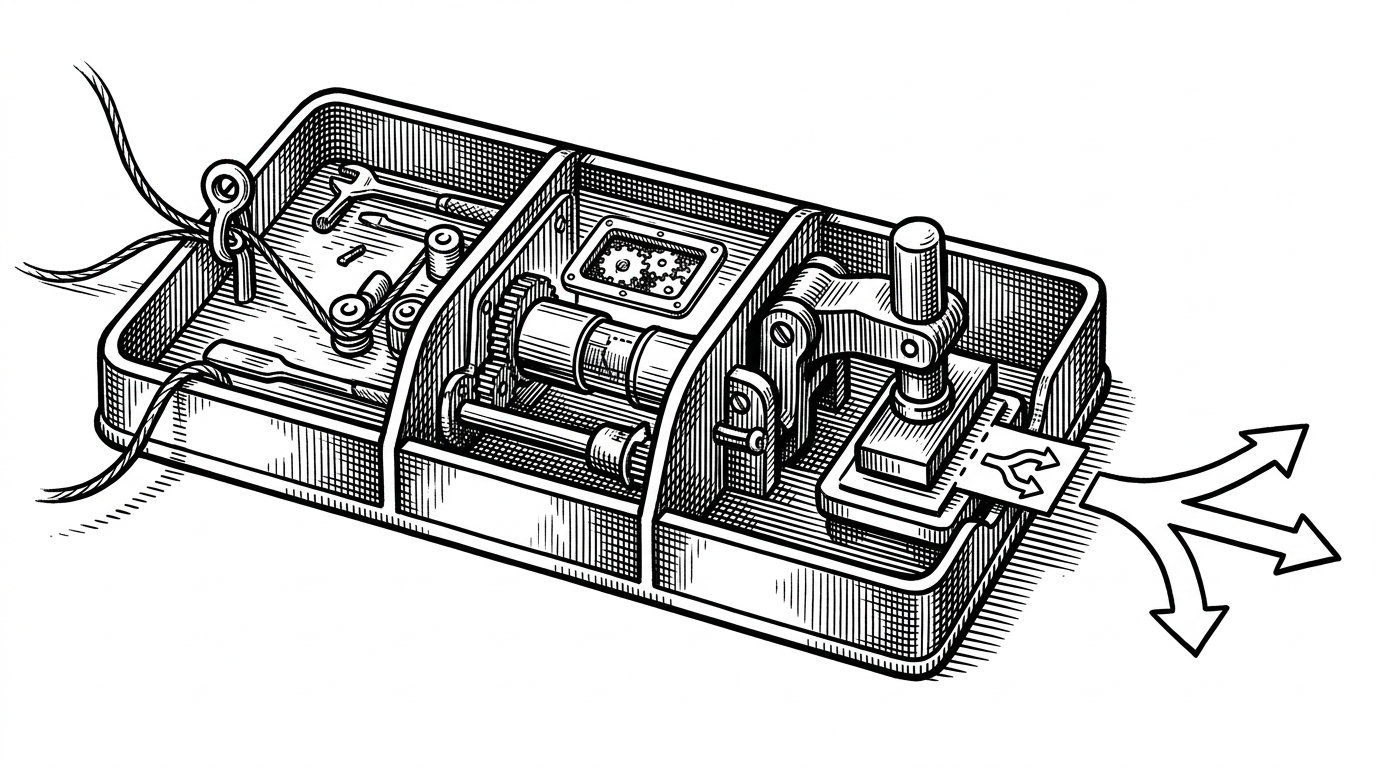
That design is not just neat. It is practical. By keeping prep separate from exec, PocketFlow makes it easier to retry a failed step without redoing the whole workflow. By keeping post responsible for state updates and routing, it gives each node a single place to declare what happens next.
Routing by Action String, Not Magic
PocketFlow’s routing model is where the abstraction becomes memorable. A node returns a string such as needs_revision or done, and the flow follows the matching edge. The graph behaves like a small finite state machine, but one that stays readable in normal code.
That matters because orchestration systems often hide control flow in decorators, metadata, or implicit scheduler behavior. PocketFlow does the opposite. The transition label is the contract. If you can read the node, you can understand the route.
How the graph resolves the next step
- A node runs
prepto read the current shared state. - The node runs
execon the prepared input. poststores results and returns an action string.- The flow matches that action string to an outgoing edge.
- If the action says
needs_revision, the graph loops back.
This is why PocketFlow feels smaller than its competitors. The graph is expressive enough for loops, branches, and nested flows, but the routing rule never changes. That gives the framework a strong mental model, which is often harder to find than raw features.
The Secret Weapon Is the .cursor/rules Folder
The most unusual part of PocketFlow is not in the runtime. It is in the repo’s agentic coding instructions. The .cursor/rules/ folder teaches AI coding tools how to implement nodes, flows, and batch patterns in PocketFlow’s own style. In other words, the project does not only run agents. It tells the IDE how to help build them.
That turns the repo into a teaching environment. A human can read the core abstractions, and an AI assistant can follow the same rules to extend them. The result is a feedback loop: small framework, clear conventions, faster extension.
What Batch and Parallel Add
PocketFlow keeps the same mental model when the workload gets bigger. BatchNode maps a node across many items. BatchFlow reruns a workflow across multiple inputs. Async parallel variants overlap I/O-bound calls so the framework can stay light without giving up throughput.
This is the part that keeps PocketFlow from feeling like a toy. The abstractions stay small, but the execution model scales from a single node to a whole batch of runs. That is a strong combination when your work involves documents, queues, or many similar agent tasks.
What PocketFlow Is Replacing
PocketFlow is not trying to out-broadside the biggest orchestration stacks. It is trying to make a sharper trade-off. The comparison is less about who has the most integrations and more about who leaves the smallest cognitive footprint.
| Project | Abstraction weight | Routing model | Control | Best fit |
|---|---|---|---|---|
| PocketFlow | Low | String-based graph edges | High | Readable agent workflows and custom orchestration |
| LangChain | High | Composable chains and tools | Medium | Large LLM application ecosystems |
| AutoGPT | Medium | Goal-driven autonomous loops | Medium | Experimental autonomous agents |
| AgentGPT | Medium | Web app agent flows | Lower | Browser-first agent setup |
| BabyAGI | Low to medium | Task queue loop | Medium | Simple autonomous task runners |
The table tells the basic story. PocketFlow wins on clarity, not breadth. That is a useful niche in a market where many frameworks grow by adding more surface area than most teams actually need.
The Real Bet
PocketFlow’s strongest idea is not a specific API. It is the belief that agent frameworks should be small enough to read, modify, and teach to the tools inside your editor. That is a subtle but important shift. The framework becomes not just runtime infrastructure, but a shared language between people and AI assistants.
If that bet works, the payoff is more than developer convenience. It is a framework that encourages disciplined workflows, explicit transitions, and fewer hidden rules. That is a credible answer to framework bloat, and a sharp one.