coding-agents-arena turns code generation into a cross-examination
A Python framework where one agent proposes, another attacks, and the sandbox decides which code survives.
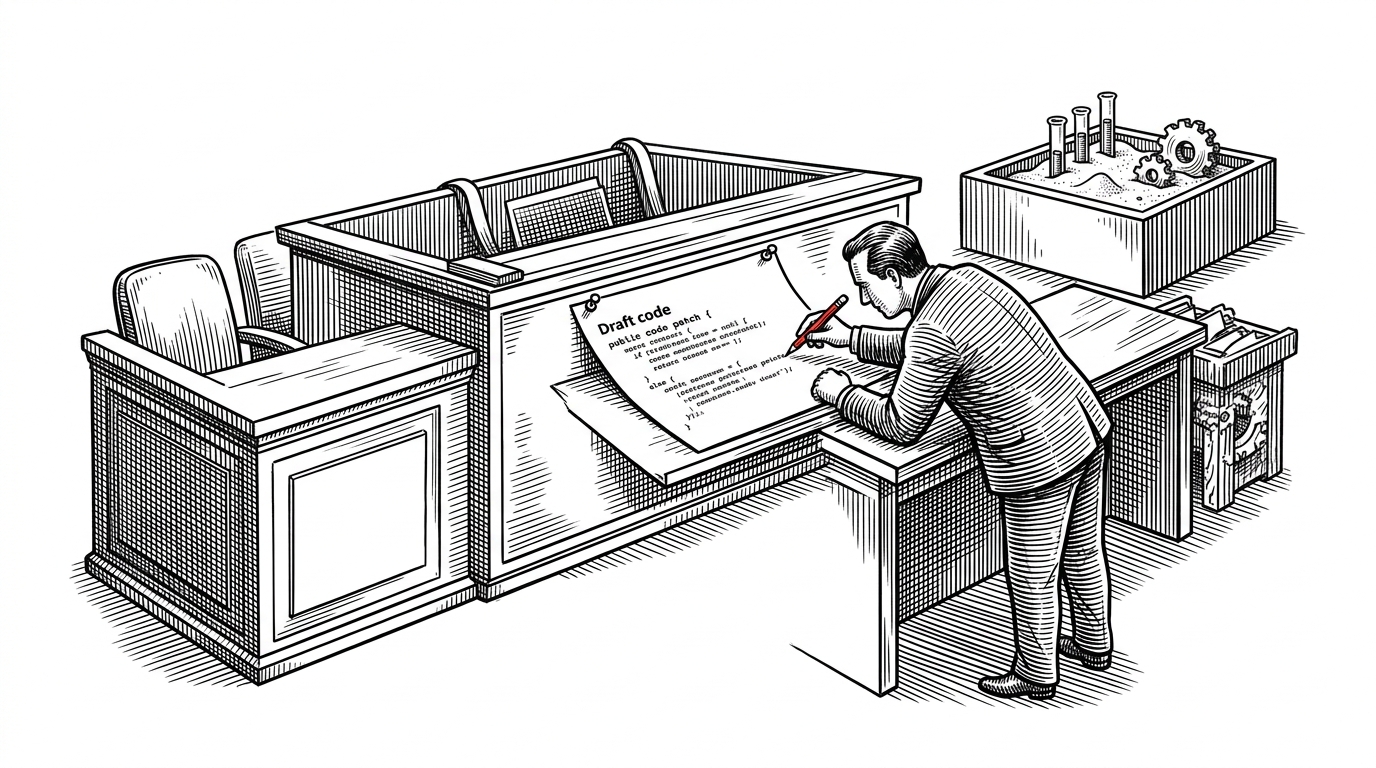
- coding-agents-arena treats disagreement as a runtime primitive, not a side effect of prompting.
- The system only becomes meaningful when critique meets execution, because argument without tests is just theater.
- Its closest neighbors are orchestration tools and dynamic benchmarks, not ordinary coding assistants.
- The tradeoff is deliberate: more confidence costs more tokens, latency, and coordination overhead.
Most coding agents optimize for a fast first answer. coding-agents-arena optimizes for surviving rebuttal. That shift changes the product category. This is not a helper that drafts code and hopes for the best. It is a system that turns disagreement into a gate.
That matters because agentic coding tools keep making the same promise in different clothes: write faster, automate more, ship sooner. This repo points at a harsher promise. Make the model defend its work, then run it in a sandbox. If it breaks, the argument was cheap.
The core idea is dialectical debugging
The public footprint around the repo is sparse, but the shape is clear enough. The codebase appears to separate agent roles, orchestration, evaluation, and prompt definitions. One agent proposes a change. Another challenges it. The evaluator decides whether either side was right.
I run 19 specialized AI agents in production. They span iOS, backend, frontend, security, QA, and DevOps.
The interesting implementation choice is not the agents themselves. It is the state model. Instead of letting every round overwrite the same file blindly, the arena can treat each turn as a patch against a managed workspace. That keeps the debate legible and gives the evaluator something concrete to accept or reject. It also helps compress prior rounds so the next agent does not inherit a bloated transcript.
What it beats, and what it does not
The competition is not another chat box. It is the default habit of asking one model for a solution and trusting the answer. coding-agents-arena is better read as a stricter review loop than as a prettier assistant.
| Approach | What it optimizes for | Weak spot |
|---|---|---|
| Single coding assistant | Speed and convenience | Confidence depends on one pass of model judgment. |
| Parallel agent swarm | Breadth of ideas | Outputs can get noisy without a decisive judge. |
| coding-agents-arena | Proposal, critique, then execution | More expensive in tokens and latency, but stricter about correctness. |
That is why the adjacent ecosystem matters. Dynamic benchmarks like CodeArena are pushing coding evaluation toward real development cycles instead of one-turn trivia. At the same time, open-source orchestrators are trying to coordinate specialist agents across frontend, backend, security, and ops. The center of gravity is moving from code generation to code verification.
The CLI intentionally starts the server as a detached background process and exits immediately. The issue is there's no way to stop it gracefully.
The tradeoff is the story
This design buys rigor by spending compute. More agents mean more tokens, more latency, and more chances to get stuck in a disagreement loop. That is fine if your goal is a benchmark, a research harness, or a high-stakes internal workflow. It is less fine if you wanted a lightweight autocomplete replacement.
The broader market is already splitting along that line. Some tools try to be fast helpers. Others are becoming systems of record for agent behavior, evaluation, and shared context. coding-agents-arena is interesting because it makes honesty a workflow, not a personality trait. In that sense, the repo is less a product demo than a thesis about the next layer of coding infrastructure.