StudentManagementSystem: Student Management System: The Smallest CRUD App That Still Teaches the Whole Stack
A tiny CLI project that makes persistence legible, from user input to stored records, with no framework hiding the plumbing.

- This repo is valuable because it makes CRUD visible, not magical, and that is exactly what a beginner needs to see first.
- The project’s strength is its straight data path from menu input to record storage, which exposes separation of concerns without hiding behind a framework.
- Its restraint is the point: a single-user CLI app is small enough to understand, but complete enough to teach persistence, update, and retrieval.
- Compared with GUI or production systems, it is simpler by design, which makes it a better learning object than a polished demo.
A small caveat: the available research points in two directions, one Python and text-file based, the other Java and JDBC based. The safest reading is to treat this repo as a minimal CRUD teaching project and focus on the thing both versions are trying to teach: how data moves from user input into storage.
This is a simple Student Management System in Python. This project is a command line application which is used to manage students. This project is developed in Python and it is very easy to understand.
A record’s journey through the app
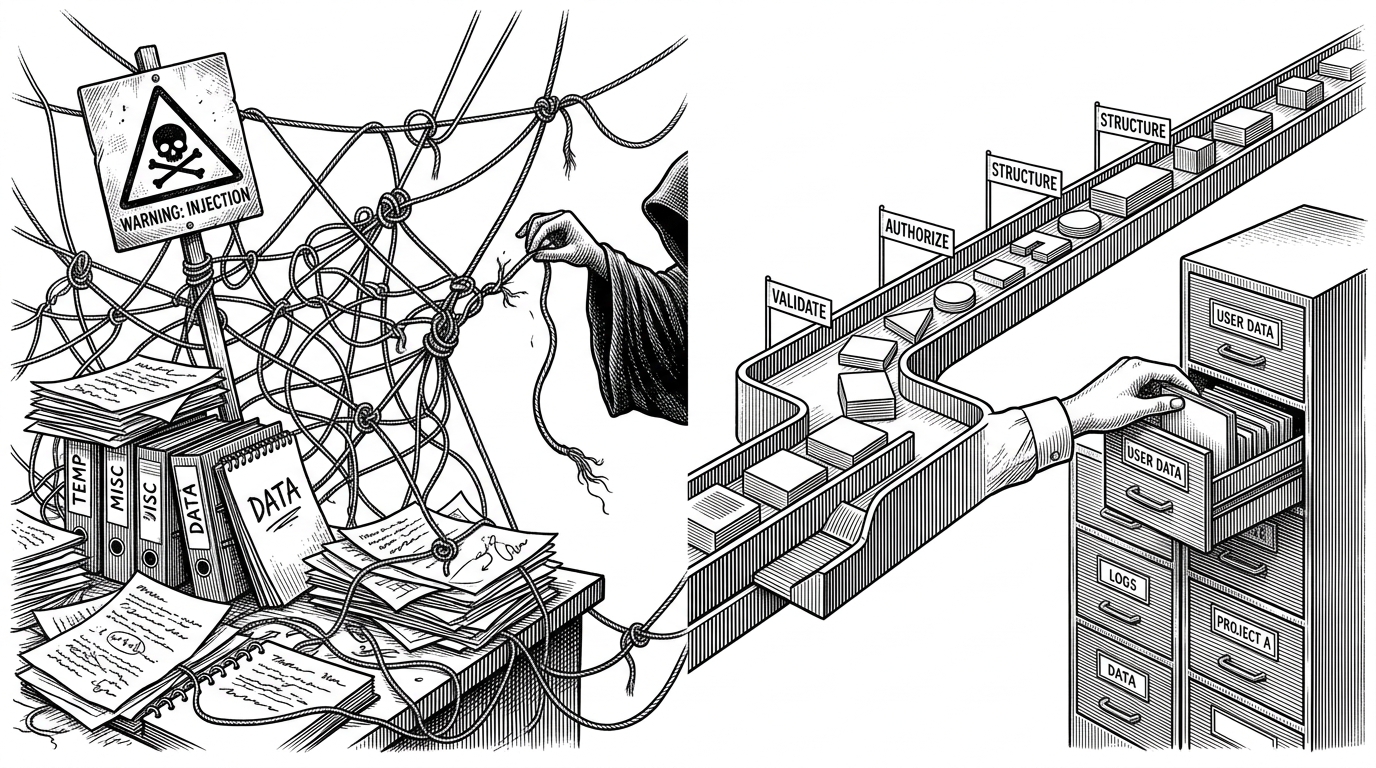
The cleanest way to understand this repo is to follow one student record. A user types a choice in the CLI, enters fields, the program turns that input into a record object, and a persistence helper writes it to storage. On the way back, the app reads the result and shows success or failure.
Why this tiny project is useful
This is the kind of repo that teaches by subtraction. There is no framework to absorb responsibility, no web layer to blur the flow, and no ORM to hide the database boundary. You can see the basic software moves plainly: capture input, validate it, transform it, store it, read it back.
That matters because beginners often learn CRUD through polished tools before they understand the mechanics underneath. This project flips that order. It makes the plumbing the lesson.
What the codebase is trying to do
The repository is organized around a single idea: one part of the program handles interaction, one part handles the record itself, and one part handles persistence. In the Python reading, that likely means a small set of functions around a text file. In the Java reading, the shape would be model, DAO, and connection helper. The architecture is the same either way.
# Conceptual shape of the app
choice = get_menu_choice()
student = capture_student_input()
if choice == 'add':
    save_student(student)
elif choice == 'update':
    update_student(student)
elif choice == 'search':
    result = find_student(student_id)
    print(result)
The point of a structure like this is not elegance for its own sake. It is traceability. If a record is wrong, you can follow the error to the exact step where it changed.
The design choice that matters most
The most valuable choice here is directness. A beginner can read the code and see where data enters the system, where it is shaped, and where it lands. That makes the project a good teacher of state, not just syntax.
If the implementation uses text files, the lesson is that persistence is just disciplined I/O. If it uses SQL, the lesson is that queries are safer when the code keeps values separate from the statement. In both cases, the design favors explicitness over magic.
What it leaves out on purpose
| Project type | Interface | Storage | Strength | Weakness | Best for |
|---|---|---|---|---|---|
| This repo | CLI | Text file or local persistence | Very easy to read | Not built for scale | Learning the CRUD path |
| GUI student app | Windowed app | Often database-backed | More polished for users | More moving parts | Basic desktop UX |
| Production SIS | Web app | Robust relational database | Multi-user and scalable | Much harder to reason about | Schools and institutions |
That comparison is the story. This project is not trying to win on breadth or polish. It wins by being small enough that every line can still teach something.
What this teaches better than a framework tutorial
Framework tutorials often start with abstractions that make the code shorter before the reader knows why those abstractions exist. This repo does the opposite. It forces the reader to encounter the ordinary parts first: input handling, control flow, persistence, and retrieval.
That is why it works as a teaching artifact. Once you understand this version, the framework version becomes a convenience, not a mystery.
Where it sits in the learning ladder
This project sits at the bottom of the ladder, and that is not an insult. It is the right place for a first implementation. A student app that stores records locally is a clean bridge between toy examples and real systems like OpenSIS or Fedena.
The progression is straightforward. First you learn to move a record. Then you learn to store it reliably. Only after that do concurrency, authentication, and multi-user workflows become worth the complexity.