Crop-Cure: The AI crop doctor that knows when to think and when to rule
A full-stack farm management system that pairs image-based disease diagnosis with plain-spoken irrigation advice, built for farmers who may have a phone number, a leaf photo, and not much else.
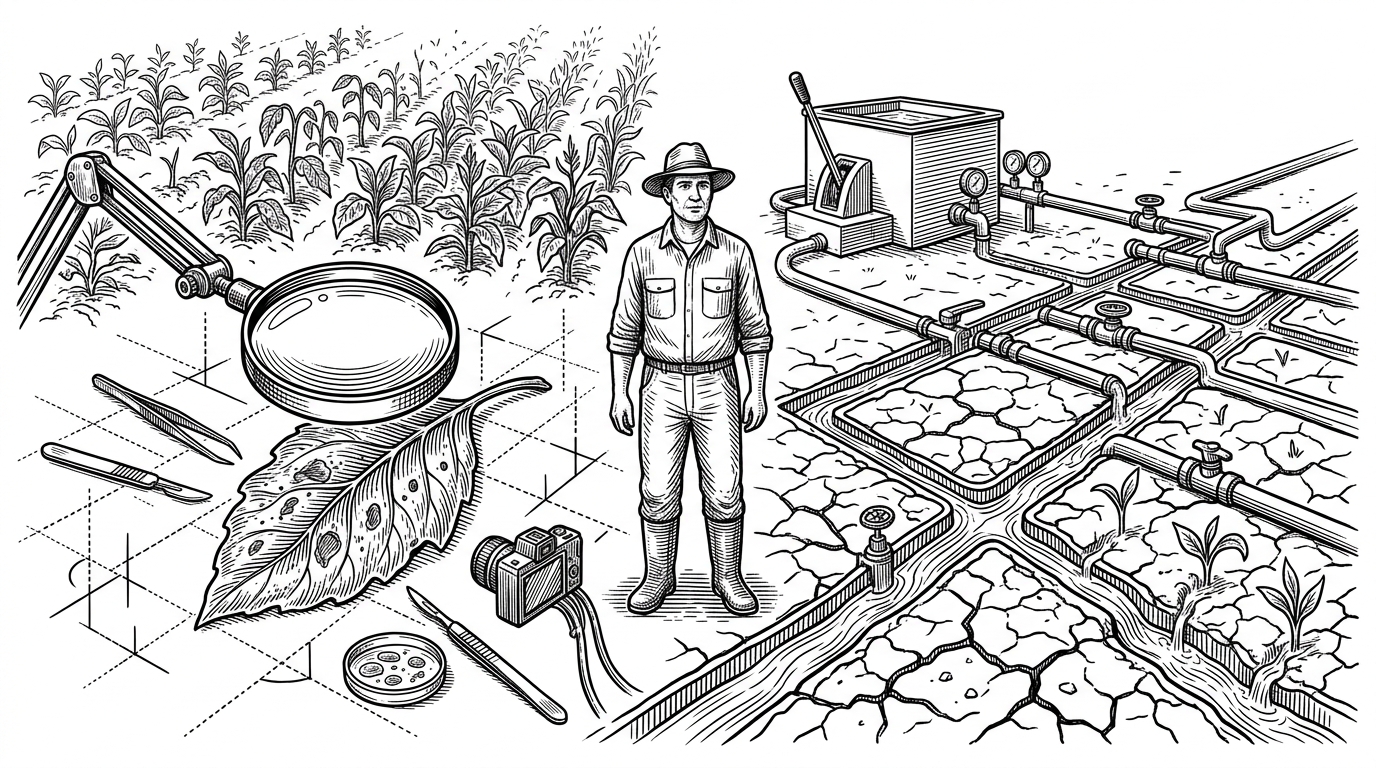 Crop-Cure routes image diagnosis and watering advice through different kinds of intelligence." data-prompt="Create an editorial illustration rendered entirely in black ink on a pure white background. The image depicts a wide agricultural landscape split into two working systems around a single farmer standing in the center. On the left, a diseased leaf is held beneath a large magnifying lens, surrounded by precise diagnostic instruments, a small camera module, and a faint grid of structured analysis marks. On the right, dry soil is crossed by irrigation channels, valves, and water lines arranged like an engineered plan, with a small reservoir and control lever nearby. The composition should make it clear that both systems belong to the same farm, but they solve different problems. The artist uses tightly packed crosshatching lines layered at different angles to build up shadow and form, with clean open areas of white for highlights. The line work has the quality of a classic metal engraving, precise and deliberate, with varied line weights where bold contour lines define shapes and finer interior lines create tonal depth. The overall style evokes vintage newspaper editorial illustrations from The Economist or Wall Street Journal. No color, no gradients, no grey fills. Only black lines on white. The background MUST be pure white #FFFFFF. No paper texture, no cream, no off-white, no noise, no grain. Perfectly clean flat white background." loading="lazy">
- Crop-Cure is not a single AI model wrapped in a web app, but a routing system that sends diagnosis to vision and irrigation to rules.
- Its most important design choice is the separation between probabilistic leaf analysis and deterministic watering advice.
- The repo treats access as product architecture, with phone-first login and Hindi support aimed at real adoption rather than demo polish.
- The project is early-stage, but its hybrid structure is more practical than the average plant-disease detector.
Crop-Cure works because it refuses to force one kind of intelligence to do every job. Leaf diagnosis is noisy, visual, and probabilistic, so the repo hands that task to Gemini. Irrigation advice is a different problem. It needs consistency, so the code uses weather and soil rules instead.
That split is the article’s center of gravity. Many crop projects stop at classification. Crop-Cure goes one step further and turns diagnosis into a workflow that can be stored, localized, and acted on.
Two kinds of advice, one farmer workflow
The product reads like a small but deliberate act of judgment. If the user uploads a leaf photo, the system asks an AI model to identify disease and return structured findings. If the user asks about water, the app does not improvise. It calculates advice from weather, soil type, and simple agronomic heuristics.
That matters because farming software fails when it overpromises a single brain. Some questions want pattern recognition. Others want repeatable rules. Crop-Cure is strongest when it admits that difference instead of hiding it.
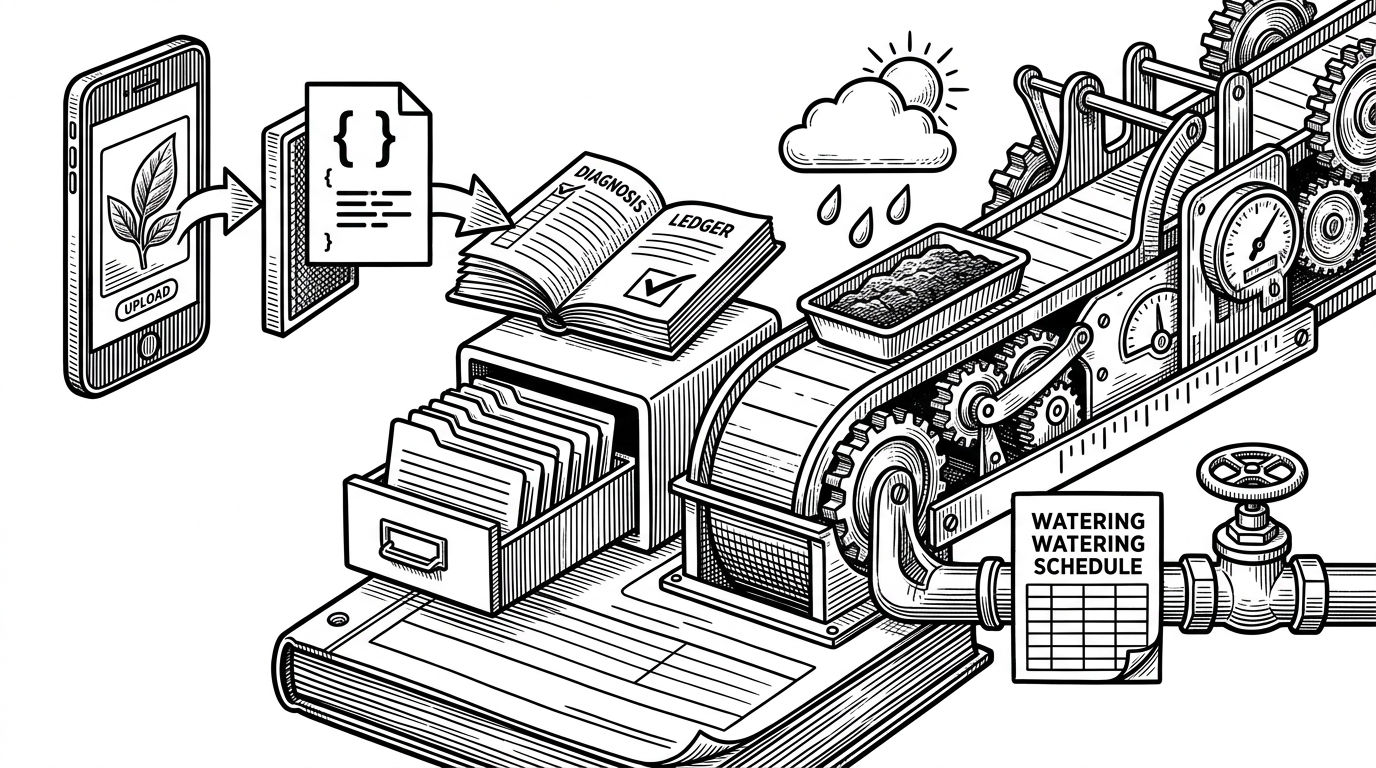
The diagnosis engine turns a leaf photo into structured output
The backend diagnosis controller is the project’s smartest piece of discipline. It does not ask Gemini for a friendly explanation first and clean it up later. It asks for machine-readable JSON up front, then treats the response as data.
const result = await model.generateContent({
  contents: [{ role: 'user', parts: [{ text: prompt }, { inlineData: { mimeType: image.mimetype, data: imageBase64 } }] }],
  generationConfig: {
    responseMimeType: 'application/json'
  }
});

const diagnosis = JSON.parse(result.response.text());
That is not a cosmetic choice. It is what makes the model usable downstream. Once the output is structured, the app can store the diagnosis, attach it to a plot, and render a stable UI instead of chasing free-form prose.
Introducing Crop-Cure, a deep learning-based tool for early detection of plant diseases. This project aims to empower farmers by providing them with a way to quickly diagnose and find potential cures for common crop diseases using just an image of a diseased leaf.
Irrigation advice is the quiet counterweight to the AI
The irrigation side is almost more interesting because it is so restrained. No model hallucination. No fuzzy confidence language. Just weather in, soil type in, and a rule set that returns an action the farmer can understand.
That is the right answer for this task. Watering advice needs predictability. A rule engine may sound less glamorous than an LLM, but it is the more honest tool when the output has to be simple and repeatable.
| Approach | Crop-Cure irrigation | What it signals |
|---|---|---|
| Decision style | Weather and soil heuristics | Rules are the point, not a fallback |
| Output | Watering schedule advice | Action over explanation |
| Failure mode | Too coarse for edge cases | Still easier to trust than a vague model answer |
Why the app feels built for real adoption, not demo value
The user experience shows up in the less glamorous parts of the repo. OTP login accepts email or phone. The frontend supports Hindi and English. The user schema keeps identity fields sparse so a person can register with whichever identifier they actually have.
That is product architecture, not garnish. In a rural setting, friction kills adoption faster than bad typography does. Crop-Cure looks like it was built by someone who understands that access is part of the feature set.
How the frontend keeps the experience simple
The React side stays clean because it carries only a few global concerns: auth state, language, and theme. JWT persistence lives in context. The UI does not try to be clever about session handling. It just keeps the app stable across navigation and login states.
That restraint helps the product feel coherent. A multilingual farm tool should not make people fight the interface before they can upload a leaf photo or check a watering recommendation.
Crop-Cure belongs to a crowded category, but not the same lane
Compared with PlantVillage-style repositories, Crop-Cure is less about benchmark pedigree and more about deployment shape. Compared with commercial tools like Agrio, it is smaller and less complete, but also more explicit about the workflow it wants to support. Compared with the usual single CNN upload demo, it simply does more with the result.
| Project type | Typical strength | Crop-Cure’s difference |
|---|---|---|
| PlantVillage-style academic repo | Dataset scale and research credibility | Crop-Cure is more workflow-oriented and product-shaped |
| Commercial agronomy app | Polished mobile experience and broader feature set | Crop-Cure is open, simpler, and easier to inspect |
| Single-model GitHub demo | Straightforward disease classification | Crop-Cure adds irrigation, localization, and storage |
That does not make Crop-Cure the strongest system in the category. It makes it more legible as a real product. Its advantage is coherence: diagnosis, irrigation, and access all point in the same direction.
What this repo gets right, and what still feels prototype-level
The repo gets the central split right. It uses AI where uncertainty is high and rules where consistency matters. It also thinks about the user before it thinks about the stack, which is why the phone-first and Hindi-friendly choices matter.
The weak spots are familiar for an early project. The OTP store is in memory, which is fine for a demo and fragile for scale. The broader system still needs production hardening. But the architecture already shows judgment, and that is harder to retrofit than a new endpoint.
| Strength | Why it matters | Risk |
|---|---|---|
| Hybrid intelligence | Matches the task to the right tool | More moving parts to maintain |
| Localization and flexible login | Reduces adoption friction | Needs careful operational support |
| Strict JSON output from the model | Makes AI usable in the app | Depends on prompt and model reliability |