`colyseus/vite`: The Multiplayer Starter That Collapses Frontend and Server Into One Dev Loop
A Vite Environment API experiment that lets Colyseus rooms, React UI, and type-safe HTTP routes share one process, one language, and one hot-reload pipeline.
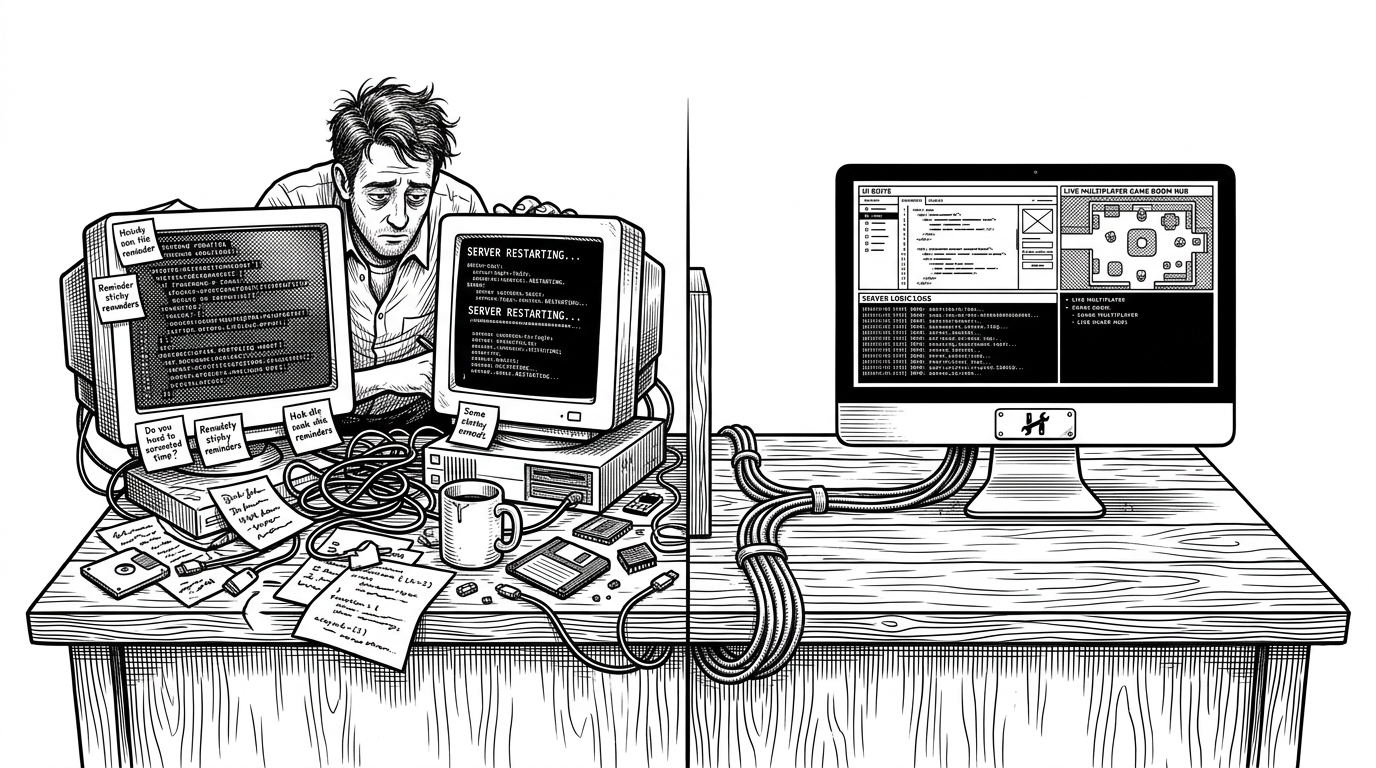

With Grapplenauts, I made the mistake of not knowing exactly what the core gameplay loop was going to look like when I started, and I spent a ridiculous amount of time implementing experimental features, interactions, and entities... most of which ended up being scrapped. I could have saved myself a ton of time by figuring out my mechanics in a local environment (no networking involved), and THEN made it multiplayer.
- `colyseus/vite` matters because it pulls the game server into the same feedback loop as the frontend without turning the backend into a second-class citizen.
- The repo’s real trick is not co-location, but a type-safe pipeline that connects room logic, HTTP routes, validation, and React hooks through one dev surface.
- Zod validation and schema sync make multiplayer iteration safer, because malformed client input gets stopped before it can corrupt authoritative state.
- This feels like a preview of where multiplayer DX is heading: less choreography, more direct editing of live game behavior.
Most multiplayer stacks still make you earn every edit. Change the client, restart one process. Change the server, restart another. Then test the mismatch between them and hope the state you just broke is easy to reproduce.
This repo attacks that ritual directly. `colyseus/vite` treats the multiplayer server like a first-class Vite environment, so the room, the React app, and the typed HTTP surface can all live inside one development loop. That is a workflow change before it is a framework change.
The Two-Terminal Tax
The old pattern is familiar: a frontend dev server on one side, a Node multiplayer server on the other, plus a gap between them where bugs breed. State changes cross that gap through WebSockets, but your edits do not. The result is a slower loop and a weaker mental model.
What Vite Is Doing Differently Here
The key shift is the Environment API. Instead of treating the server as a sidecar process bolted next to Vite, the repo runs server code through Vite’s plugin layer. That means the dev server can reason about both the frontend and the backend as part of one execution environment.
That matters because reload semantics change. When the environment itself is part of the Vite pipeline, server edits can participate in the same hot-reload logic as UI edits. The server stops feeling like a separate world you have to reconnect to mentally.
One Server Definition, Three Kinds of Routes
`src/server/index.ts` is the first real proof that this is not just a nicer folder structure. The `defineServer` abstraction pulls together room registration, Express middleware, and typed native routes in one place. Colyseus room mapping, old-school middleware, and lightweight HTTP endpoints sit side by side instead of being split across unrelated setup files.
| Surface | Traditional setup | `colyseus/vite` setup |
|---|---|---|
| Process model | Frontend and server usually run separately | One Vite-driven development loop |
| Route handling | Express or ad hoc server wiring | Rooms, middleware, and typed endpoints together |
| Type sharing | Often manual or partial | Shared server type surface for client access |
| Reload behavior | Client and server can drift out of sync | Server code participates in the same dev environment |
| Dev complexity | Two terminals, two mental models | One workflow, one place to reason about changes |
The important part is not that routes are co-located. It is that the server no longer needs a separate conceptual toolkit just to participate in the app. That lowers the cost of adding tiny utility routes, admin endpoints, and room entry points without turning the project into a maze.
The Room Is the Brain
`src/server/MyRoom.ts` is the authoritative core. It uses `@colyseus/schema` to define state, which means clients receive compact binary delta updates instead of expensive full redraws of the world. That is the classic Colyseus advantage, but the repo adds a more modern layer on top.
The `move` message is validated with Zod before state mutation. That is the part that should matter to anyone shipping real-time software: malformed input does not get to become game logic. The room accepts a narrow shape of truth, then applies it to the authoritative state.
The reconnection path matters too. `allowReconnection(client, 10)` keeps the session alive for a short window, which is the difference between a transient disconnect and a lost player. For mobile networks and flaky home Wi-Fi, that is not a nicety. It is survival.
The Client Feels Like a Normal React App
The client side does not read like a bespoke game engine wrapper. `App.tsx` uses the hooks-based Colyseus SDK, and `useMovement.ts` runs a decoupled 30Hz input loop. The app can subscribe to room state selectively, so the UI rerenders when relevant data changes instead of on every network twitch.
That small design choice changes the feel of the whole stack. The game client behaves like a conventional data-driven React app, but it is still speaking to an authoritative multiplayer server. The interface stays familiar while the transport stays honest.
Why Zod Matters More in Multiplayer
In ordinary web apps, bad input is annoying. In multiplayer, bad input is a protocol problem. A malformed `move` payload is not just a validation error, it is a chance to desynchronize state, trigger edge cases, or widen the attack surface.
That is why the repo’s Zod usage is more than tidy TypeScript ergonomics. It is defensive multiplayer programming. The server defines the shape of acceptable intent, and only then does it translate that intent into authoritative state.
How This Compares to the Old Stack
| Dimension | Traditional multiplayer setup | Integrated `colyseus/vite` setup |
|---|---|---|
| Process model | Separate client and server processes | One environment that hosts both |
| Reload behavior | Server and client can restart independently | Shared dev loop with less choreography |
| Validation | Often ad hoc message checks | Schema-driven validation with Zod |
| State sync | Manual state handling or patchwork helpers | Colyseus schema sync and selector hooks |
| Reconnection | Often bolted on late | Built into the room flow |
| Iteration speed | Slower, more context switching | Tighter, more direct feedback |
This is not a claim that every multiplayer project should look like this. It is a claim that the old stack spends too much of a developer’s attention on process management. `colyseus/vite` gives that attention back.
Why This Feels Like the Future of Colyseus
Colyseus has always been about authoritative state, sync efficiency, and multiplayer infrastructure that does not waste bandwidth. This repo pushes the brand one layer higher. It says the dev workflow itself should be as ergonomic as the runtime.
That is the important signal here. The next step in multiplayer tooling is not only better netcode or cleaner schemas. It is making server code feel as editable, inspectable, and local as frontend code already does.