the-terminal-news: The 4,000-Byte Newsroom
How a handful of Go files and a "No StackOverflow" rule turned the terminal into a focused, zero-config wire service.
- The utility limits its footprint to 4,000 bytes by favoring stateless design over local databases.
- Hard-coded query constraints filter out StackOverflow results to separate industry news from debugging noise.
- A dedicated error-handling logic unmarshals JSON into specific structs to provide clear feedback on API failures.
- The inclusion of an ASCII art package establishes a distinct visual identity within the minimalist terminal environment.
News Without the Noise
Modern development environments are notoriously loud. Between CI/CD alerts, Slack pings, and the inescapable pull of browser tabs, maintaining focus is a constant battle. Enter the-terminal-news, a Go-based utility that strips the news consumption experience down to its absolute bare minimum.
With fewer than 4,000 bytes of source code, the project is a masterclass in 'Good Enough' engineering. It eschews complex configuration files, local databases, and heavy dependencies in favor of a stateless, imperative design.
#### 1. Get an API Key from NEWS API #### 2. Set environment variable ##### Windows - ``` set apiKey=your_api_key ``` ##### Mac/Linux - ``` export apiKey=your_api_key ``` #### 3. Execute the binary
The "Anti-StackOverflow" Clause
The soul of the-terminal-news lies not in what it includes, but what it explicitly rejects. A look into api/api_main.go reveals a hard-coded constraint appended to every NewsAPI query.
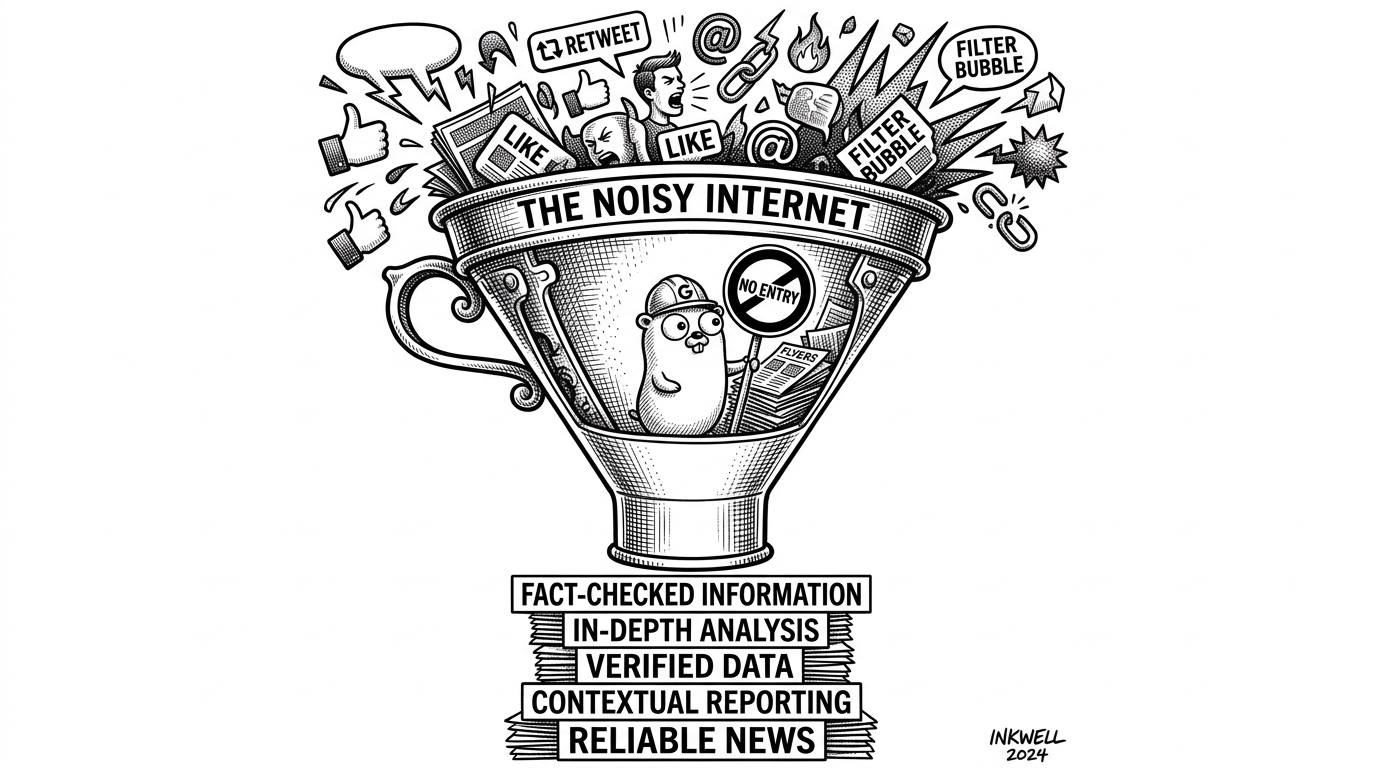
This single exclusion draws a philosophical line in the sand. It distinguishes 'Developer News' from 'Developer Support.' The terminal is already the venue for debugging; this tool ensures that when a user asks for 'tech' news, they get industry headlines, not a feed of unresolved CSS issues.
Anatomy of a 5-Minute CLI
Despite its microscopic footprint, the architecture respects the separation of concerns. The code is divided into three distinct packages: api for network operations, cli for argument parsing via the urfave/cli framework, and art for presentation.
One of the more robust patterns hidden in the api package is its approach to dual-unmarshaling. When the HTTP response returns, the tool first attempts to parse the JSON into a success struct. If that fails, it catches the error and unmarshals the payload into a dedicated Error struct, ensuring the user sees exactly why NewsAPI rejected the request.
| Tool | Language | Data Source | Architecture |
|---|---|---|---|
| the-terminal-news | Go | NewsAPI | API-first, stateless |
| Cast-text | Go | RSS/Atom | Prefetch full-text |
| Newsboat | C++ | RSS/Atom | Local SQLite database |
The ASCII Identity
For a tool so fiercely dedicated to minimalism, it is notable that nearly 20% of the logic is dedicated to an /art package. This package does nothing but print a large ASCII banner upon execution.
In the realm of terminal utilities, aesthetics matter. A sterile output feels like a log file, but a branded ASCII header transforms the terminal into a destination. It’s a reminder that even the smallest tools benefit from a sense of identity.