Partial Control: Inside the Salesforce Kill Switch Architecture
How hwong103/partial uses granular trigger deactivation to survive the complexity of enterprise-scale automation.
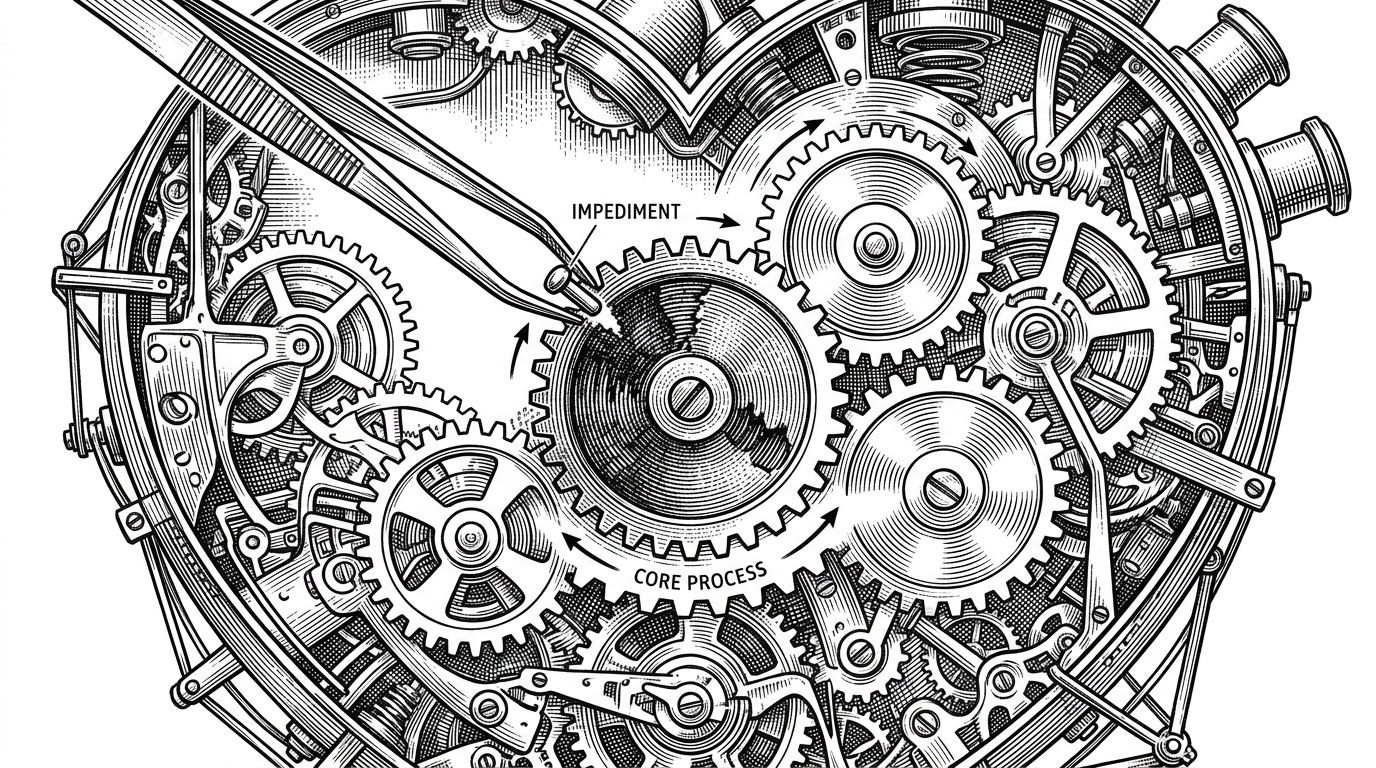
- The partial repository implements a custom object to programmatically deactivate specific triggers during complex automated tests.
- A centralized data factory caches record IDs in static maps to prevent exhausting Salesforce governor limits through redundant database queries.
- The architecture uses a surgical kill switch pattern to isolate bugs by silencing the interconnected logic of the Non-Profit Success Pack.
- Strict C-style formatting via Uncrustify ensures deterministic code quality in a chaotic multi-tenant environment.
The Governor's Gavel
Salesforce operates on a strict multi-tenant architecture. To prevent any single customer from monopolizing server resources, the platform enforces "Governor Limits." These limits cap everything from database queries to CPU time. In heavily customized enterprise environments, particularly those running the Non-Profit Success Pack (NPSP), a single record update can set off a chain reaction of automated triggers. This recursion often exhausts execution limits in milliseconds.
The repository `hwong103/partial` reveals a specialized survival mechanism for this environment. Rather than relying on standard testing protocols, it implements a highly controlled data factory. It is a surgical kit designed to selectively deactivate parts of a massive, interconnected system to allow for safe testing and data maintenance.
The Master Console
At the core of this architecture is `iTest_DataFactory.cls`. This class functions as mission control for the test environment. It relies heavily on a custom object called `TriggerControls__c`, which acts as a master toggle switch for business logic.
When a developer needs to isolate a bug in the Account system, they do not want the Opportunity or Contact triggers firing and polluting the test context. The factory provides methods like `toggleTriggerControlsInstance` to programmatically silence specific triggers. It is feature flagging applied directly to the internal nervous system of the database.
Memory Over Disk
Combating recursion is only half the battle. The other half is avoiding the SOQL Query Limit. Every time a test script asks the database for a record, it consumes a precious query allowance. The `partial` repository solves this by caching record IDs in memory.
Using static maps like `public static Map
| Metric | Standard Testing | The Partial Pattern |
|---|---|---|
| Record Creation | Manual instantiation per test | Centralized factory methods |
| Trigger Behavior | All triggers fire automatically | Granular programmatic deactivation |
| ID Retrieval | Repeated SOQL queries | Static Map memory caching |
The Ghost in the Machine
Beyond the architecture, the repository provides a glimpse into the operational realities of enterprise maintenance. Scripts like `executeAnonymous.cls` act as scratchpads for surgical data fixes, invoking batches with specific point-in-time parameters.
The presence of an exceptionally detailed `uncrustify.cfg` file is particularly telling. Apex is a case-insensitive language with loose formatting norms. Enforcing strict C-style formatting via Uncrustify points to a development culture that values deterministic, rigid order in an otherwise chaotic multi-tenant environment.