The Digital Physics of Move: Inside ticket-tutorial
How a minimalist 50-line Aptos smart contract perfectly illustrates the fundamental difference between Ethereum's central ledgers and Move's resource-oriented paradigm.
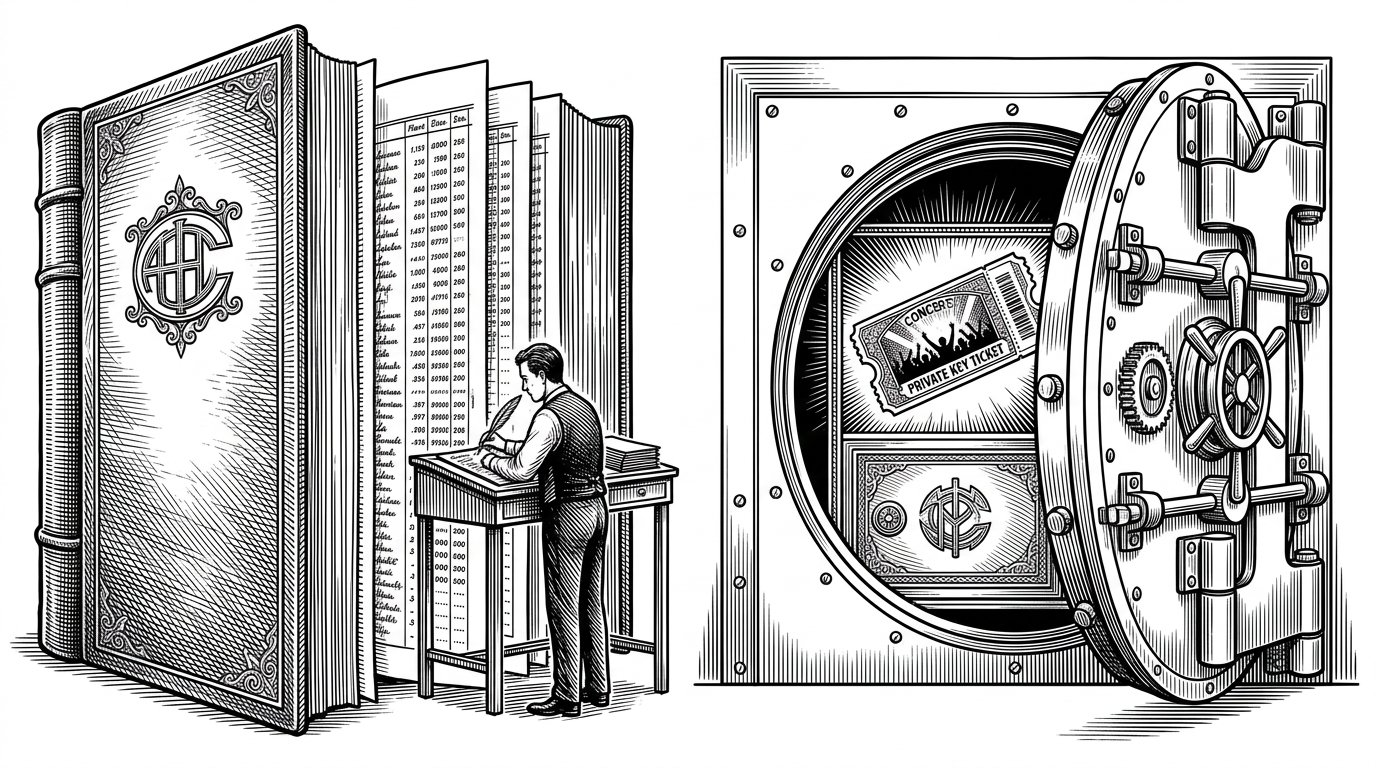
- The Aptos Move language treats digital assets as physical objects that reside within individual user accounts.
- A 50-line tutorial contract demonstrates how the 'move_to' instruction fundamentally differs from updating a centralized ledger.
- Move's resource-oriented architecture enforces security by default by requiring cryptographic signatures to place data in storage.
The Ledger vs. The Vault
Solidity fundamentally operates like a giant spreadsheet. If you own a concert ticket on Ethereum, you do not actually hold a digital object. Instead, a central smart contract maintains a master dictionary mapping your address to a ticket ID.
This centralized ledger model comes with inherent risks. If a vulnerability exists in the smart contract, an attacker can rewrite the master dictionary. In an instant, the mapping changes, and your ticket belongs to someone else.
| Solidity (The Ledger) | Move (The Vault) |
|---|---|
| mapping(uint256 => address) public tickets; | move_to<ConcertTicket>(recipient, ticket); |
| Contract owns the state. | User owns the resource. |
Enter Resource-Oriented Programming
The ticket-tutorial repository by magnum6actual is a minimalist 50-line codebase. It serves as a perfect Rosetta Stone for understanding Move. In the Move language, developers define resources that behave like physical objects.
A ticket is not a ledger entry here. It is a discrete, isolated piece of data. When a ticket is created, it is physically transferred into the user's personal storage space.
Deconstructing the 50-Line Contract
The entire logic resides in a single file called tickets.move. The most critical part of this file is the struct definition. The has key ability grants the struct permission to be saved in global storage.
struct ConcertTicket has key {
    seat: vector<u8>,
    ticket_code: vector<u8>,
}

public fun create_ticket(recipient: &signer, seat: vector<u8>, ticket_code: vector<u8>) {
    let ticket = ConcertTicket { seat, ticket_code };
    move_to<ConcertTicket>(recipient, ticket);
}
Without the key ability, the ticket would vanish as soon as the transaction finished executing. By defining it as a key resource, the developer explicitly instructs the Aptos virtual machine to treat this data structure as permanent, ownable state.

The Cryptographic Handshake
Notice the &signer argument in the function signature. In Move, a signer represents absolute cryptographic authority. You cannot simply airdrop a ticket into someone else's account without their permission.
The signer requirement ensures that data is only placed in an account if the owner explicitly agrees to sign the transaction. This prevents malicious actors from bloating other users' storage with junk data.

A Snapshot of Early Aptos
The project's manifest file points directly to the devnet branch of the Aptos core repository. It serves as a static, frozen-in-time artifact from 2022. It captures the raw, foundational days of Aptos development before complex abstraction layers and standard libraries were introduced.
While modern Aptos development utilizes more sophisticated string libraries and robust access controls, this tutorial remains relevant. It isolates the purest expression of Move's architecture, proving that sometimes the simplest code teaches the most profound lessons.