The Decompiled Logic of a Billion-Dollar War: Inside plutoniummod/t6-scripts
How 25MB of GSC scripting defines the game feel, AI ethics, and architectural soul of Black Ops II.
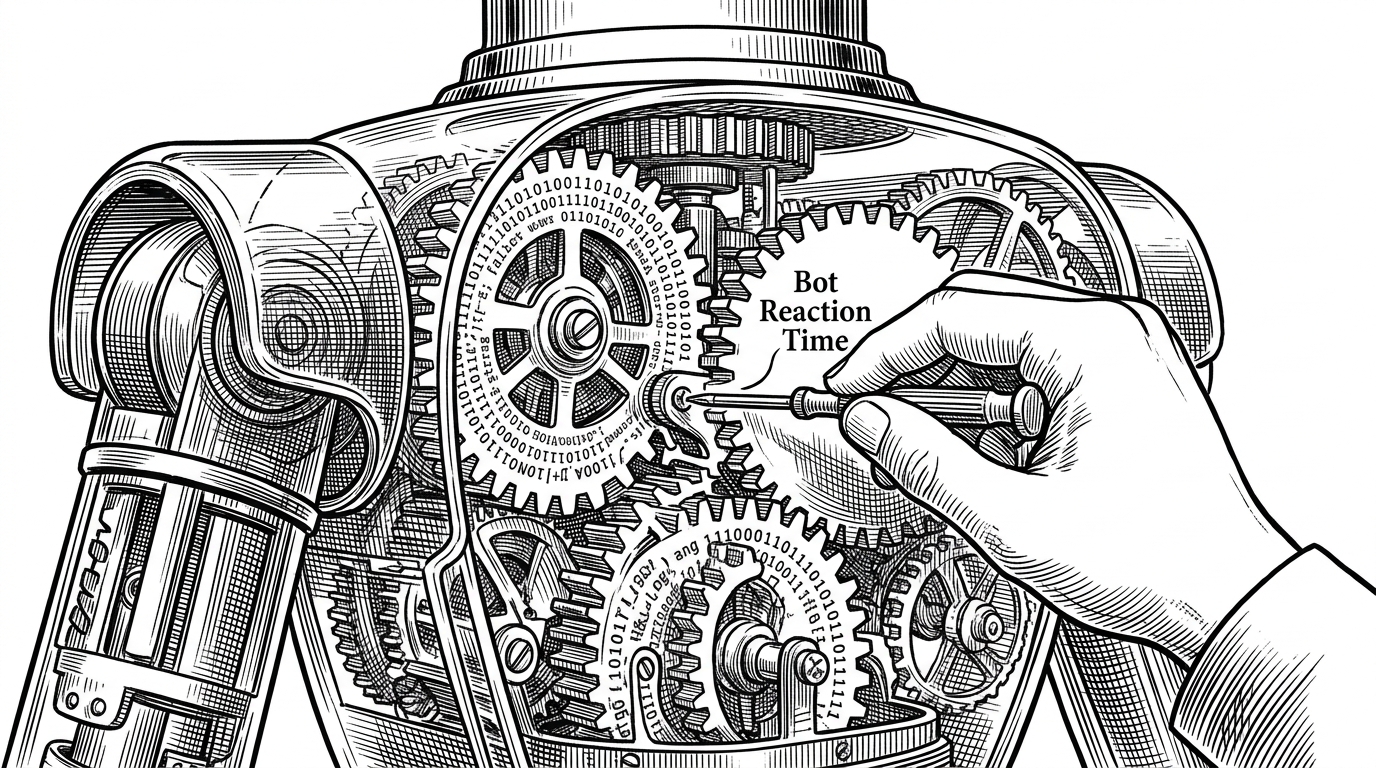

These are unedited decompiled scripts the base game uses nothing else.
- Difficulty scaling for AI bots is implemented through simple timing delays in a continuous evaluation loop.
- The GSC script layer communicates with the C++ engine via dedicated callback functions for player events and damage.
- Spawning logic uses a mathematical influencer system to score map coordinates based on proximity to threats.
- Persistent player data is maintained across match rounds by separating volatile objects from persistent arrays.
The 0.05-Second Consciousness
The source code of a AAA masterpiece is rarely locked in a vault. It often sits in a GitHub repository, readable and moddable. The plutoniummod/t6-scripts repository is the decompiled brain of Call of Duty: Black Ops II. It serves as an autopsy of peak game design from 2012. We are looking at the literal scripts that defined a generation's game feel.
Consider the bots. How does a script simulate a vibe and reaction time? In the file _bot_combat.gsc, bots operate on a continuous loop that evaluates the environment every 0.05 to 0.5 seconds depending on difficulty. Difficulty scaling is literally just a wait command. An easy bot waits 0.75 seconds after a kill to react, while a hard bot waits only 0.25 seconds.
The Callback Bridge
This repository relies on several engine-level abstractions. The file _callbacksetup.gsc acts as the primary interface between the C++ game engine and the GSC script layer. It defines code callbacks that the engine calls directly when specific events occur. If a player connects, takes damage, or a host migration begins, this file handles the handshake.
Without this file, the script environment would be blind to engine-level events. It heavily uses level callbacks (like [[ level.callbackplayerdamage ]]), allowing different gametypes to swap out damage handling logic without modifying the engine-facing function.
level.callbackStartGameType = ::Callback_StartGameType;
level.callbackPlayerConnect = ::Callback_PlayerConnect;
level.callbackPlayerDisconnect = ::Callback_PlayerDisconnect;
level.callbackPlayerDamage = ::Callback_PlayerDamage;
level.callbackPlayerKilled = ::Callback_PlayerKilled;
The Invisible Heat Map
Spawning in a multiplayer game is not random. It is governed by a strict set of mathematical rules. The _spawning.gsc file manages the Influencer system. It calculates where players should spawn based on the positions of enemies, claymores, and active killstreaks.
The system uses a bitmask-based approach to categorize threats. It defines shapes (spheres and cylinders) and curves (linear and steep) to calculate a score for every potential spawn point. The highest score wins.
Survival of the Persistent
A player's lifecycle is managed by _globallogic_player.gsc. It bridges the gap between persistent data stored on servers and volatile data active in the current match. This ensures that when a player joins, their rank, challenges, and unlocks are correctly loaded.
The most elegant aspect is state persistence. The self.pers array survives player deaths and round transitions, while the self object is often wiped or reset. This distinction allows the game to handle complex round-based logic without losing track of earned medals or scorestreaks.
From GSC to the Modern Era
The ecosystem represents the modernization era of Call of Duty modding. While legacy GSC remains the native way to mod, the shift toward Lua-based wrappers provides a more robust, performant, and accessible environment. It lowers the barrier to entry for new creators.
Plutonium T6 now supports loading source scripts so compiling them isn't needed anymore
| Feature | Plutonium T6-Scripts (Lua) | Legacy GSC |
|---|---|---|
| Language | Lua 5.1 / Luajit | GSC (Proprietary C-like) |
| Approach | Plugin-based wrapper/VM | Native engine execution |
| Ease of Use | High (Modern syntax, tables) | Medium (Quirky, limited types) |
| Performance | High (Luajit is very fast) | Native (Optimized for engine) |