replicate/getting-started-vinext: The Next.js Starter That Isn’t Running Next.js
It keeps the App Router feel, routes AI inference through Replicate, and shows how vinext and Cloudflare Workers can carry the stack without the usual Node-heavy assumptions.
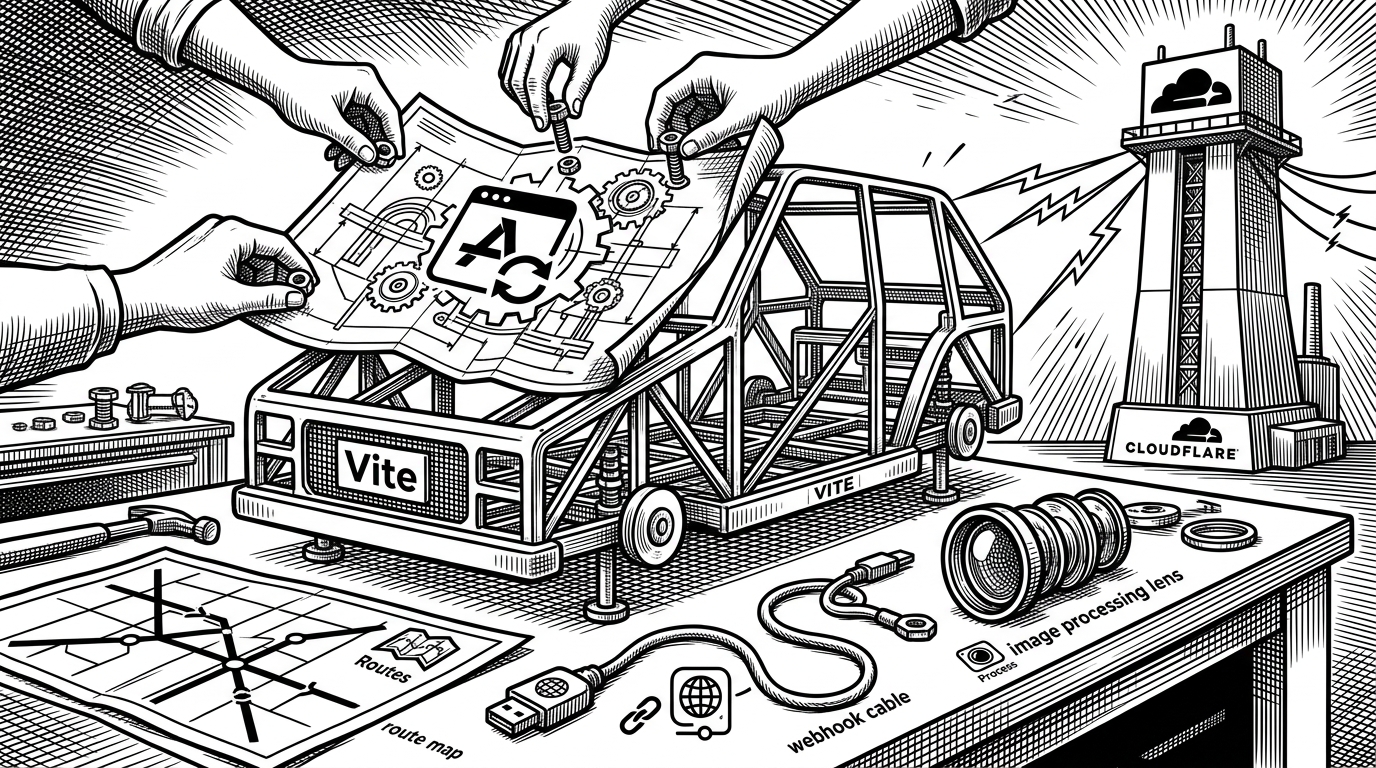

This is a vinext starter app that uses Replicate to generate images with [FLUX.2 [klein]]. It deploys to Cloudflare Workers.
- The repo's real innovation is a runtime swap that keeps App Router habits while moving execution onto vinext and Cloudflare Workers.
- Replicate is the payload here, but the architectural story is the split between fast polling and durable webhook truth.
- The image shim is a tiny code path with an outsized payoff because it replaces a heavy framework assumption with a narrow edge-native bridge.
- This starter argues that Next.js ergonomics and Next.js runtime are separable, which makes edge deployment feel like a rewire instead of a migration.
A Next.js starter with a different engine
At first glance, this looks like another Replicate starter. It is actually a bet that the App Router experience can live outside Next.js, on vinext, Vite, and Cloudflare Workers.
That is the useful twist. The repo keeps the familiar folder shape, route handlers, and client patterns, then changes the machine underneath them. The AI demo is real, but it is also a decoy that hides the deeper story: runtime portability.
Why vinext exists at all
vinext exists because a lot of developers want Next.js-like DX without inheriting a Node-first runtime. This starter is a practical proof that you can keep the mental model and move the deployment target to Cloudflare Workers.
That shows up everywhere in the repo. You see App Router conventions next to Cloudflare-specific files like `wrangler.jsonc` and `.dev.vars`, which is a quiet but important signal that the app was built for the edge, not translated there after the fact.
The quote is blunt because the repo is blunt. It is not trying to reinvent generative AI. It is trying to make a familiar React app shape fit an edge runtime without forcing every team through an adapter maze.
One prediction, two clocks
The most interesting machinery in the repo is the prediction lifecycle. The browser starts a mutation, the app polls for immediate state, and Replicate sends a signed webhook when the job is actually done.
const query = useQuery({
  queryKey: ['prediction', id],
  queryFn: () => fetch(`/api/predictions/${id}`).then((r) => r.json()),
  refetchInterval: (state) => {
    const status = state.state.data?.status;
    return status === 'succeeded' || status === 'failed' ? false : 250;
  },
});
That is a smart split. Polling makes the interface feel alive the moment the user clicks, while the webhook route is what lets the app trust completion data instead of hoping the tab stays open.
The webhook handler also does the unglamorous work that matters in production. It clones the request before validation, then verifies the signature so only Replicate can finalize the state.
The Worker shim that makes images feel native
The cleanest edge-specific trick is in `worker/index.ts`. It intercepts `/_vinext/image`, sends that path through Cloudflare Images, and lets every other request flow into the vinext handler untouched.

if (new URL(request.url).pathname === '/_vinext/image') {
  // Route the request through Cloudflare Images, then return the optimized asset.
}

return vinextHandler.fetch(request, env);
This is the pattern repeated across the repo. Instead of asking Next.js to behave everywhere, the app carves out a few edge-native bridges and keeps the rest simple. That keeps the surface familiar and the runtime small.
What this starter proves, and what it does not
The comparison is not really between image models. It is between runtime strategies. Replicate/getting-started-vinext preserves the App Router feel, Replicate/getting-started-nextjs stays with the canonical Next.js path, and adapter-based deployments like OpenNext try to translate between the two.
| Project | Runtime model | Deployment target | Image handling | Webhook support | Operational complexity | Best fit |
|---|---|---|---|---|---|---|
| replicate/getting-started-vinext | Next.js-style App Router on vinext and Vite | Cloudflare Workers | Worker shim maps `/_vinext/image` to Cloudflare Images | Validated webhook plus polling | Moderate | Edge-first teams that want App Router ergonomics |
| replicate/getting-started-nextjs | Native Next.js on the standard Next.js runtime | Vercel or similar Next.js hosts | Standard Next.js image pipeline | Standard API routes and webhooks | Low if you stay in the happy path | Teams that want the canonical Next.js stack |
| Next.js plus an adapter layer like OpenNext | Next.js compiled through a compatibility layer | Cloudflare Workers or other edge runtimes | Adapter-dependent and more fragile | Varies by adapter | Highest | Teams that must keep an existing Next.js codebase |
The takeaway is simple. This repo is not trying to beat Next.js at being Next.js. It is trying to show that the App Router experience can be detached from the Next.js runtime, and that the edge can carry the load without the usual translation tax.