The Embedding-Free Rebellion: Inside shrijacked/TreeRAG
Why a deterministic, LLM-navigated hierarchy is replacing vector databases for high-stakes documentation.
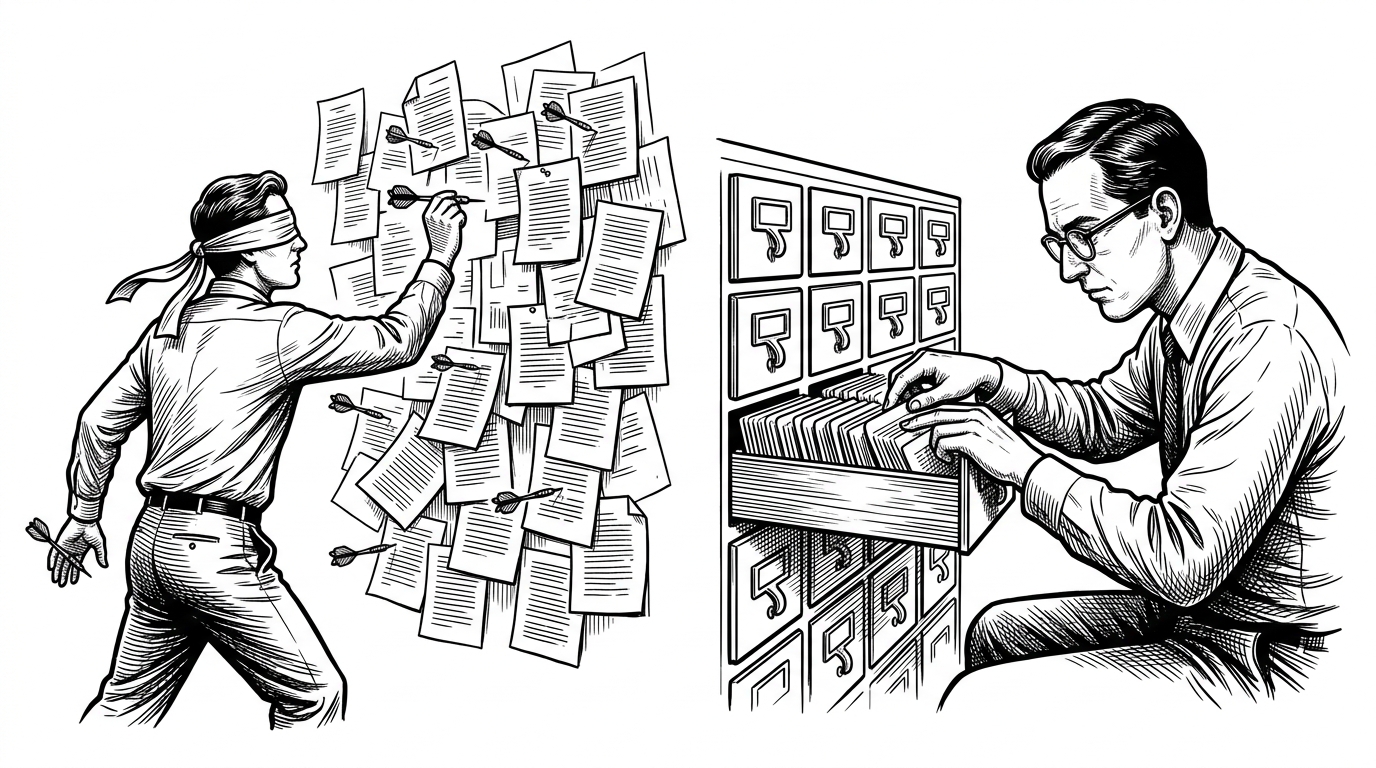
- TreeRAG abandons vector embeddings entirely in favor of an LLM-navigated hierarchical tree of document summaries.
- The framework solves the vocabulary mismatch problem by prioritizing context and literal truth over fuzzy semantic similarity.
- Retrieval is deterministic and traceable, returning exact file paths and line numbers instead of arbitrary similarity scores.
- The precision comes at a steep cost, requiring multiple expensive LLM calls during the indexing phase to build the semantic map.
The Vocabulary Mismatch Problem
Modern AI applications treat the vector database as an unquestioned default. You chunk your documents, embed them into a high-dimensional space, and use cosine similarity to find the closest match to a user's query. For general knowledge, it works beautifully. For structured technical manuals and runbooks, it is fundamentally flawed.
The standard approach suffers from vocabulary mismatch. If a user asks about an 'escalation policy' but the document uses the phrase 'incident routing protocol', a vector search might miss the critical paragraph entirely. Standard RAG relies on fuzzy math. High-stakes documentation requires literal truth and absolute context.
TreeRAG is a specialized Python framework that drops embeddings entirely. It trades the cheap, fast ingestion of vector databases for expensive, deterministic, and perfectly traceable retrieval.
Navigating Instead of Searching
To understand TreeRAG, look at its retrieval engine. When a query enters the system, it does not calculate distances across a massive array of floats. It starts at the root node of a pre-built document tree.
The system presents the LLM with a multiple-choice decision based on the summaries of the root's children. The LLM reads the query, evaluates the summaries, and selects the most relevant branch. This process repeats recursively until it hits a leaf node containing the exact text.
This yields a massive architectural advantage. Every answer includes a precise navigation path and exact line numbers. You get traceable provenance instead of a black-box similarity score.
Building the Semantic Map
The retrieval magic depends on a meticulously constructed index. The ingestion phase uses an LLM to recursively segment raw text into logical sections. If a section exceeds a word threshold, the system calls the LLM again to break it down further.
Once the tree structure is mapped to exact line numbers, the indexer works bottom-up. Leaf nodes are summarized based on their raw content. Parent nodes are then summarized based on the summaries of their children. The root node ends up containing a high-level semantic map of the entire document.
The Cost of Absolute Precision
This architecture deliberately accepts a brutal trade-off. Indexing a document requires dozens of LLM calls. It is significantly slower and more expensive to build a TreeRAG index than to fire a batch of text chunks into a fast embedding model.

To mitigate this, TreeRAG implements a robust file cache. By hashing the prompt and model parameters, the system only re-indexes the specific branches of the tree that have changed. If you update one paragraph in a 100-page runbook, the system rebuilds only that leaf and its direct ancestors.
| Feature | TreeRAG | Standard Vector RAG |
|---|---|---|
| Ingestion Cost | High (Multiple LLM calls per document) | Low (Cheap, fast embedding models) |
| Retrieval Mechanism | Deterministic LLM Routing | Fuzzy Cosine Similarity |
| Traceability | Exact Path & Line Numbers | Approximate Chunk Match |
| Vocabulary Mismatch | Excellent (LLM reasoning) | Poor (Requires exact semantic overlap) |
The Rise of Structured Retrieval
TreeRAG is not an isolated experiment. It is part of a broader movement toward 'Agentic RAG' where retrieval is treated as a reasoning task rather than a math problem.
Instead of precomputing vectors, it constructs a structural representation of each document—a Global Index—that mirrors human navigation patterns. Sections, subsections, appendices, and other logical units are organized into a tree.
As foundational models get cheaper and faster, the heavy ingestion cost of frameworks like TreeRAG will become negligible. For now, it offers a compelling escape hatch for developers building systems where 'close enough' is a failure condition.