Rock RMS: The Church Platform Teaching Its Own Rewrite
A massive .NET codebase, a strict block architecture, and an AI-ready migration playbook show how a nonprofit software stack can modernize without starting over.
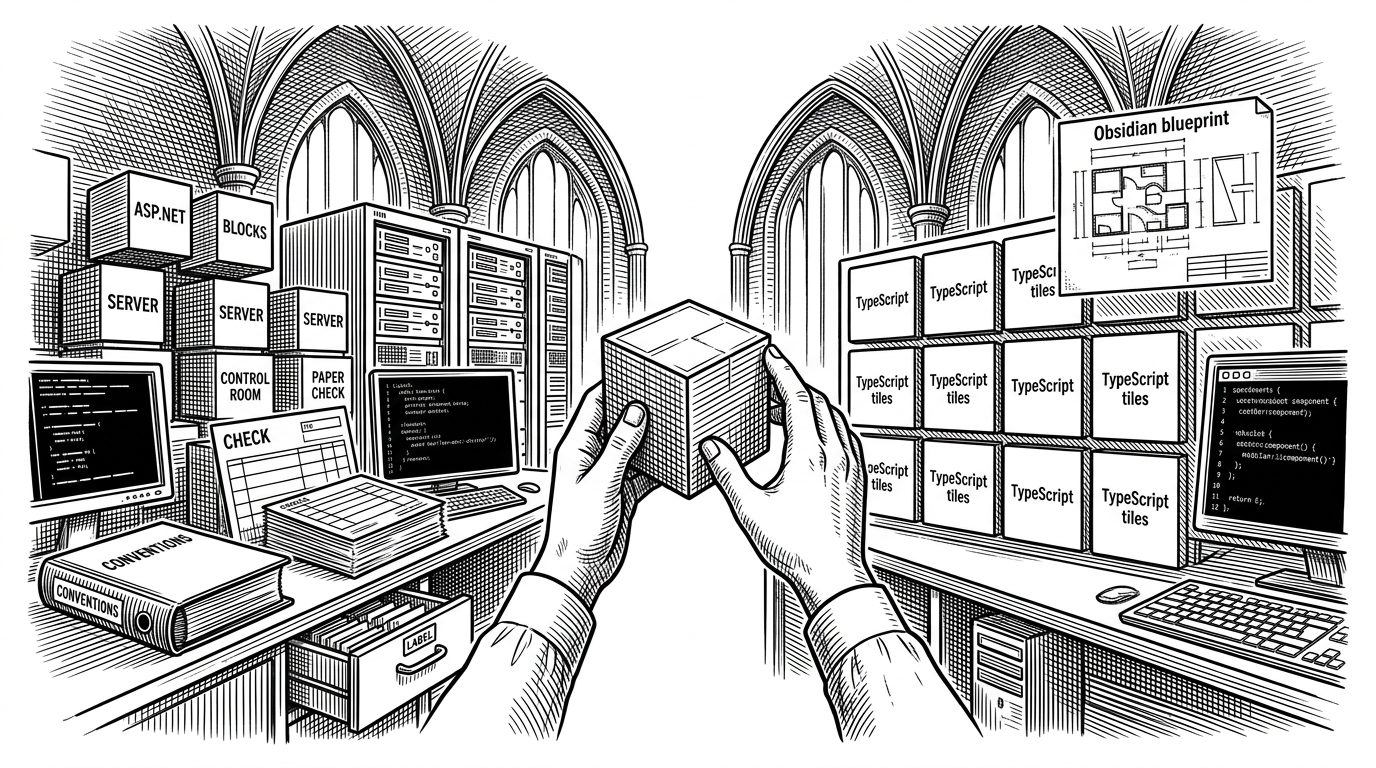
- Rock RMS is most interesting as a system that encodes its own migration path, not as a church CRM with a large codebase.
- Its block architecture turns pages into replaceable units, which makes incremental modernization possible instead of reckless.
- The repo’s `.claude/` and `.github/` conventions act like operating instructions for humans and AI, preserving tribal knowledge in machine-readable form.
- Rock’s real moat is not SaaS convenience. It is the ability to support complex ministry workflows, physical hardware, and deep customization in one stack.
A legacy system that is writing its own migration guide
Rock RMS is old enough to have accumulated the usual warnings: legacy ASP.NET, SQL Server dependencies, jQuery-era UI, Windows hosting assumptions, and a codebase big enough to resist casual change. What makes it unusual is that the repository does not pretend this away. It documents the rewrite inside the repo itself, with conventions, style checkers, and migration rules that treat modernization as a first-class feature.
That is why the Obsidian transition matters. The repo reads less like a frozen product and more like an operating manual for a long, careful transfer from one architecture to another. In Rock, maintenance is not just fixing bugs. It is a formal process of teaching humans and AI how to move the system forward without breaking the trust it already has.
Among the ChMS platforms, our powerful workflow engine is our most distinguishing feature. Rock RMS is really flipping the table on the current ChMS industry.
What Rock actually is: a relationship system, not a generic CRM
Rock is built around the realities that church software usually flattens: families, ministries, giving, check-ins, spiritual journeys, volunteer roles, and multi-site operations. The point is not merely to store contacts. The point is to model relationships, responsibilities, and repeated human workflows.
| Dimension | Generic CRM | Rock RMS |
|---|---|---|
| Primary object | Lead or account | Person, family, ministry, and workflow |
| Operational scope | Sales or service pipeline | Check-ins, giving, events, groups, and follow-up |
| Customization | Mostly configured | Highly extensible at the source and database levels |
| Deployment | Usually SaaS | Self-hosted, Windows and SQL Server dependent |
| Best fit | Standardized teams | Organizations with complex ministry operations |
That distinction shapes everything else. Rock is not trying to be a lighter, prettier CRM. It is trying to be the system of record for institutions that need relationships to become action, and action to happen across both software and physical spaces.
The architecture that keeps the old world alive
The repository is a layered survival organism. `Rock/` contains the core domain logic. `RockWeb/` carries the web application layer. Around them sit auxiliary tools for printing, check scanning, and Windows-specific hardware handling. The stack is broad because the job is broad.
That layering explains why the codebase can modernize without collapsing. Rock still supports a classic ASP.NET world, but it also points toward a TypeScript frontend and stricter conventions around blocks, migrations, and style enforcement. The future is not bolted on as a side project. It is being codified as a pattern.
| Layer | Purpose | What it reveals |
|---|---|---|
| Core C# and EF | Business logic and persistence | The domain is stable, and the data model matters deeply |
| RockWeb | Legacy web UI and page composition | The old interface still carries real production weight |
| Applications / WPF utilities | Printing and scanning hardware | Church software still touches physical devices |
| .claude and .github | Migration rules and developer guidance | The repo is prepared for humans and AI to make consistent changes |
That is a rare combination. Most mature repos accumulate entropy. Rock accumulates instructions.
Why the block model matters more than the UI
The block architecture is the key design idea hiding in plain sight. A page is not treated as a single brittle artifact. It is a composition surface made of blocks, each with its own behavior, constraints, and migration path.
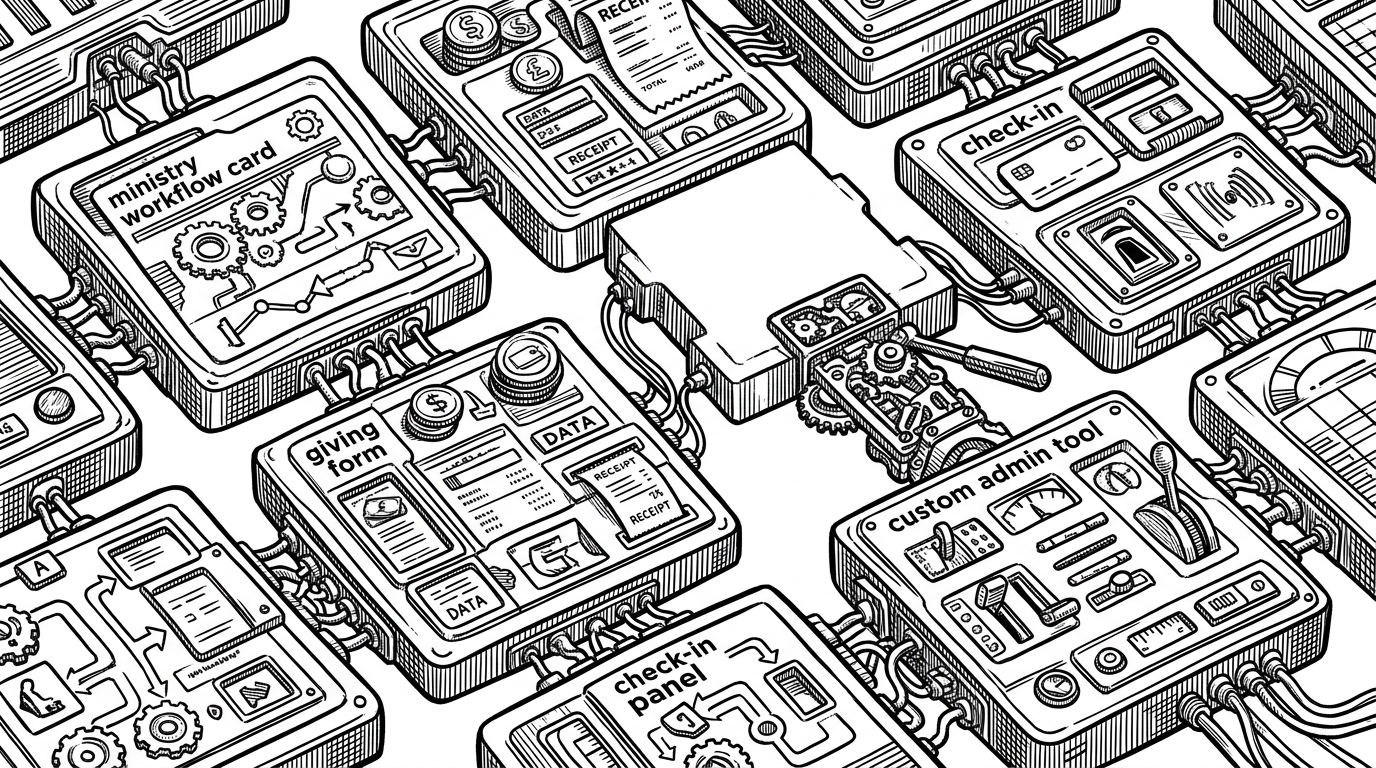
That matters for two audiences at once. Developers get a bounded unit of change. Non-technical admins get a system that can expose complexity without forcing them to think about the whole platform at once.
We are feature comparable with all the big church management systems.
Church tech is not just software. It includes printers, scanners, and paperwork
Rock’s hardware story is easy to miss if you only think in SaaS terms. The repository includes printing utilities, check scanner tooling, and Windows wrappers for MICR and donation workflows. That is not a side note. It is the reality of nonprofit operations.
The lesson is blunt. A church management platform cannot stop at forms and dashboards if it is expected to process physical checks, labels, tickets, and in-person intake. Rock keeps the digital and physical layers connected, which is exactly why it can serve larger organizations with more complicated operations.
| Workflow | SaaS-only assumption | Rock’s approach |
|---|---|---|
| Check donations | Hand off to an external service | Support scanning and processing inside the operational stack |
| Printing | Basic browser print flows | Dedicated print utilities and hardware integration |
| Admin tasks | Mostly screen-based | Screen-based plus physical-world handling |
| Support burden | Simpler but narrower | Harder, but better aligned with real ministry operations |
The ecosystem choice: source-available power vs. SaaS simplicity
Rock sits in a strategic gap that most products avoid. Planning Center and Breeze win on simplicity because they are cloud services. MinistryPlatform competes on depth, but Rock adds source access, database control, and self-hosting in a package that suits organizations with serious internal capability.
That trade-off is not cosmetic. Rock asks for infrastructure, expertise, and patience. In return, it gives churches a platform they can shape around their own operational logic rather than around a vendor’s product boundaries.
| Platform | Deployment model | Main advantage | Main trade-off |
|---|---|---|---|
| Rock RMS | Self-hosted | Deep customization and source access | Operational complexity |
| Planning Center | SaaS | Ease of adoption | Less control over internals |
| Breeze ChMS | SaaS | Simple pricing and usability | Limited depth for large organizations |
| MinistryPlatform | Proprietary platform | Enterprise customization | Vendor dependence |
That is also why the licensing conversation matters. Rock is practical open source in spirit and source-available in governance, which makes it attractive to mission-driven institutions that want control without pretending the economics are neutral.
What Rock reveals about modern maintenance
Rock’s real innovation is not a flashy interface or a trendy stack. It is the decision to preserve institutional knowledge in the repository itself. Conventions, style rules, block patterns, and migration guides become part of the product, not just part of the process.
That is what serious legacy modernization looks like. Not heroics. Not a full rewrite fantasy. Rules, automation, and a willingness to turn tribal memory into machine-readable guidance.