DSPy: The Compiler That Turns Prompts Into Programs
A deep dive into the Stanford NLP framework that replaces manual prompt hacking with signatures, modules, and optimization loops.
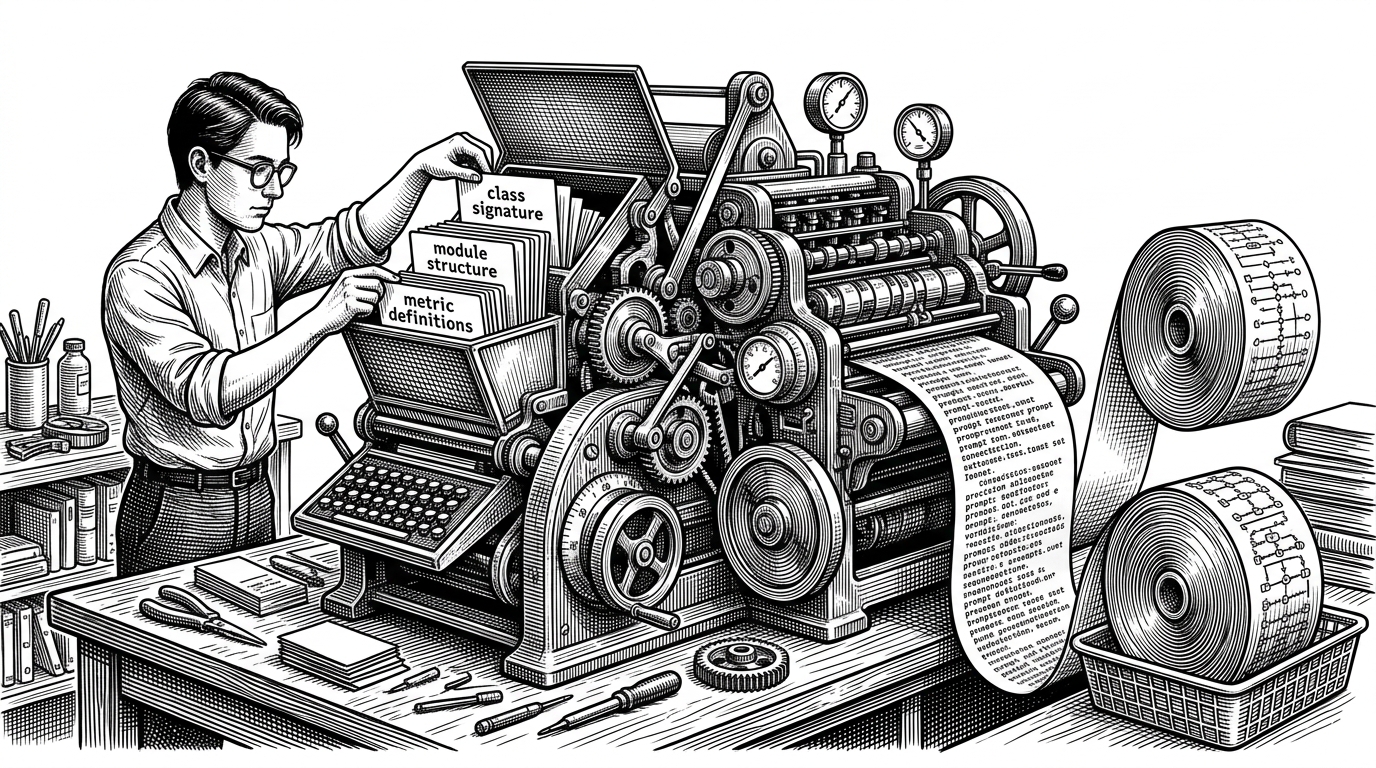
- DSPy replaces prompt tinkering with a declarative model where signatures, modules, and metrics define the task.
- Its real innovation is compilation: the framework searches for better prompt behavior instead of asking humans to hand-edit every instruction.
- The project is most convincing when you already have examples and a metric, which makes optimization measurable rather than mystical.
- DSPy is not an orchestration layer like LangChain or a retrieval stack like LlamaIndex, because its center of gravity is optimization.
The prompt is not the product
DSPy starts from a blunt idea: if you keep rewriting prompts by hand, you are treating an AI system like a text file. The repo argues for something stricter. Define the task, give it examples, decide how success is measured, then let the framework search for a better implementation.
That shift matters because prompt strings are fragile. They drift across models, break on edge cases, and become hard to reason about once a workflow grows beyond one call. DSPy tries to move that work into software structure, where programs can be evaluated, reused, and recompiled.
copying an optimized prompt into your codebase is like pasting assembly snippets
What DSPy actually optimizes
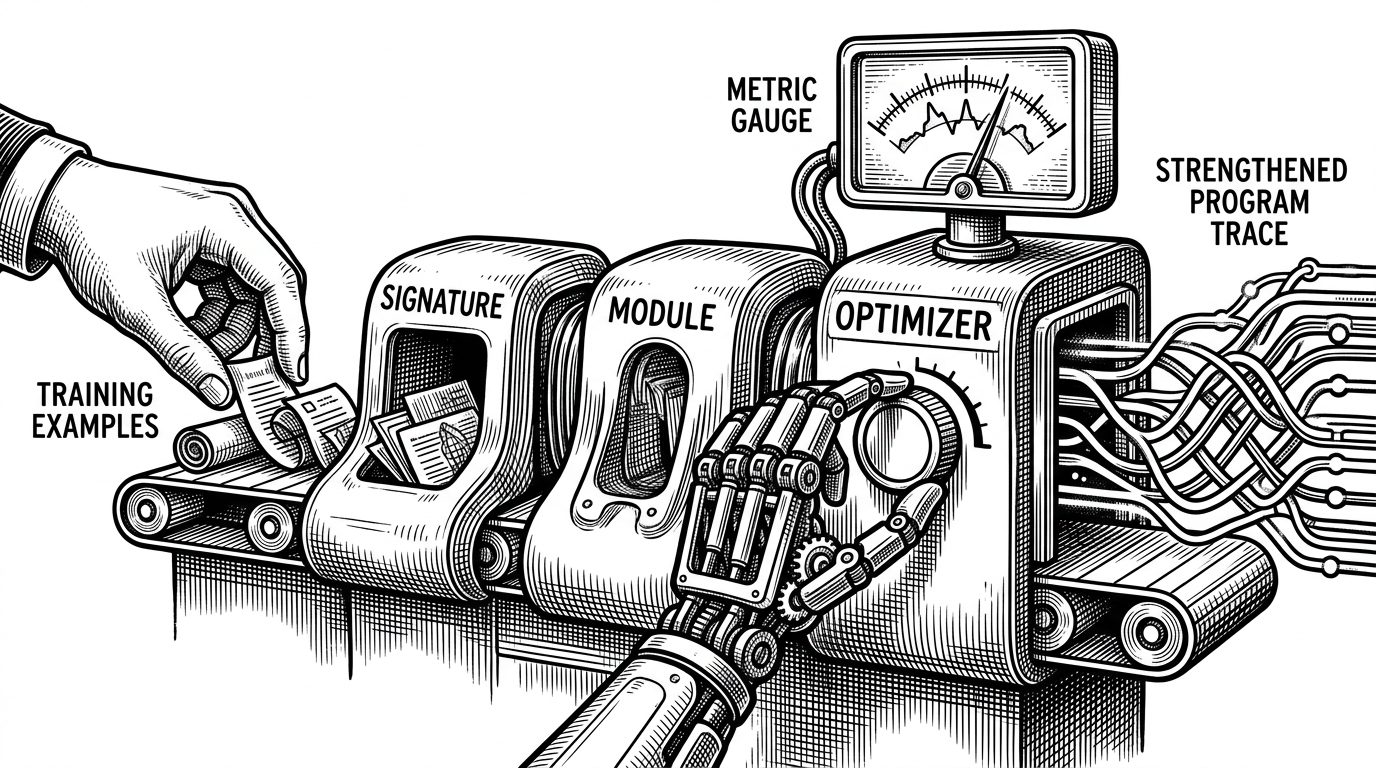
The framework is built around three core abstractions. A signature declares the input and output contract. A module turns that contract into executable behavior. An optimizer, still often called a teleprompter in older docs, uses examples and a metric to improve the program’s prompt behavior.
That is why the framework gets compared to a compiler. You do not manually author the final low-level form. You describe what the system should do, then the optimizer searches for prompt structures that do it better under your metric.
| Project | Primary job | What it abstracts away | What the human still does manually | Best fit |
|---|---|---|---|---|
| DSPy | Optimize LLM programs | Prompt details and few-shot selection | Task definition, training examples, metric design | RAG, classification, extraction, agent loops |
| LangChain | Orchestrate LLM apps | Wiring and tool plumbing | Prompt design and control flow choices | Multi-step app assembly |
| LlamaIndex | Index and retrieve data | Document ingestion and retrieval plumbing | Prompt behavior and downstream evaluation | RAG over private corpora |
| Guidance | Constrain generation | Token-level output shaping | Higher-level task optimization | Structured outputs and templates |
The backbone: Module, Example, Prediction
The primitives are the reason DSPy feels like a programming system instead of a prompt library. A module wraps a forward() method, but the framework intercepts execution so it can track history, usage, and nested calls. That history matters later, because optimization needs to know what happened during successful runs.
import dspy

class QA(dspy.Signature):
    question = dspy.InputField()
    answer = dspy.OutputField()

class Answerer(dspy.Module):
    def __init__(self):
        self.predict = dspy.Predict(QA)

    def forward(self, question):
        return self.predict(question=question)

program = Answerer()
result = program(question="What is DSPy?")
Examples behave like flexible records, but they also tag which fields are inputs. Predictions extend that idea by carrying outputs, completions, and sometimes score-aware behavior. The result is a small but expressive data model for running tasks, judging them, and iterating on them.
Teleprompters, rebranded as optimizers
The older DSPy name, teleprompter, hinted at the original intuition. The framework is not just picking one prompt from a shelf. It is coordinating a search over candidate instructions, candidate traces, and candidate few-shot examples until the metric improves.
That is where BootstrapFewShot and COPRO matter. BootstrapFewShot uses successful traces to create better few-shot demonstrations. COPRO proposes instruction variants and keeps the ones that score better. In both cases, the human’s job is to define the metric and provide enough signal for the search to be meaningful.
| Optimizer | What it changes | What it learns from | Main tradeoff |
|---|---|---|---|
| BootstrapFewShot | Few-shot demonstrations | Successful traces from a teacher or prior runs | More reliable examples, less manual curation |
| COPRO | Instruction text and prompt structure | Metric feedback across candidate variants | Better adaptation, less direct control |
| GEPA | Reflective prompt evolution | Iterative evaluation and feedback | More automation, more abstraction |
Why this is not LangChain
The category confusion is understandable, because both live in the LLM application stack. But they solve different problems. LangChain helps you wire tools, memory, retrieval, and agents into a runnable app. DSPy helps you make the core LLM behavior better under a metric.
That difference shows up in the workflow. In LangChain, you often still tune prompts by hand after the plumbing is in place. In DSPy, the prompt is part of the search space. The framework is not trying to be the app shell. It is trying to be the optimizer inside the shell.
Where it shines
DSPy is strongest when the task has a measurable target and enough examples to learn from. That makes it a natural fit for retrieval QA, structured extraction, classification, reranking, and agent subroutines. The clearer the score, the more useful the framework becomes.
It is also a good fit for teams that need portability. If the underlying model changes, the old prompt often degrades silently. DSPy’s abstractions make recompilation part of the workflow, which is a cleaner response than copying prompt text from one place to another and hoping for the best.
The tradeoff: power through abstraction
I still can't figure out what it's useful for beyond optimizing basic few shot prompts.
That skepticism is fair. DSPy adds conceptual overhead, a compile step, and a stronger dependence on metrics than many teams are used to. If you do not have examples or a useful evaluator, the abstraction can feel heavier than the problem.
But that cost is also the point. DSPy is betting that AI software will mature the way conventional software did: from hand-crafted strings to structured programs, from local hacks to reusable abstractions, and from vibes to optimization.
The important question is not whether prompts matter. They do. The question is whether prompts should be treated as the final artifact, or as an intermediate representation that a compiler can improve. DSPy chooses the second answer, and the repo is most interesting when you accept that premise.