cc-thinking-skills: A Library of AI Reasoning Skills That Tries to Prove Itself Wrong
A Claude Code skill system, a multi-model evaluation harness, and a brutally honest scorecard that treats mental models like hypotheses, not gospel.
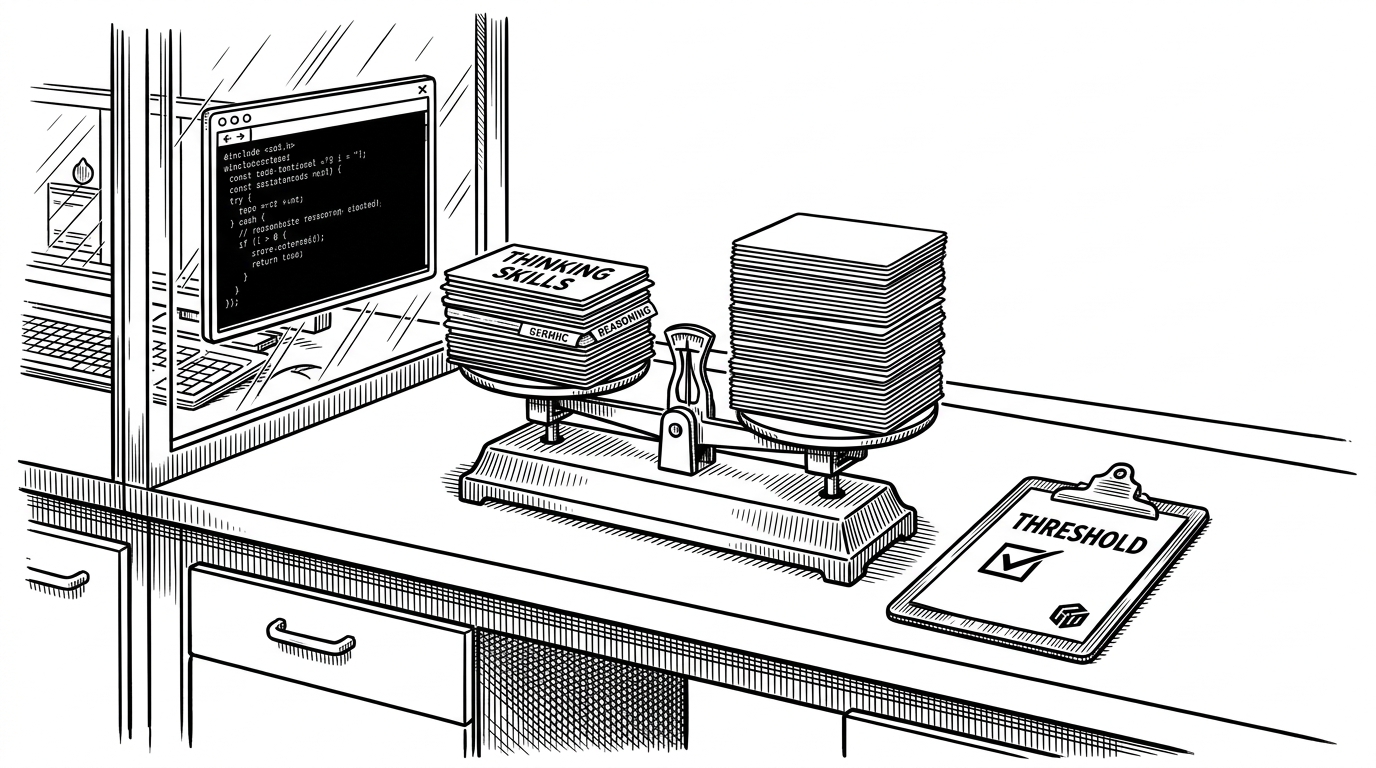
- The repo treats thinking skills as hypotheses, not wisdom, and only promotes them if they survive controlled evaluation.
- Its real novelty is the harness around the skills, which tries to isolate length bias, tool access, and judge preference.
- The router turns a large skill library into something usable by selecting a skill and confidence score for a task.
- This is less a prompt pack than a prototype cognitive operating system for Claude Code.
Most prompt libraries ask you to trust the prompt. This one does the opposite. It starts with the uncomfortable premise that a reasoning skill is worthless until it beats a placebo, clears a statistical gate, and convinces more than one judge model.
The uncomfortable truth: the scorecard comes first
That is what makes tjboudreaux/cc-thinking-skills interesting. The repository is not selling you 39 mental models as if they were finished products. It is trying to find out whether any of them actually help Claude Code do better work.
This repository contains the curriculum for the Critical Thinking course at [Institution Name Redacted in Source].
What this repo actually is
The repo has three jobs. The /skills folder holds the reasoning guides. The /evals folder holds the scoring machinery. The analysis and plugin metadata wrap the whole thing in a usable Claude Code package.
The skills are the surface. The experiment is the product
Each skill is a markdown guide that Claude Code can ingest as a structured reasoning lens. The catalog includes patterns like first principles, OODA, and Bayesian thinking, but the point is not the labels. The point is that each one is testable.
{
  "skill": "thinking-first-principles",
  "confidence": 0.91
}
That turns the repo into a library with a very specific temperament. It does not assume the best framework is the one that sounds smartest. It assumes the best framework is the one that changes outcomes.
How the repo tries to make prompt engineering behave like science
The evaluation contracts define the rules of the game. A skill has to clear a primary delta threshold and a paired significance test before it can be elevated. That matters because it forces the project to separate genuine gain from model theatrics.
| Dimension | Ordinary prompt pack | cc-thinking-skills | Full evaluation harness |
|---|---|---|---|
| Evidence standard | Anecdotes and vibes | Claims must beat a threshold | Paired tests and gatekeeping |
| Prompt structure | Loose instructions | Markdown skill guides | Controlled inputs and contracts |
| Failure handling | Ignored or hand-waved | Marked kill or refine | Explicit verdicts and reruns |
| Scalability | Depends on the author’s memory | Catalog of 39 skills | Automated selection and judging |
| Human selection burden | High | Medium | Lower with router |
The clever part is how the repo tries to keep itself honest. It disables tools during evaluation, uses distractor sets, and runs blind pairwise comparisons. In other words, it keeps asking whether the skill improved reasoning, or just gave the model more words to work with.
The placebo problem

This is the strongest part of the harness. If the skill only works because it bloats context, the neutral filler should do the same job. If the skill still wins, then the content matters. That is a much harder claim, and a much better one.
Why the panel judge matters
A single judge model is easy to bias. A panel of judges is still imperfect, but it is harder to fool. The repo leans into that trade-off by using multiple models to vote on quality rather than letting one model declare victory over its own output.
There is a real methodological tension here. LLMs judging LLMs can amplify shared blind spots. But for a repo that is already trying to control for length bias and tool access, the committee approach is the right kind of practical skepticism.
The router solves the last mile problem
Once you have 39 skills, the bottleneck becomes selection. The router is the repo’s answer. It classifies a task, returns a skill, and attaches confidence so the system can behave more like an operating layer than a static library.
| Problem | Manual skill choice | Router-based selection |
|---|---|---|
| Find the right lens | User remembers the catalog | Model proposes the skill |
| Speed | Depends on expertise | Fast enough for routine use |
| Scalability | Breaks as the catalog grows | Improves as the catalog grows |
| Operational burden | High | Lower |
| Risk | Wrong skill chosen silently | Wrong choice can be inspected |
What this repo is really pointing toward
The deeper idea here is not that prompts should become cleverer. It is that reasoning systems should become testable. That changes the ambition of the project. It is no longer a list of mental models. It is an attempt to build a cognitive stack that can justify its own existence.