cn-math-taxonomy Treats a Wrong Answer as a Symptom
An open prerequisite graph for Chinese K-12 math that walks backward from a student's mistake to the concept they never learned.
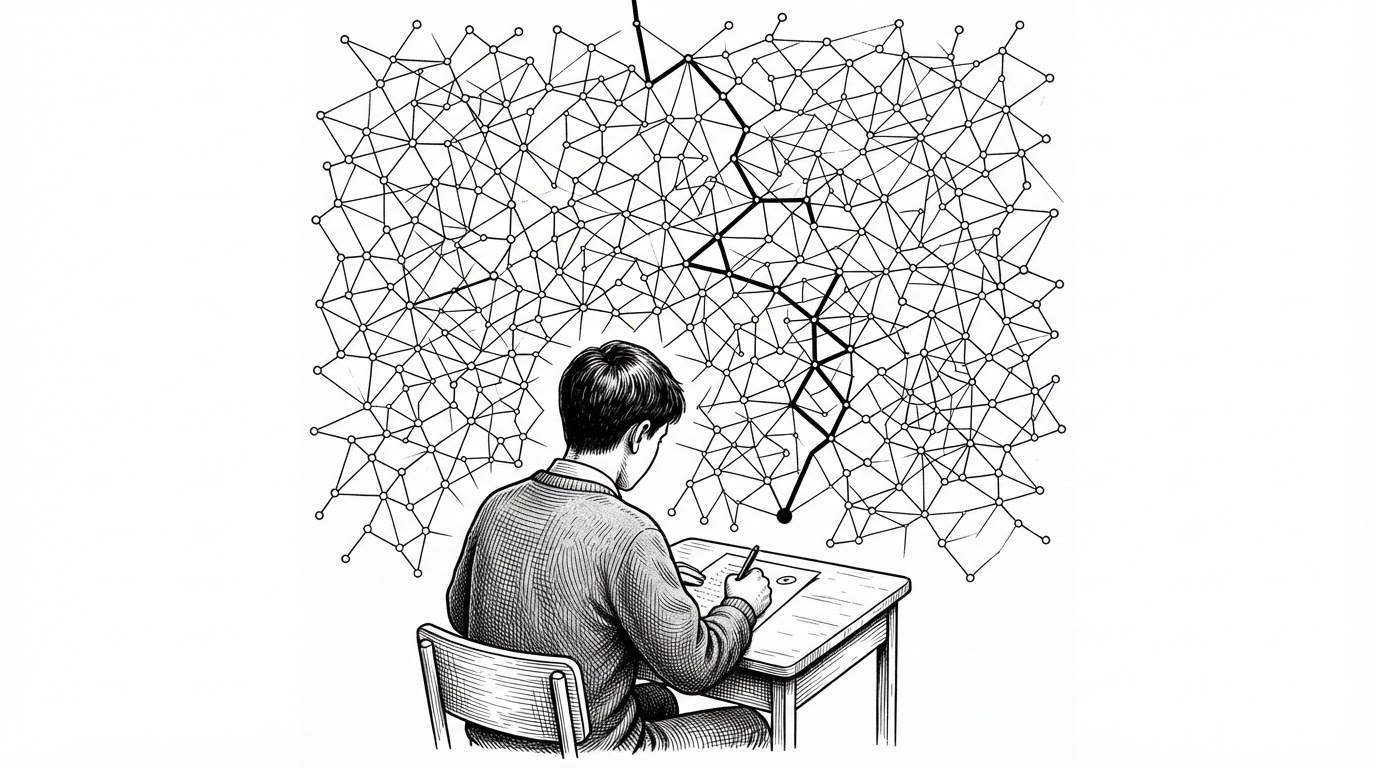
- cn-math-taxonomy inverts the usual tutoring loop: a wrong answer is the symptom, and the missing prerequisite is the disease.
- The engine runs on a two-question protocol that keeps tests short and deliberately refuses to backtrack on a borderline result.
- The whole diagnostic runs as pure functions over a static JSON graph, so a session persists in localStorage with no server.
- The sharp idea sits on an AI-generated draft that no teacher has reviewed, and the project's own counts do not reconcile.
The Wrong Answer Is the Symptom
A student misses a quadratic equations problem. The pencil circles the question. A tutor explains the factoring, the student nods, and everyone moves on. That is how nearly every learning tool handles a mistake: find the error, patch the error.
cn-math-taxonomy starts from a different premise. The visible error is the last thing that went wrong, not the first. The quadratic problem may be fine. The break may be in factoring. And factoring may be fine too, with the real gap sitting one level deeper in the multiplication formulas that factoring depends on. The failed question is a symptom. The disease lives somewhere up the prerequisite chain.
The project states the thesis itself, in the README's own words: 先找到真正没学会的那一步. Find the step you truly have not learned.
That single inversion is the whole point of the repository. It is not a question bank with a search box bolted on. It is a prerequisite graph for the Chinese K-12 curriculum, paired with an adaptive engine that treats backward diagnosis as the primary job rather than a feature.
Diagnosing Backward
The engine runs on a directed acyclic graph. Every knowledge point is a node, and every prerequisite relationship is an edge pointing from the earlier concept to the later one. The graph is built once, then queried.
Edges carry strength. A hard edge means the earlier concept is truly required. A soft edge means it helps but is not strictly necessary. The distinction matters, because when the engine backtracks it prefers hard edges first.
When a target node fails, the engine does not stop there. It walks up the prerequisite edges, testing as it goes, until it lands on a node that is genuinely weak. Then it stops and reports the root cause.
The output is a study path, ordered from lower grade to higher by a topological sort. The student gets a short list of concepts to shore up, not a wall of red marks. The engine reports a status for every node it touched: mastered, shaky, weak, or untested.
Two Questions, Four States
Each knowledge point gets at most two questions. The protocol is small enough to hold in your head.
- Q1 correct: mastered, and the engine infers the ancestors as mastered too.
- Q1 wrong: a second question, same or easier difficulty.
- Q2 correct: shaky, and the engine deliberately does not backtrack.
- Q2 wrong: weak, and the engine backtracks, hard edges first.
The shaky rule is the most opinionated choice in the repo. A borderline result does not trigger a full prerequisite audit. The engine trades a little recall for far fewer false alarms, which is the right call when the goal is to send a student to a short, credible list rather than an exhaustive one. A single lucky answer can hide a real gap, and the design accepts that.
Who Built It
The trail is thin. The repository belongs to the GitHub account @xiaoyang111222, display name Aifeng, with a homepage at math.pansgo.com. No verified real-world identity, no interviews, no conference talks.
Someone built a curriculum graph with hundreds of knowledge points and thousands of questions, wrote an adaptive diagnostic engine around it, shipped a static site, and signed it with a handle. That is the entire available story, and it is worth stating plainly rather than padding into a profile.
又到了每日🔥放福利的时候👇 💻 GitHub · 新仓 top5 1. cn-math-taxonomy 🛠 做什么:对着人教版课标做的中小学数学知识图谱,999 个知识点、4143 道题,带前置诊断 👤 给谁:做 K12 辅导和刷题产品的人 🎯 解决啥:自己扒课标、理知识点的前后关系 💰 怎么赚钱:未公开 🔥 热度:建仓三天 1570 星、341
A Graph That Fits in a Browser
The engineering is disciplined in a quiet way. The frontend is vanilla JavaScript with no framework and no bundler. Each page is a plain script tag. The engine itself is a set of pure functions with a small, explicit surface.
buildGraph(topics, deps, questions?) -> graph
createSession(graph, targets, {limit, seed, avoid}) -> session
nextItem(graph, session) -> {topicId, question, attempt}
applyAnswer(graph, session, id, 'correct'|'wrong'|'skip') -> new session
summarize(graph, session) -> root cause, learning path, status buckets
applyAnswer returns a new session instead of mutating its input, which means a session is plain JSON that can be persisted to localStorage and restored after a reload. The same file runs in the browser and in Node through a UMD wrapper, with no build step. A session can be seeded, so a diagnosis is reproducible.
Small details show care. The graph uses null-prototype maps so that arbitrary string IDs cannot collide with prototype keys. Edges are deduplicated. The topological sort breaks ties by file order, which makes the question order deterministic. Cycle detection throws an error in Chinese rather than silently looping.
The whole thing is a static site. It runs on GitHub Pages and at math.pansgo.com, with a manifest for offline use and a canvas share poster that renders a 1080 by 1920 result card with local QR generation. There is effectively no test suite, which is the one gap in an otherwise careful build.
The Data Is a Draft
Here is the catch, and it is a real one. The graph, the prerequisite edges, and the questions are AI-generated. A technical write-up of the project is explicit that the data has not been reviewed by teachers. The clever engine is reasoning over a substrate that no human has certified.
The counts do not reconcile either. Different sources report different totals for the same project.
| Source | Knowledge points | Questions |
|---|---|---|
| README (math) | 828 | 3,459 |
| Repository description | 1,644 | 6,723 |
| Sina News | 1,244 | 5,123 |
| 0539edu write-up | 802 | 3,355 |
| @inoriaaaa on X | 1,644 | 6,723 |
The README's own math figures (828 knowledge points, 3,459 questions) are the most defensible anchor for a specific release, since the math row matches the README's own arithmetic. The rest should be treated as snapshots from different points in time and different scopes, not as a single settled inventory.
So the engine is careful and the substrate is a draft. The diagnosis is a lead for a teacher to check, not a validated assessment. The project does not pretend otherwise, and neither should anyone reading the output. The engine even hands ambiguous free-form answers to a human rather than guessing.
What It Is Not
It helps to place this against what already exists. cn-math-taxonomy is not a learning platform, not a research instrument, not an open textbook, and not a commercial adaptive engine.
| Project | What it is | Relationship to cn-math-taxonomy |
|---|---|---|
| cn-math-taxonomy | Chinese K-12 topic taxonomy, prerequisite graph, question bank, and adaptive root-cause diagnosis | The subject |
| Khan Academy | Large structured learning platform with exercises and mastery practice | Product-level comparator; does not publish an equivalent open Chinese K-12 prerequisite dataset |
| ASSISTments | Formative-assessment and learning-analytics platform | Adjacent on assessment; different on publishing an open curriculum graph |
| OpenStax | Open textbooks and learning content | Open-content alternative, not a graph-backed diagnostic engine |
| MATHia / Carnegie Learning | Commercial adaptive math product | Product-level alternative; closed, different licensing and scope |
Its niche is narrow and specific: an open, inspectable, Chinese-curriculum-specific link between topic data and diagnosis. A learner's error decides what prerequisite to test next, and the graph proposes foundational topics for review. General platforms offer adaptive practice and open textbook projects offer content. Neither is automatically a substitute for a reusable Chinese K-12 prerequisite dataset plus a separately usable diagnostic engine.