mlx-vlm: The MacBook's Native Vision Engine
How a lightweight Python framework exploits Apple's unified memory to bring multimodal fine-tuning and autonomous GUI agents to consumer hardware.

This PR adds TurboQuant, a compression method that achieves a high reduction in model size with zero accuracy loss, making it ideal for supporting both key-value (KV) cache compression and vector search.
- The framework transforms Macs from passive inference machines into autonomous agents capable of interpreting and acting upon macOS screenshots.
- It utilizes fractional KV cache quantization and strict thinking budgets to run massive multimodal models locally without exhausting memory.
- By selectively freezing the vision-language projector during mixed quantization, developers can fine-tune models on custom visual domains while preserving multimodal alignment.
The Autonomous Desktop
The story of mlx-vlm begins not with code, but with action. Standard local AI setups treat the computer as a passive host for a chatbot. The computer_use module inside mlx-vlm changes this dynamic entirely. It turns the Vision Language Model (VLM) into an active agent that interprets live macOS screenshots and generates precise pixel coordinates for interaction.
This is Actionable AI running natively on consumer hardware. The model captures the screen context, processes the visual data through a finely-tuned local VLM, and physically moves the mouse to click buttons or type text. The MacBook is no longer just running the model. The model is running the MacBook.
Fractional Bits and Thinking Budgets
Running massive multimodal models on a laptop requires aggressive memory management. Apple's unified memory architecture provides the canvas, but mlx-vlm provides the specific paintbrushes required to keep the system from crashing.
The framework implements TurboQuantKVCache, enabling fractional quantization like 2.5-bit compression. This drastically reduces the memory footprint during long-context multimodal chats without the severe quality degradation seen in standard 2-bit quantization.
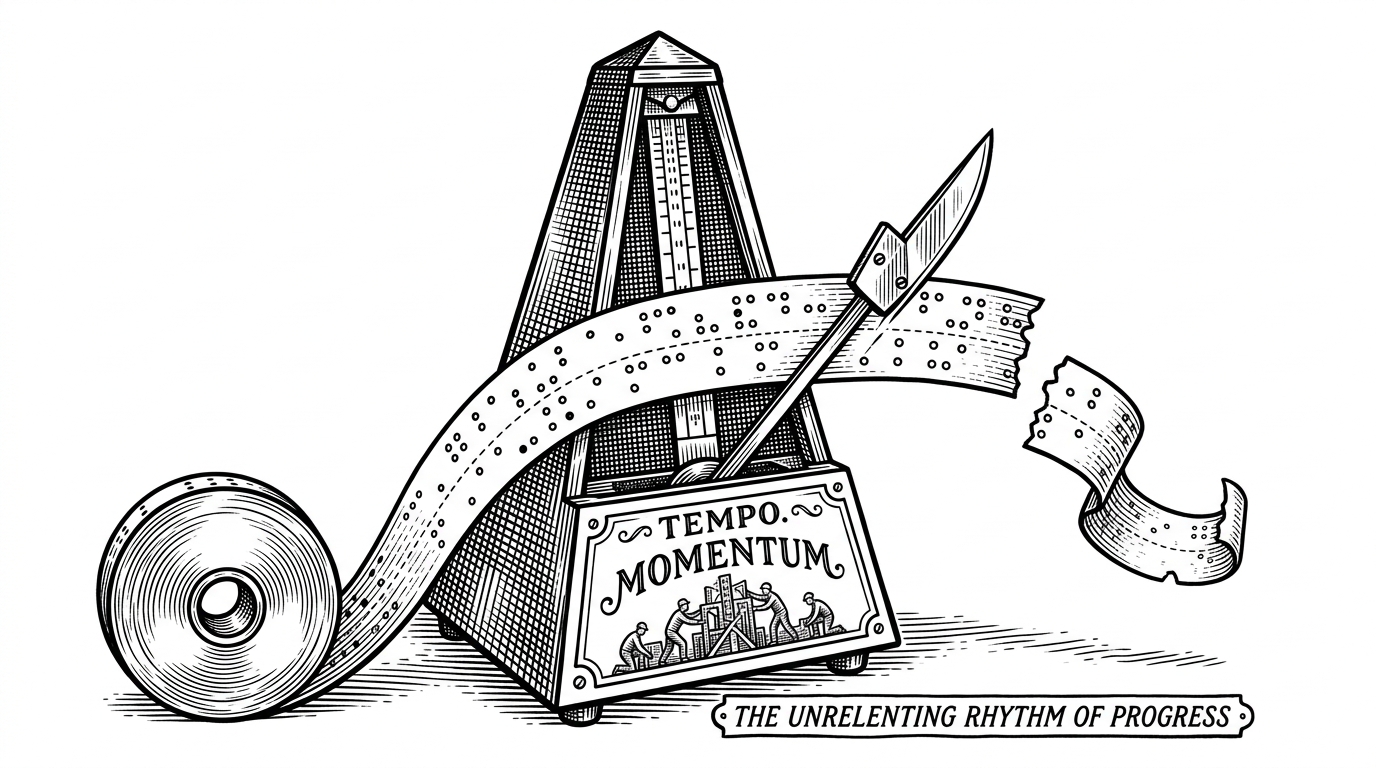
For newer reasoning models, the framework introduces a ThinkingBudgetCriteria. When a model gets stuck in an endless loop of generating internal <think> tokens, this budget forcefully injects a closing token. It is a pragmatic, hard-coded limit that prioritizes latency over endless deliberation.
The Anatomy of a Local Vision Model
Converting standard PyTorch models into MLX format requires a delicate touch. The convert.py module handles this via a mixed quantization pipeline. It applies heavy compression to standard text layers while explicitly protecting the model's ability to see.
The mixed_quant_predicate_builder ensures that sensitive components, specifically the vision-language projector, remain untouched. If you compress the projector, you destroy multimodal alignment. The framework safely shrinks the language brain while keeping the optical nerve at full precision.
Fine-Tuning in the Backpack
Most local AI tools stop at inference. mlx-vlm extends into local fine-tuning through its lora.py implementation. Developers can unfreeze the vision tower and teach models entirely new visual domains offline.

Whether training on proprietary medical scans or custom software interfaces, the ability to fine-tune both the language model and the vision projector locally provides a massive privacy and cost advantage over cloud equivalents.
The Apple Silicon Divide
The landscape of local AI is fragmented by hardware. Standard Hugging Face Transformers struggle with memory overhead on Macs. Tools like vLLM are optimized for maximum throughput on data center NVIDIA GPUs. mlx-vlm occupies the specific niche of leveraging Apple's unified memory for multi-modal tasks.
| Feature | mlx-vlm (Native Mac) | llama.cpp (Cross-Platform) | vLLM (Data Center) |
|---|---|---|---|
| Target Hardware | Apple Unified Memory | CPU / Metal Edge | NVIDIA GPUs |
| Core Capability | Inference + PEFT Fine-Tuning | Inference Only | High-Throughput Serving |
| Quantization | MLX Native / Fractional | GGUF | AWQ / GPTQ |
| Multimodal Alignment | Dynamic Mixed Precision | Static Conversion | Server-side Pipeline |