CLM: Contrastive-LM: The Model That Makes AI Decisions Without Writing Sentences
CLM splits states from actions, caches what it can, and turns agent reasoning into a fast contrastive lookup problem.
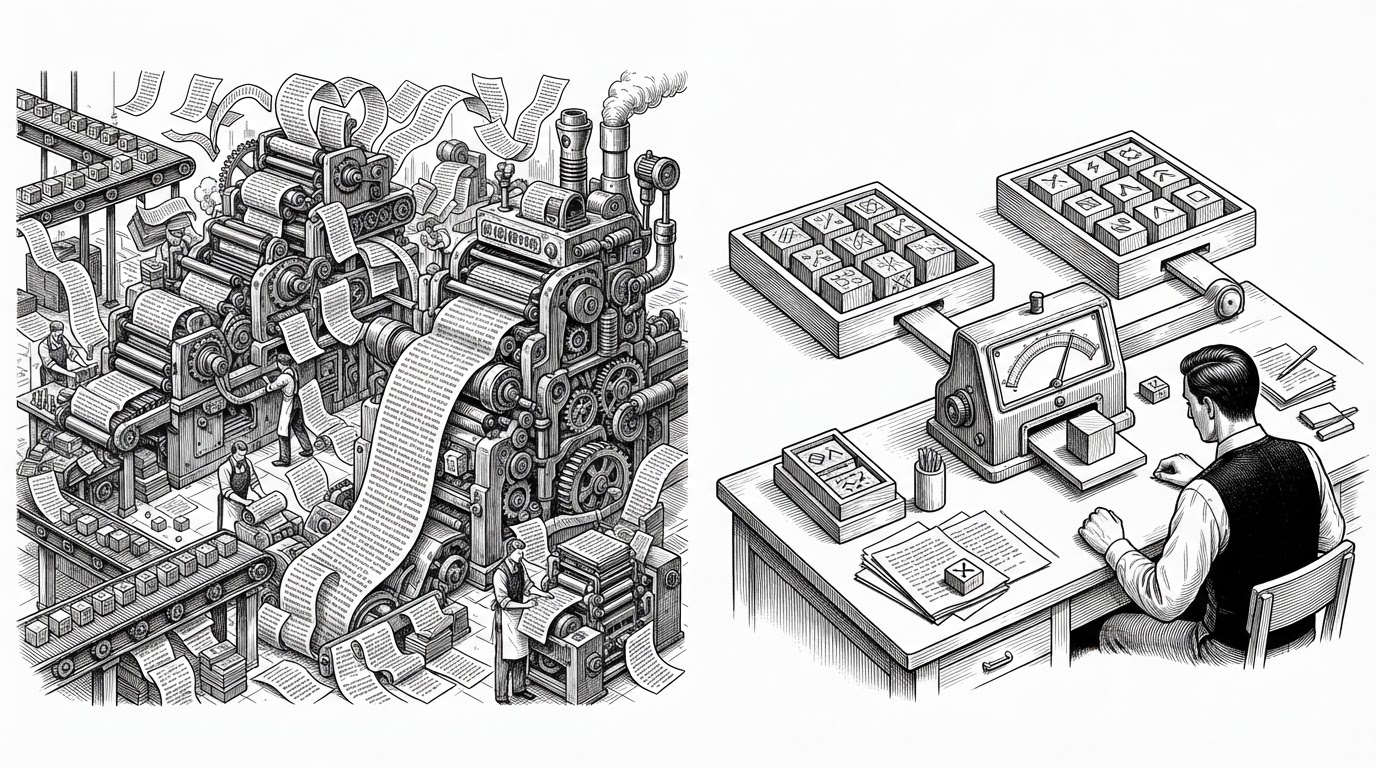
- CLM’s main trick is architectural: it turns agent choice into scoring, not generation.
- By separating state from action embeddings, CLM makes repeated decisions cheaper to serve and easier to cache.
- The repo is really an argument for typed, low-latency System One primitives that fit repetitive agent loops.
- CLM is most compelling where the environment is stable, the action set is reusable, and latency matters more than prose.
Contrastive-LM is not trying to become a better chat model. It is trying to become a better chooser. That sounds small until you look at agent loops, where the same tool options, DOM nodes, or verifier outputs come back again and again.
The project’s bet is simple: if you can separate what changes from what stays reusable, you can make decisions far faster than a token generator can draft them. In CLM, the state moves every turn. The action bank often does not. That single mismatch is where the speedup comes from.
Why CLM Feels Like a Different Species of Model
Most LLM systems fuse prompt, reasoning, and output into one stream. CLM breaks that habit. It embeds the current state and the candidate actions separately, then compares them in a shared space. The decision is not a completion. It is a score.
That matters because it changes the unit of work. If actions can be reused, the model stops paying the full cost of re-encoding them on every step. The engine can cache those embeddings and spend its effort only on the new state.
States and actions are disaggregated, so their embeddings are cached and reused independently, which makes training and serving cheap and blazing fast!
That one sentence is the project in miniature. CLM is not a text factory. It is a matching system for structured decisions.
The Origin of the Idea: System One for Agents
CLM belongs to the System One camp of models, the family that tries to make AI act more like fast judgment than slow narration. The repo frames that as a practical response to agent workloads that need typed outputs, low latency, and repeatable decisions.
The open-source angle matters because the proprietary benchmark was set by closed systems first. CLM answers that by offering an open-weight alternative with the same basic interface shape. It is not just a model release. It is a claim that decision APIs do not have to be rented from a single vendor.
The maintainers also position the project as more than a benchmark chaser. It is meant for computer use, gaming, tool calling, and verifier-style tasks where the action set is constrained and the environment keeps changing.
The Trick Is Separation, Not Generation
The core architecture is a dual-head setup. One path encodes the state, another encodes the action, and both are projected into a common embedding space. The heads are smaller than the backbone and do the real work of turning general representations into decision vectors.
The score is the product of a learned scale and cosine similarity between the projected state and action vectors. That is a small implementation detail with a large implication. CLM is learning compatibility, not language fluency, at the decision layer.
That design also makes the output more legible for software. Instead of parsing free-form text, the system can emit typed primitives such as Noul, Choice, and Score. The API is opinionated on purpose. It is built to keep downstream code simple.
Why Caching Changes the Economics
Caching is not a micro-optimization here. It is the architecture. If the action set is stable across many steps, CLM can precompute those action embeddings once and reuse them every time the state changes. That converts repeated reasoning into a much cheaper compare-and-rank loop.

That is why CLM reads like infrastructure, not just a model. It is trying to make the cost of decision-making depend mostly on the changing part of the world, not the fixed part.
For browser agents, gaming loops, or tool selectors, that difference compounds quickly. The more repetitive the action space, the more CLM’s cache starts to look like the main event.
How the Engine and API Turn Embeddings Into Decisions
The repository is organized like a small production system. The engine handles the inference loop. The embedder connects to a pooled model backend. The server layer exposes the decision API. This separation keeps the hot path lean and makes the pieces easier to swap or inspect.
There is also a raw ablation path. That matters because it lets you compare the learned heads against the base representation space without the projection layers. In other words, the repo does not just claim the heads help. It gives you a route to test whether they do.
# Conceptual shape of the scoring path
state_vec = state_head(encode(state))
action_vec = action_head(encode(action))
score = logit_scale * cosine_similarity(state_vec, action_vec)

# The selected action is the highest-scoring candidate
chosen = max(candidate_actions, key=lambda a: score(state, a))
The typed primitives are the final piece. Noul handles boolean-style judgment. Choice handles categorical selection. Score handles ranked evaluation. That gives downstream systems a clean contract, which is exactly what agents need if they are going to be composed reliably.
CLM vs. Jev, Rerankers, and Traditional LLM Agents
CLM is best understood in contrast to nearby tools. Against a text-generating agent loop, it removes the full decode step. Against a classic reranker, it is more opinionated about typed decisions and repeated action reuse. Against Jev, it makes the strongest case where openness, caching, and local control matter.
| Approach | Decision method | Caching | Output shape | Best fit |
|---|---|---|---|---|
| CLM | Scores state and action embeddings | Yes, actions can be reused across many turns | Typed primitives like Choice, Noul, Score | Repetitive, latency-sensitive agent loops |
| Jev | Closed System One decision API | Less visible to the user, more opinionated in the product | Typed primitives | Hosted decision services and turnkey use cases |
| Traditional LLM agent | Generates text or tool calls token by token | Limited, usually prompt-level reuse only | Free-form text or parsed tool output | Open-ended reasoning and conversational tasks |
| Classic reranker | Cross-encodes candidates against context | Usually candidate-level, but not agent-specific | Scores or ranks | Retrieval and shortlist ranking |