liquidstyleeditor: Taste Skill: The Repo That Tries to Teach AI Good Taste
An open-source frontend anti-slop framework built around portable `SKILL.md` files, tunable dials, and specialized variants that steer agents away from generic UI.


The Anti-Slop Frontend Framework for AI Agents. Portable Agent Skills that upgrade AI-built interfaces: stronger layout, typography, motion, and spacing instead of boilerplate-looking UIs.
- Taste Skill’s main trick is not better prompting, but turning frontend judgment into a portable instruction layer that agents can load and reuse.
- The repo is most interesting when you read it as a system of dials and variants, not as a single prompt file.
- Its value extends beyond code generation because it also tries to improve the handoff from reference images and design intent into shipped UI.
- In landscape terms, it behaves less like a UI kit and more like a behavioral layer for AI agents.
Most AI coding tools can produce a page that technically works. Taste Skill is for the harder problem: getting them to produce something that looks intentional. The repo frames that problem as an anti-slop workflow, where frontend taste becomes a reusable artifact instead of a private skill.
That is the real reversal here. Instead of handing an agent a component library and hoping it improvises well, Taste Skill hands it a set of opinionated constraints. The result is less about invention from scratch and more about keeping the output inside a lane.
Taste, but portable
At the center of the project is `SKILL.md`, a file format that packages design guidance into something agents can actually consume. The repo is built to work across tools such as Cursor, Claude Code, Codex, and others, which matters because the problem it is solving is not framework-specific. It is language-agnostic judgment.
Taste-Skill - gives your AI good taste. stops the AI from generating boring, generic slop
That line from the README is blunt, but it is also the thesis. Taste Skill assumes the failure mode is not lack of capability. It is generic output produced by models that have no taste constraints attached.
What lives inside the repo
The repository is not a single skill. It is a catalog of outcomes. There is a default all-rounder, stricter GPT and Codex variants, redesign mode, soft mode, minimalist mode, brutalist mode, output-completion mode, and image-generation skills that support web, mobile, and brand workflows.
| Variant | Primary bias | Best use |
|---|---|---|
| taste-skill | Balanced taste with adjustable constraints | General frontend generation |
| gpt-taste | Stricter layout and motion rules | GPT and Codex workflows |
| redesign-skill | Audit first, then reshape | Refreshing existing interfaces |
| soft / minimalist / brutalist | Style-specific visual direction | Matching a defined aesthetic target |
| output-skill | Completion discipline | Cleaning up half-finished generations |
The secret is in the dials
The default skill’s most teachable idea is its three controls: `DESIGN_VARIANCE`, `MOTION_INTENSITY`, and `VISUAL_DENSITY`. They make the repo feel less like a prompt pack and more like a mixing board. You are not asking for “better design” in the abstract. You are turning specific pressures up or down.
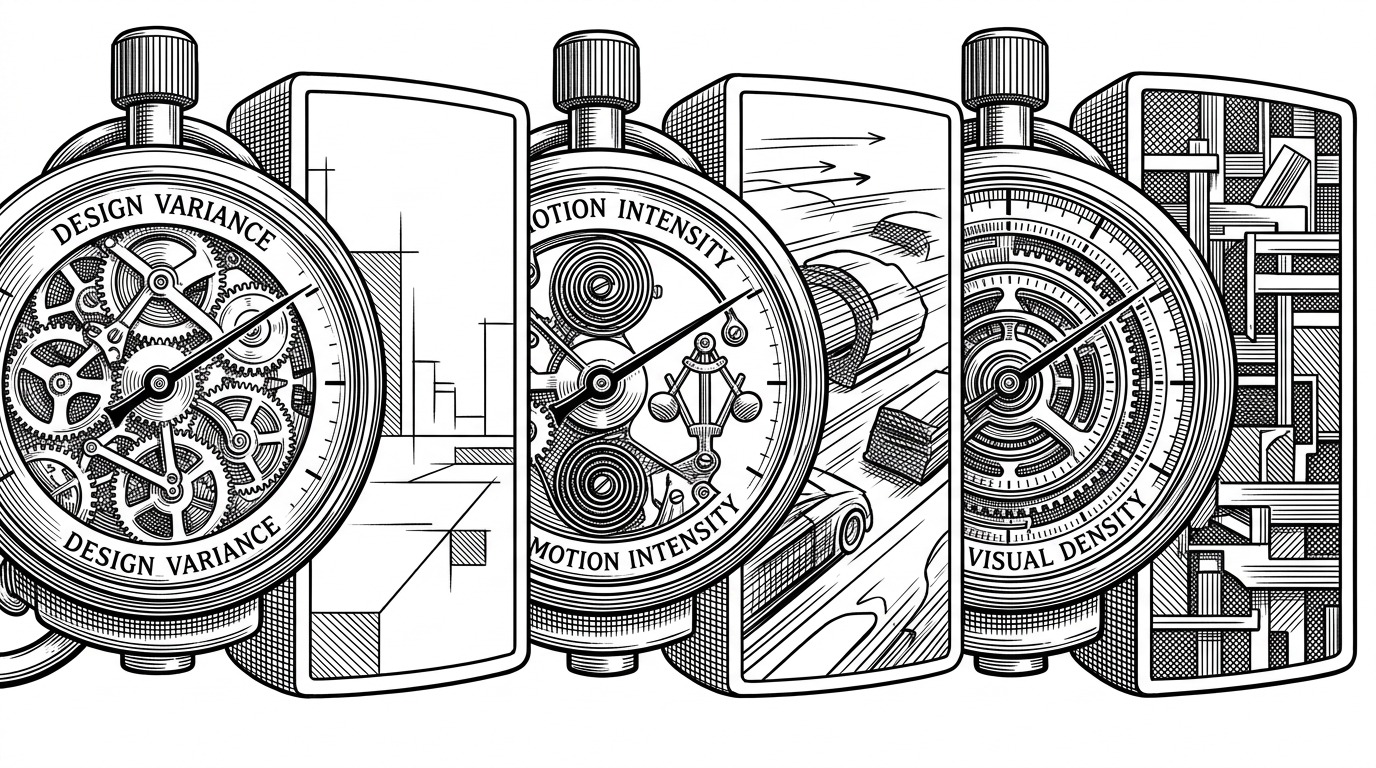
That matters because taste is usually presented as something fuzzy and unteachable. Here, it is operationalized. The agent is not told to “be tasteful.” It is told how much variation, motion, and density is allowed.
A skill layer, not a style layer
That distinction is easy to miss. A style system tells you what to render. Taste Skill tells an agent how hard to push, what to suppress, and where to stop. It is closer to a behavioral layer than a theme file.
npx skills add https://github.com/Leonxlnx/taste-skillThe install flow is intentionally lightweight. That is part of the point. The repo wants to be something you can drop into an existing workflow without rebuilding your stack.
Why the variants matter
The specialized skills are where the project stops being a single trick. A stricter variant for GPT and Codex changes the tone of the output. Redesign mode starts from an audit. Soft, minimalist, and brutalist variants bias the same base system toward different visual outcomes.
| Comparison | Generic prompt pack | Taste Skill |
|---|---|---|
| Instruction shape | Loose advice and examples | Portable skill files with rules and variants |
| Role in workflow | One-off prompting | Reusable behavioral layer for agents |
| Design output | Unpredictable and often generic | Constrained by taste dials and style targets |
| Best fit | Quick experiments | Repeated frontend generation across tools |
That puts the repo in a weird but useful category. It is not a design system in the classic sense. It is not a UI kit either. It is a set of rules that tries to make agents act like someone with a point of view.
From reference board to shipped UI
The image-generation skills extend the idea beyond code. They matter because many frontend workflows now begin with a reference image, a mood board, or a rough visual direction. Taste Skill tries to tighten that handoff so the agent can move from inspiration to implementation without flattening the design into generic component soup.
That is also why the repo feels more complete than a normal prompt repository. It is trying to influence the whole path from reference material to final interface, not just the first generation pass.
Who built this, and why it reads as a founder project
Leon Lin’s name is on the project, but the broader signal is that this is built like a maintainer’s opinionated answer to a real workflow pain. The repo also credits blueemi99, which reinforces that this is being shaped by active iteration rather than a static product dump.
Where it fits in the landscape
Taste Skill sits between three familiar categories and belongs fully to none of them. It is not a traditional design system, because it does not primarily define components. It is not a framework-specific UI library, because it is meant to work across agent tools and frontends. And it is not just a prompt pack, because it tries to encode behavior, not just phrasing.
| Category | What it optimizes for | What Taste Skill changes |
|---|---|---|
| Prompt pack | Faster prompting | Reusable constraints and variants |
| Design system | UI consistency | Agent behavior and aesthetic pressure |
| UI kit | Ready-made components | How agents generate those components |
The conceptual win is simple. Taste Skill treats design judgment as something you can operationalize without pretending it becomes objective. That is a stronger claim than “AI can now make pretty UIs.” It says the judgment layer itself can be packaged.
What happens next
The project still reads as a live system, not a finished monument. The official site points to ongoing beta work and a v2 direction, which suggests the family of skills may keep expanding. If that happens, the interesting question will not be whether the repo can make cleaner interfaces. It will be how far an opinionated taste layer can scale before it needs to split into separate philosophies.