NVFlow: NVIDIA’s Recipe Engine for LLM Pipelines
A look at how NVFlow turns synthetic data, fine-tuning, and cluster execution into reusable workflows that speak NeMo and Slurm natively.

- NVFlow’s real product is not a generic scheduler, but a packaged recipe for NeMo workflows that keeps prompts, stages, configs, and cluster settings together.
- Its strongest trick is Slurm-native dependency chaining, which lets the cluster scheduler carry orchestration work instead of a central workflow service.
- The registry and YAML inheritance model make short stage names readable without sacrificing precise Python class resolution or repeatability.
- The finance recipe proves the system is practical, because synthetic data generation, grounding, filtering, and training all fit into one reusable pipeline.
NVFlow is interesting because it refuses to be a universal orchestrator. It narrows the problem to LLM pipelines inside the NeMo stack, then makes that narrow scope feel elegant: reusable recipes, declarative YAML, and Slurm jobs that chain themselves without a heavyweight control plane.
The Real Product Is the Recipe
That recipe metaphor is doing real work. In NVFlow, a workflow is not just a DAG of tasks. It is a bundled unit of prompts, stages, configs, and cluster settings that can be reused the way a training playbook can be reused.
Workflow orchestration framework for end-to-end synthetic data generation (SDG), training (SFT), and evaluation pipelines built on NVIDIA's NeMo ecosystem
That changes the mental model. Instead of asking, "How do I schedule jobs?" you ask, "How do I package a repeatable method for synthetic data, fine-tuning, and evaluation?" NVFlow answers with a recipe layer that keeps the implementation close to the domain.

Why It Is Not Trying to Be Airflow
Airflow, Prefect, Dagster, and Kubeflow solve broader orchestration problems. NVFlow does something narrower and more opinionated. It assumes you are already in the NeMo world, and it optimizes for the things that matter there: staged LLM workflows, Slurm execution, synthetic data generation, and reusable recipes.
| Tool | Scope | Primary strength | Scheduler model | Best fit |
|---|---|---|---|---|
| NVFlow | NeMo LLM pipelines | Recipe-style reuse across SDG, SFT, and evaluation | Slurm-native dependency chaining | Teams already standardized on NVIDIA's stack |
| Airflow | General workflows | Huge ecosystem and mature scheduling | Central DAG scheduler | Broad data platform coordination |
| Prefect | General workflows | Developer-friendly Python experience | Central orchestration service | Fast-moving data teams |
| Dagster | Data assets and pipelines | Strong typing and asset lineage | Central orchestration service | Analytics and data engineering |
| Kubeflow | ML platform | Kubernetes-native ML workflows | Platform-managed orchestration | K8s-first ML infrastructure |
| NV-sflow | Declarative DAG execution | General YAML DAG running with pluggable backends | Backend-driven execution | Lightweight DAG execution outside NeMo |
The point is not that NVFlow is more capable in every dimension. It is more fit for a specific job. When the domain is expensive, specialized, and already standardized around NVIDIA tooling, fit matters more than generality.
# Conceptual shape of the registry pattern
@StageRegistry.register(recipe="finance", workflow="sdg", stage="generate_questions")
class GenerateQuestions(BaseStage):
    def execute(self, cluster, run_after=None):
        ...

# The same short stage name can exist elsewhere
@StageRegistry.register(recipe="finance", workflow="eval", stage="generate_questions")
class GenerateEvalQuestions(BaseStage):
    def execute(self, cluster, run_after=None):
        ...
The Registry That Makes Short Names Work
The extensibility trick is a hierarchy: Recipe -> Workflow -> Stage. NVFlow can keep YAML concise because the registry resolves a short stage name in context, not in isolation. The same name can exist in multiple workflows without collisions.
That matters because the YAML stays readable while the Python stays explicit. You get a human-friendly config surface and a deterministic runtime mapping to concrete stage classes.
Slurm Is the Orchestrator
This is the most distinctive part of the design. NVFlow passes Slurm job IDs through run_after, so one stage can submit the next stage with a dependency already attached. The scheduler enforces ordering, and NVFlow stays thin.
That removes the need for a central heartbeat and a persistent workflow brain. The orchestration logic becomes a chain of submissions, not a standing service that watches everything happen.
YAML Inheritance Without the YAML Bloat
NVFlow uses _base_ inheritance to let one config inherit from another, then override only the parts that change. That keeps recipe files small even when the workflow branches across models, checkpoints, or execution modes.
The other smart move is dynamic stage expansion. Instead of manually writing a new evaluation stage for every checkpoint, the runner can expand a list into a set of repeated stages automatically. That is configuration reuse, but it is also guardrail design.
# conceptual pattern
_base_: sdg/base.yaml
model_path: /checkpoints/model-a
num_nodes: 8
checkpoints:
  - ckpt-1000
  - ckpt-2000
  - ckpt-3000
The Finance Recipe Is the Proof Case
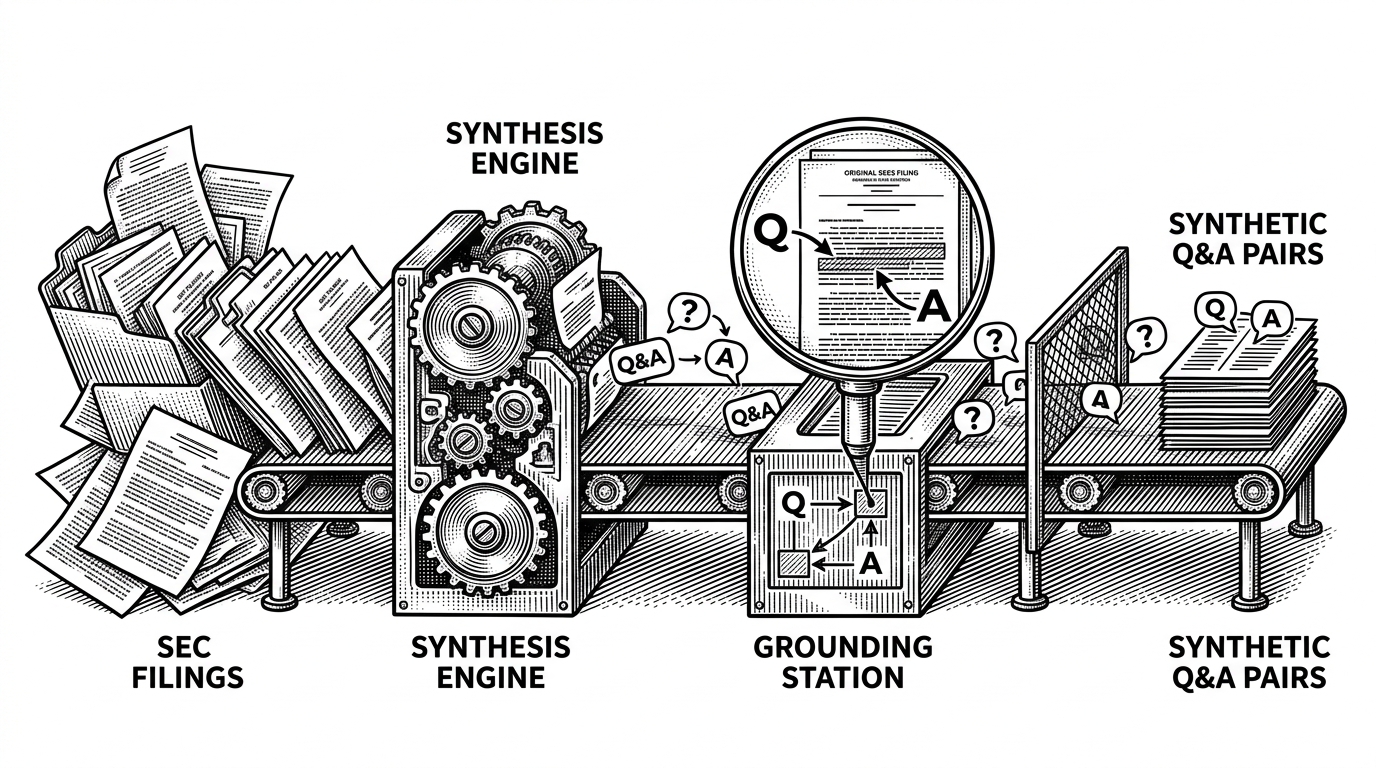
The finance recipe is where the framework stops being abstract. It chains seed data creation, question generation, context mapping, and answer filtering into one pipeline. The important step is grounding: synthetic answers have to point back to the source text, or they are just polished noise.
That is why the example matters. NVFlow is not merely wiring tasks together. It is shaping the data quality loop that decides whether synthetic data becomes useful training data.
| Stage | Input | Output | Why it matters |
|---|---|---|---|
| Create seed data | Source filings | Seed examples | Starts the chain with grounded material |
| Generate questions | Seed examples | Candidate questions | Expands coverage without manual authoring |
| Map questions to context | Questions plus filings | Grounded context spans | Anchors synthetic data to evidence |
| Filter answers | Context plus candidate answers | Training-ready pairs | Removes weak or unsupported examples |
What NVFlow Reveals About NeMo
NVFlow reads like infrastructure consolidation. It suggests NVIDIA wants one front door for synthetic data generation, fine-tuning, evaluation, and eventually adjacent tools like Data Designer and NeMo-Gym. That is a strategy signal, not just a repo choice.
The larger pattern is clear: a narrow orchestration layer can be more valuable than a broad one when the surrounding stack is already opinionated. NVFlow is not trying to win every orchestration contest. It is trying to make NeMo workflows feel native.
It exists to standardize how teams build, reproduce, and scale complex ML pipelines across domains with reusable stages and declarative workflows that run locally or on Slurm clusters.